A Definitive Guide to 9am Central Time Global Conversions
Easily convert 9am Central Time to any global time zone. Our definitive guide helps you master scheduling for global meetings and social media.

On this page (15)
If you’ve ever seen an invite for 9am Central Time, you know it’s a popular slot. It’s the go-to for scheduling just about anything, from webinars to social media drops, because it hits a huge chunk of North America right as the workday gets going.
What Is 9am Central Time?
Getting everyone on the same page across different regions can be a headache, but understanding Central Time (CT) is the first step. It is a major time zone for North America and Mexico, making it a critical reference point for business and media. When you see 9am Central Time, you're looking at a moment that lines up for millions of people at once.
The thing is, "Central Time" is not just one thing. It actually shifts depending on the time of year:
- Central Standard Time (CST): This is what you will see in the winter months. It is six hours behind Coordinated Universal Time (UTC-6).
- Central Daylight Time (CDT): During the summer, most of the region springs forward to this time. It is five hours behind Coordinated Universal Time (UTC-5).
This switch for Daylight Saving Time is the key detail to watch, and we will dig into that a bit more later. For now, just remember that 9am CT is a solid choice for scheduling events targeting a broad North American audience. This little graphic gives you a quick visual of how that time translates to other key US zones and the global UTC standard.
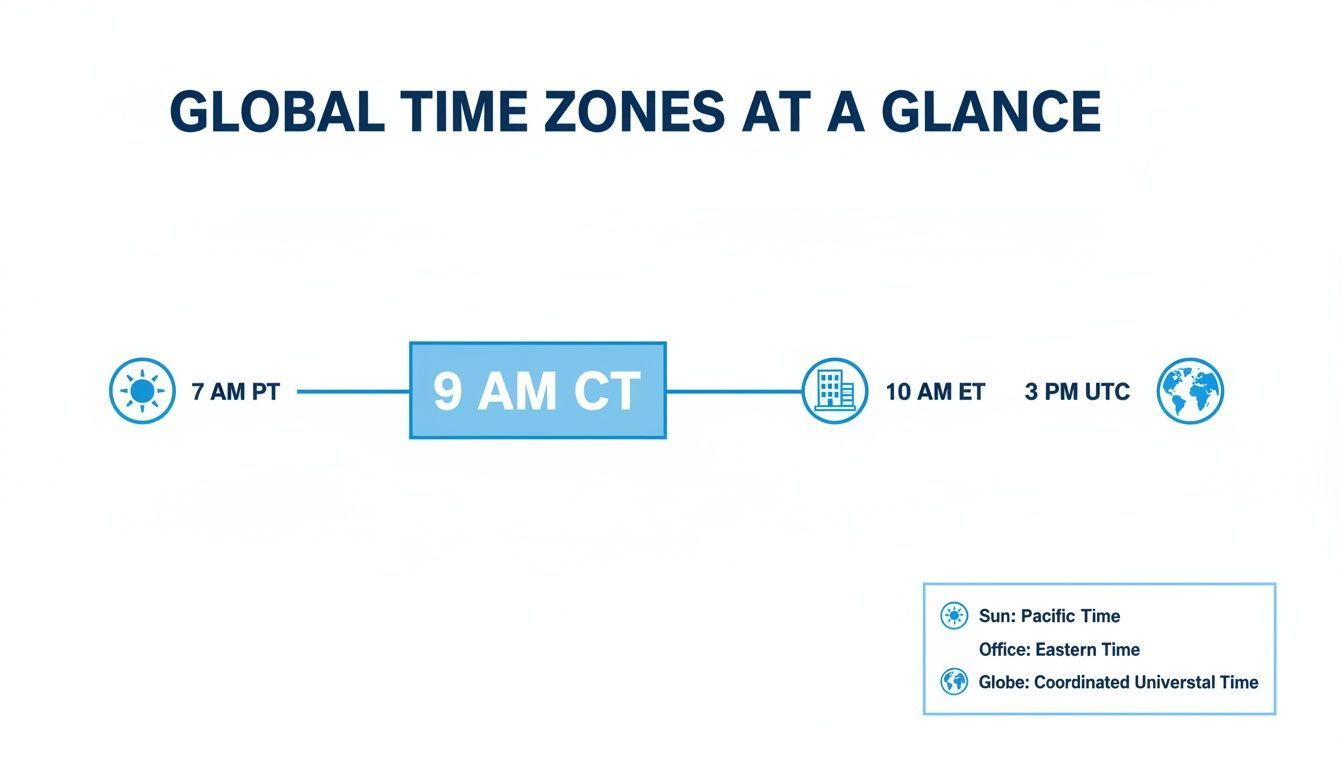
As you can see, a single 9am CT slot works beautifully. It aligns perfectly with the start of the business day on the East Coast (10am ET) while catching folks on the West Coast as they are getting started (7am PT).
Getting to Grips with Central Time
 To nail your scheduling for 9am Central Time, you first need to know which version of "Central Time" you are dealing with. The answer changes twice a year thanks to Daylight Saving Time (DST).
Through the autumn and winter, the region is on Central Standard Time (CST), which sits six hours behind Coordinated Universal Time (UTC-6). But come springtime, clocks "spring forward" an hour to Central Daylight Time (CDT), shifting the offset to UTC-5 for the warmer months.
Where Is Central Time Observed?
Central Time is a major time zone in North America, stretching across parts of Canada, the United States, and Mexico.
A few key areas to keep in mind:
- Canada: Manitoba is fully on Central Time, as are parts of Saskatchewan and Ontario.
- United States: You will find it in states like Illinois, Texas, and Alabama. Be aware, though, that not all areas within these states follow DST.
- Mexico: Most of the country, including major hubs like Mexico City, operates on Central Time.
Knowing these shifts is a huge deal. If you are a creator scheduling content, that single hour's difference between CST and CDT can make or break your engagement. For a deeper dive into another key US time zone, check out our guide on what time it is in the US Eastern Time Zone.
Of course, using a solid scheduler like PostFast means you can forget about the mental gymnastics. It handles all the time zone and DST conversions for you, so your content always drops at the perfect local time.
How Daylight Saving Time Changes Everything
Daylight Saving Time (DST) is easily the biggest headache in global scheduling. This twice-a-year shift completely changes how your 9am Central Time slot lines up with the rest of the world, because it messes with the region's offset from Coordinated Universal Time (UTC).
In North America, the clocks "spring forward" one hour on the second Sunday in March. That is when Central Standard Time (CST at UTC-6) flips to Central Daylight Time (CDT at UTC-5). Things stay that way until the first Sunday in November, when the clocks "fall back" an hour.
The bottom line? A meeting set for 9am CT in July is at a totally different UTC time than one scheduled for December.
Why The Shift Matters
If you are not ready for it, that one-hour adjustment can cause some serious scheduling chaos. The real problem is that different parts of the world change their clocks on different dates, if they even change them at all.
Just look at the disconnect:
- Europe has its own version of DST, but the start and end dates do not line up perfectly with North America. This creates a few awkward weeks every year where the time difference is totally out of whack.
- Many regions, especially in Asia and Africa, do not observe DST at all. For them, the time difference with CT changes twice a year, like clockwork.
This misalignment is a classic recipe for missed meetings and botched content launches. A campaign you have carefully aimed at 9am Central Time can easily land an hour late if your scheduler is not smart enough to handle these global DST quirks.
This is exactly where a tool like PostFast saves the day. It automatically adjusts for all these seasonal shifts, making sure your content goes live at the right local moment, every single time.
Converting 9am CT for European Audiences
If you are aiming to connect with an audience in Europe, getting your timing right for a 9am Central Time post is a big deal. That specific time lands very differently across the continent, and the whole thing gets even trickier when daylight saving mismatches throw a spanner in the works.
Nailing this conversion means your content arrives just when your audience is ready for it. The first step is getting your head around the main European time zones. The time difference is not fixed, so it helps to know who is who.
-
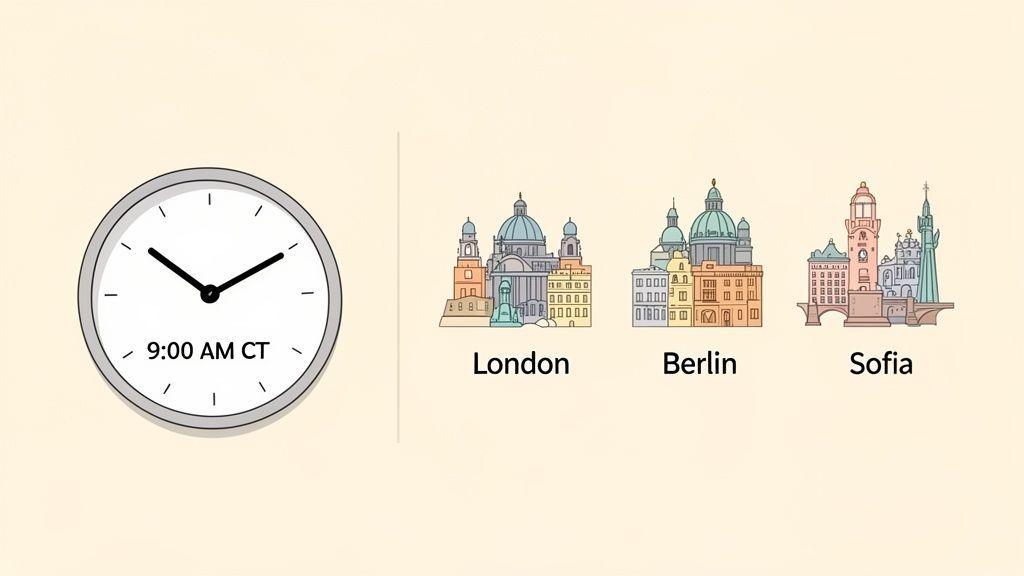
London (GMT/BST): In winter, London uses Greenwich Mean Time (GMT), which is six hours ahead of CST. So, a 9am CST post goes live at 3pm GMT. When both regions are in daylight saving (CDT and BST), that six-hour gap holds steady, making 9am CDT a 3pm BST affair. You can find out more about managing British Summer Time in our detailed guide.
-
Berlin (CET/CEST): Central European Time is another hour ahead of London. A 9am CST event happens at 4pm CET in Berlin. Come summer, that simply shifts to 4pm CEST when it’s 9am CDT.
-
Sofia (EET/EEST): Push further east, and you will find Sofia on Eastern European Time. This puts a 9am CST post at a perfect 5pm EET, a prime late-afternoon slot just as people are winding down.
Capitalising on European Engagement Peaks
That late afternoon window in Europe is pure gold. In Bulgaria (BG), for example, social media use really picks up right around the local equivalent of 9am Central Time. People are checking their feeds after work, making it the perfect time to grab their attention.
With 4.50 million social media users in Bulgaria, that is 67.1% of the population, hitting this peak window is a massive opportunity. For anyone using PostFast, scheduling content for the local equivalent of 9am CT ensures it lands right when this highly engaged audience is scrolling. You can dig into more stats about Bulgaria's digital trends on DataReportal.
Aligning 9am CT with Asian and Pacific Time Zones
Scheduling a 9am Central Time event with partners in Asia or the Pacific is where things get really tricky. The time difference is so massive that your morning meeting is often happening on a completely different calendar day for them.
To make it even more interesting, many of these regions do not bother with daylight saving at all. Unlike Europe or North America, countries like India and China stick to a single, consistent time zone all year round. This means the time gap with CT changes predictably, but only when North America shifts its clocks.
Major Time Zone Conversions
For a global meeting to work, knowing the local time is non-negotiable. A 9am Central Time slot means your colleagues in Mumbai, for example, will be joining you late in their evening.
Here’s a quick look at what 9am CT means across the region:
- India (IST): It will be 7:30pm in Mumbai when it’s 9am CST, and 8:30pm once North America switches to 9am CDT. India Standard Time is a constant UTC+5:30.
- China (CST): In Beijing, it’s 11pm during Central Standard Time, which shifts back to 10pm when Central Daylight Time is active.
- Japan (JST): Tokyo is even further ahead. Expect a 12am (midnight) start during CST, and 11pm during CDT.
- Australia (AEST/AEDT): Sydney’s time flip-flops with its own DST. A 9am CST call is 2am AEST, while a 9am CDT call is 1am AEDT.
This is exactly the kind of headache that scheduling tools were made for. Instead of juggling these mental gymnastics, you can use a tool like PostFast to handle it all automatically. It ensures your content and meetings line up perfectly with your global team's local time, no matter the season.
Why 9am Central is a Strategic Time for Content
Picking 9am Central Time for a product launch or a big announcement is not just pulling a time out of a hat. It is a calculated move. Think of it as a sweet spot that hits a massive chunk of the North American audience right as they are settling into their workday.
At 9am CT, the East Coast is already an hour into their day at 10am ET, making it a perfect moment for a mid-morning check-in. At the same time, the West Coast is just waking up at 7am PT, meaning your content is one of the very first things they see. This timing captures millions of people when they are most likely to be online and paying attention.
Tapping into Global Engagement Windows
The power of 9am Central Time does not stop at North America's borders. It syncs up surprisingly well with the late afternoon in Europe, a period when social media use often hits its peak.
Take Bulgaria, for instance. Posting at 9am CT unlocks a prime engagement window there. The local afternoon sees a big spike in social media use among its 4.50 million users. Facebook is huge, and the 25-34 age group is especially active during these after-work hours. They are scrolling for fresh content on their breaks, creating a perfect opportunity for anyone using PostFast to schedule posts that land with maximum impact.
To really dial in your timing, it’s worth looking at data on optimal LinkedIn posting times to see how you can refine your strategy for different platforms. Understanding these audience habits is what turns a good content plan into a great one.
Reliable Scheduling for 9am Central Time
Trying to manually hit that perfect 9am Central Time window is a real headache, especially if you live in another time zone. You are constantly doing mental gymnastics with time conversions, trying to remember when Daylight Saving Time kicks in and messes everything up. It is so easy to be an hour early or late, completely missing your audience's sweet spot.
That kind of guesswork does not just waste time; it adds a layer of stress you do not need. A mistimed post can throw off your entire content rhythm and break the consistency your followers expect. For any serious creator or brand, using a dedicated scheduling tool is not a luxury, it is just smart.
Automation Is the Answer
A good social media scheduler just gets rid of the problem. Instead of you having to crunch the numbers, the platform handles all the time zone quirks for you, automatically.
Here’s what makes it work:
- Visual Calendars: You can see your whole schedule laid out, with every post locked in for the right local time. No more second-guessing.
- Smart Queues: Got a bunch of content ready to go? Just add it to a queue that publishes automatically at your chosen times, so you never have a dead slot.
- Automated Publishing: Set it and forget it. The tool does the posting for you, right on the dot.
To really nail your timing, like consistently posting at 9am CT, you need a solid publishing schedule. Building this out starts with creating a content calendar that keeps your team organised and your content flowing.
When you use a tool like PostFast, you can set your posts for 9am Central Time and know, without a doubt, they will go live at exactly that moment, every single time. Find out more about how to schedule a social media post to multiple platforms and claim back hours of your week.
Common Questions About 9am Central Time
Let's clear up a few common snags that trip people up when scheduling for 9am Central Time. A couple of quick pointers will help you get it right every single time.
One of the biggest mix-ups is the abbreviation “CST”. While it usually means Central Standard Time in North America, it also stands for China Standard Time. That is a huge problem because China is a full 14 hours ahead of North America’s CST. One small typo can mean your post goes live while your target audience is fast asleep.
How Should I Write The Time for an International Audience?
Clarity is everything. When you’re trying to coordinate across different countries, being vague is a recipe for confusion.
To make sure everyone understands your 9am Central Time slot, try these simple formats:
- Be Specific: Add the location. Something like "9am CT (North America)" or "9am CDT (Chicago)" helps a lot.
- Use the UTC Offset: This is the gold standard. Writing "9am CDT (UTC-5)" is crystal clear and leaves zero room for error, no matter where someone is.
The absolute safest bet is to provide the UTC offset. It’s a globally recognised system that cuts through all the local confusion around time zone names and daylight saving rules.
When in doubt, a quick search on a time zone converter is always a good idea. It is a tiny step that guarantees everyone is on the same page.
Juggling all these details for every single post is a grind. With PostFast, you can set your entire content schedule once and forget about it. Your posts will always go live at the perfect time, on every platform. Give the free trial a go and see how much time it saves you.
Related

Your Guide to Using an Instagram Image Downloader Safely
Learn how to use an Instagram image downloader the right way. Our guide covers safe methods for desktop and mobile, plus legal and ethical considerations.
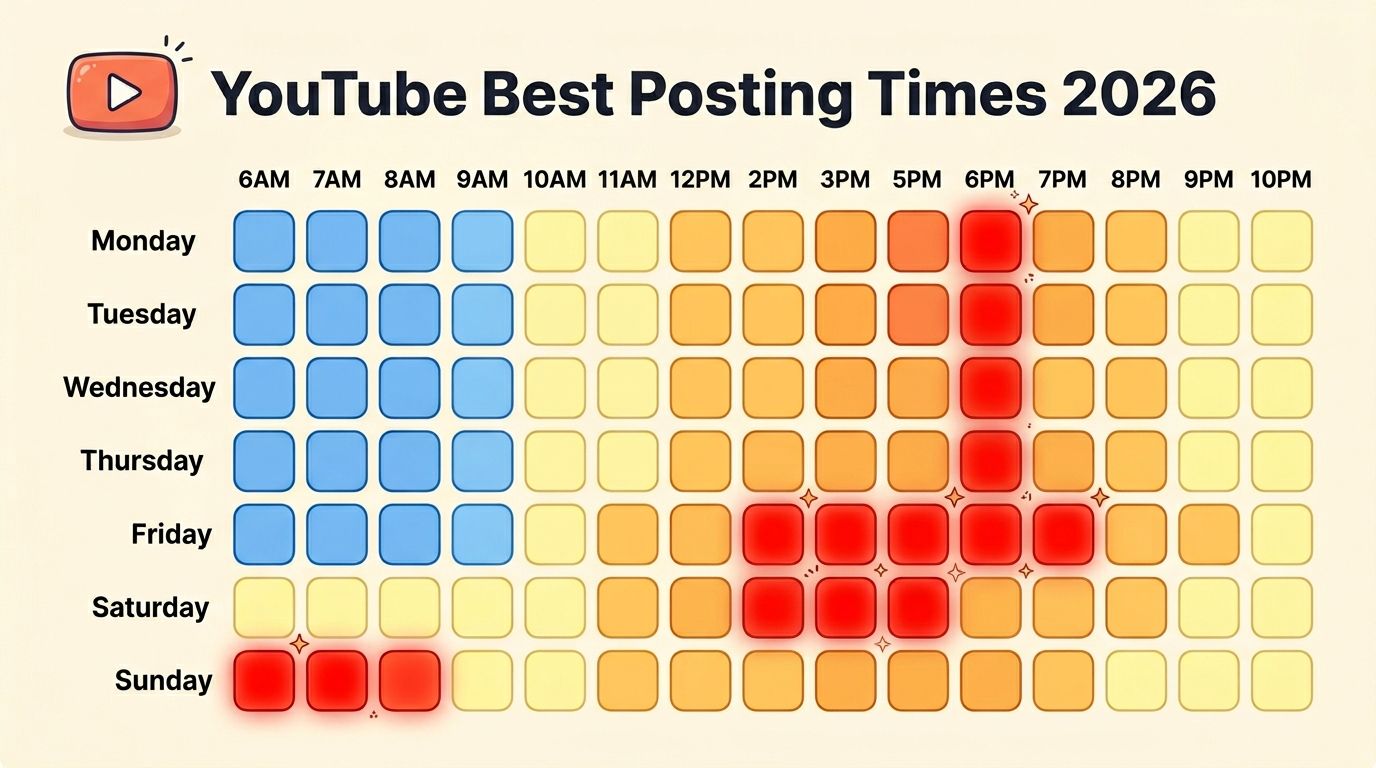
Best Time to Post on YouTube in 2026: Data From 6,175 Posts (Videos and Shorts)
Best time to post on YouTube in 2026: first-party data from 6,175 posts scored against each channel's normal. 5 PM UTC wins; weekends beat Wednesday by 25%.

How to Create a Social Media Content Calendar That Actually Saves You Time
Create a social media content calendar that saves hours weekly. Step-by-step guide to plan, batch, and automate posts across platforms with PostFast.

How to Connect Claude to Instagram: Post, Schedule, Reply
Connect Claude to Instagram so it can schedule posts, Reels and Stories, answer comments and report post stats. Setup steps, prompts that work, and limits.