A Global Team's Guide to the Time in US EST Now
Discover the precise current time in US EST and how it affects global teams. Quick, practical guides and simple conversions for time in us est now.

On this page (15)
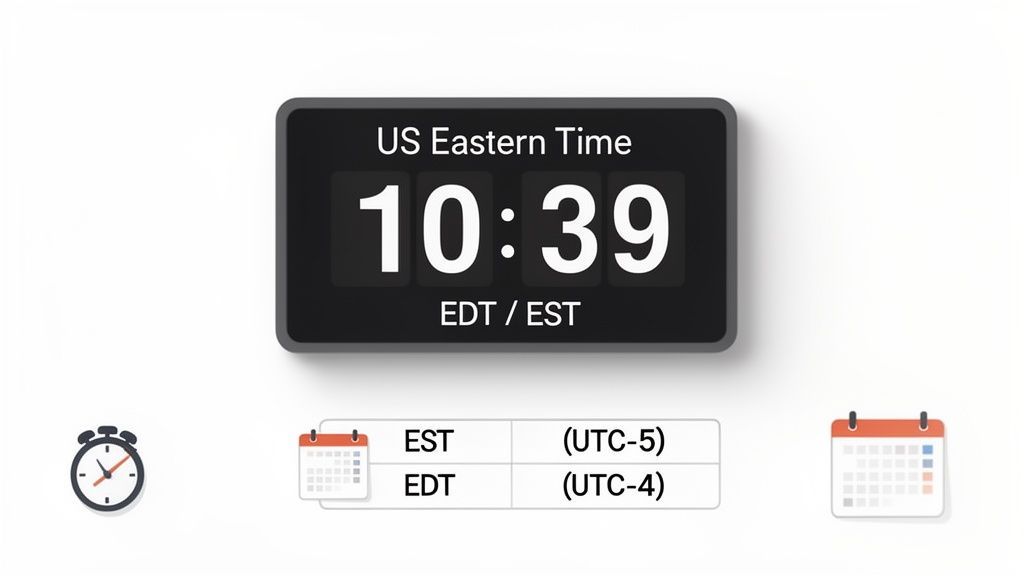
Trying to figure out the time in us est now? The answer is a bit of a moving target, and it all depends on the time of year. Thanks to Daylight Saving, "Eastern Time" isn't a single thing; it flips between EST in the winter and EDT in the summer.
Your Instant Answer to US Eastern Time
When you're trying to coordinate projects or schedule social media content, knowing the exact time on the East Coast is essential. A simple one-hour mistake can lead to a missed deadline or a post that goes live to an empty room instead of a peak audience.
This is especially critical for global teams. If you’re managing social accounts from another country, that one-hour mix-up can hurt your engagement rates and throw off team communication.
EST vs EDT at a Glance
So what’s the real difference between these two acronyms? It’s simpler than it sounds. This quick table breaks down exactly what you need to know. Getting this distinction right is the first step to mastering your cross-country scheduling.
| Feature | Eastern Standard Time (EST) | Eastern Daylight Time (EDT) |
|---|---|---|
| UTC Offset | UTC-5 | UTC-4 |
| Active Period | Early November to mid-March | Mid-March to early November |
| Primary Use | Standard time during winter | Daylight Saving time during summer |
Keeping track of this manually can be a real headache. That’s why many agencies and creators use a tool like PostFast, which handles all the time zone conversions automatically. It lets you schedule your posts with total confidence, knowing your content will drop at the perfect moment for your audience, every single time.
Understanding the Difference Between EST and EDT
It’s a classic mix-up: people often use "Eastern Time" and "EST" as if they mean the same thing. They don't. This tiny detail is the culprit behind countless scheduling blunders, especially for teams coordinating across different regions.
The key to getting it right is understanding a little concept called Daylight Saving Time (DST).
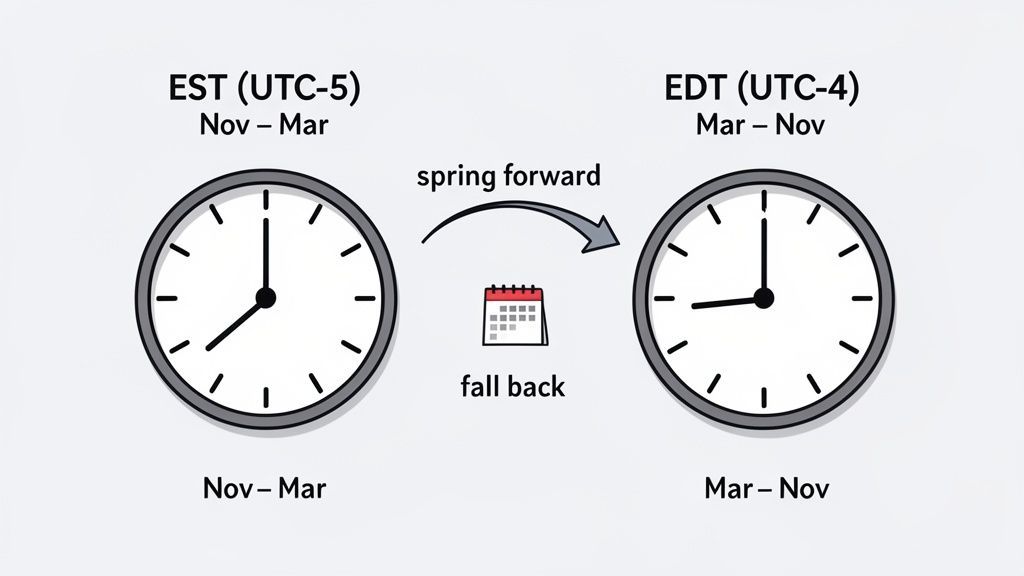
Think of DST as a seasonal clock adjustment. To squeeze more usable daylight out of the longer summer days, many places "spring forward" by setting their clocks ahead one hour. For the US Eastern Time zone, this means switching from Eastern Standard Time (EST) to Eastern Daylight Time (EDT).
Because of this annual shift, knowing the time in us est now depends entirely on the date. When DST is in effect, the correct time is EDT, which is four hours behind Coordinated Universal Time (UTC-4).
The Annual Time Change
So, when does this switch actually happen? Thankfully, the schedule for Daylight Saving Time in the United States is consistent and predictable.
- Spring Forward: Clocks jump one hour forward from EST to EDT on the second Sunday in March.
- Fall Back: Clocks move one hour backward from EDT back to EST on the first Sunday in November.
This shift keeps daily life in sync with the sun. It ensures that 9:00 AM in New York feels like the start of the business day in both January and July, even though the sun is in a totally different position.
For social media teams managing a content calendar, this change is a recurring headache. A post scheduled for 9:00 AM EST in early March will suddenly go out an hour "late" just a week later unless you account for the switch to EDT. That's where a smart scheduler saves the day.
By the way, if you work with teams in the UK, you might find our guide on understanding British Summer Time useful; it follows a very similar principle.
How to Convert Eastern Time for Your Team
Knowing the difference between EST and EDT is a good start, but putting that knowledge to work for your team is where it really counts. Even small mix-ups with time zones can cause missed meetings, delayed campaign launches, and a whole lot of confusion nobody has time for.
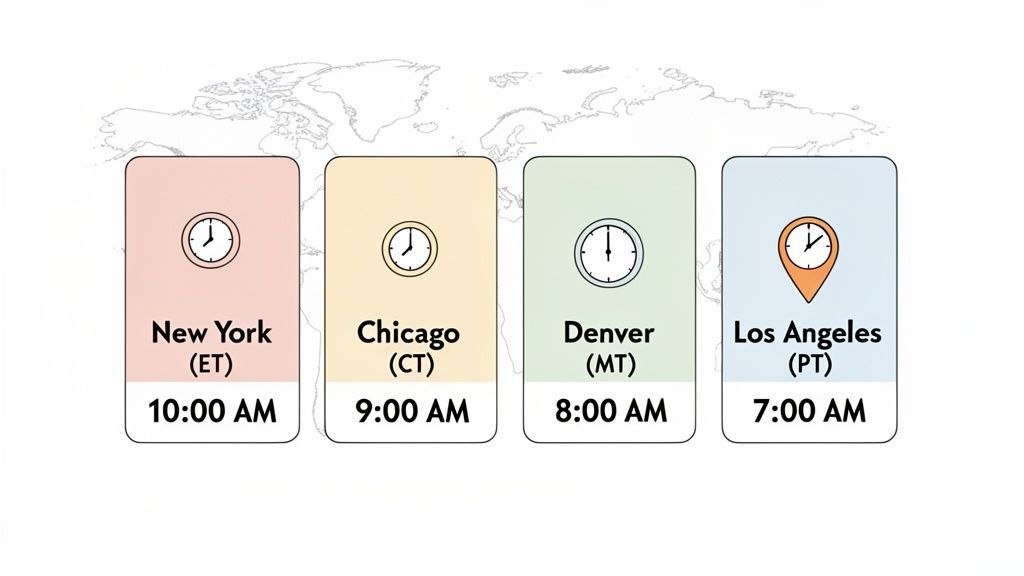
Think about it: your marketing team in New York has a huge product launch scheduled for 10:00 AM Eastern Time. It’s a make-or-break moment. But your development team is in Denver, and your support team is in Los Angeles. If they aren’t all perfectly in sync, things can go sideways fast.
The Denver team might jump in an hour late, and the Los Angeles team could be a full three hours behind schedule. This is exactly why having a simple, reliable way to convert times is essential for any remote or distributed team.
Eastern Time Conversion Cheat Sheet
To keep everyone on the same page, a quick reference guide is a lifesaver. Let's use our 10:00 AM ET launch as an example. Here’s what that time looks like across the other major US time zones.
This cheat sheet makes it easy to see the time difference at a glance, whether you're trying to figure out the time in us est now or planning an event for next month.
| If It's This Time in ET... | ...It's This Time in Central Time (CT) | ...It's This Time in Mountain Time (MT) | ...It's This Time in Pacific Time (PT) |
|---|---|---|---|
| 10:00 AM | 9:00 AM | 8:00 AM | 7:00 AM |
| 2:00 PM | 1:00 PM | 12:00 PM | 11:00 AM |
| 5:00 PM | 4:00 PM | 3:00 PM | 2:00 PM |
Remember, these one-hour jumps between zones stay the same all year. When Daylight Saving Time kicks in, the entire country shifts together, so the time difference between New York and Chicago is always one hour.
While a table like this is great for quick checks, manually converting times for every single social media post is tedious and a recipe for human error. That’s why so many teams rely on scheduling tools.
A platform like PostFast lets you set your entire content calendar in your own local time. The tool handles the rest, making sure your posts go live at the perfect moment for your audience, no matter where they are. No more manual calculations or second-guessing.
Why Eastern Time Matters for Social Media Success
Knowing time zones is one thing. Using them to your advantage is what separates a good social media strategy from a great one.
Eastern Time isn't just another line on the map; it's the pulse of a massive chunk of the United States population and its entire media world. That’s why it has become the unofficial benchmark for scheduling content if you want to get the widest possible reach.
When you post matters just as much as what you post. A perfect post that drops while your audience is asleep or stuck in traffic is a total waste. Hitting those "peak times" means showing up right when they’re most active and ready to engage. This is where knowing the time in ET becomes a secret weapon.
Aligning Your Schedule with Your Audience
For social media managers, this is a daily headache, especially if your team is scattered across the globe. How do you make sure your content goes live at 8:00 AM in New York when you’re sitting in London or Sofia? Doing the time zone math for every single post isn't just a drag, it’s asking for mistakes.
Beyond just understanding your audience, you need to know the absolute best time to post on social media to get the most out of every piece of content. This is where smart scheduling tools come in and change the game.
Platforms like PostFast automate the entire process. They let teams anywhere in the world plan and schedule their content without ever having to wrestle with a time zone converter again.
Take Bulgaria, for instance, a growing hub for digital marketing. With 4.50 million active social media users, the audience is huge. For a Bulgarian agency or creator trying to tap into the US market, timing posts for key EST hours is critical.
Intelligent scheduling finds the best posting windows for you, boosting engagement no matter where your business is located. It turns a complex global puzzle into a simple, automated workflow.
This completely removes the guesswork and human error from your workflow. You can learn more about how to schedule posts to multiple platforms and get back hours of your week. A good scheduler ensures your message lands with impact, every single time.
Nail Your Global Content Workflow with Automation
Manually converting time zones is a massive headache for any team juggling social media across different regions. It’s slow, tedious, and a recipe for mistakes. This is exactly where scheduling platforms come in, solving the time zone puzzle for good and letting your team get back to creating great content.
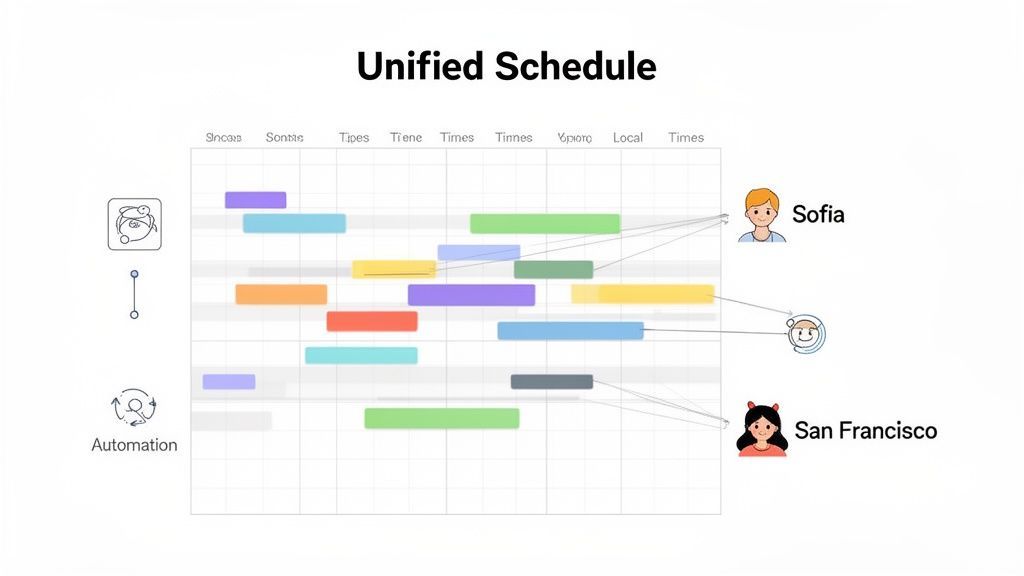
Imagine a single, visual calendar where every post is shown in your local time, no matter where it’s being published. The platform just handles the heavy lifting in the background. It’s a simple shift that turns a huge source of stress into a totally invisible part of your workflow.
Create a Single Source of Truth
This is a game-changer for distributed teams. A social media manager in Sofia can work with a designer in San Francisco on the exact same schedule, and there's zero chance of a time zone mix-up. Everyone sees the same plan, but it’s automatically localized to their own clock.
Modern tools take human error out of the equation. No more frantic Google searches for the time in us est now or second-guessing Daylight Saving changes. Your content just goes out at the right time, every time.
In a market like Bulgaria, this is crucial. Facebook alone has 4,600,400 users, which is 68.9% of the entire population. Tools like PostFast let creators manage their content across TikTok, Instagram, and Facebook from one place, timing posts perfectly for audiences at home and abroad.
The end goal is to make content delivery seamless and keep your brand presence consistent. You can even automate LinkedIn posts and other channels, getting back hours you used to lose to busywork. With the right setup, you can queue up weeks of content in minutes, knowing every post will hit its mark.
By centralizing your workflow, you build a reliable system that grows with your team. Check out our guide to see more of PostFast's advanced social media scheduling features.
Common Questions About US Time Zones
Let's clear up some of the usual snags people hit when dealing with time on the East Coast. Getting these basics down will make scheduling a whole lot easier.
What’s the Real Difference Between ET, EST, and EDT?
This is easily the biggest point of confusion. Think of ET (Eastern Time) as the umbrella term for the time zone. It just has two different modes depending on the time of year.
- EST (Eastern Standard Time) is what we use in the autumn and winter. It’s five hours behind Coordinated Universal Time (UTC-5).
- EDT (Eastern Daylight Time) kicks in during the spring and summer to account for Daylight Saving. This one is four hours behind UTC (UTC-4).
So, if you search for the time in us est now in the middle of July, what you’re really looking for is the time in EDT.
Which States Are Entirely on Eastern Time?
A total of seventeen US states run completely on Eastern Time, which is why it's such a massive hub for business and media. The full list includes:
- Connecticut
- Delaware
- Georgia
- Maine
- Maryland
- Massachusetts
- New Hampshire
- New Jersey
- New York
- North Carolina
- Ohio
- Pennsylvania
- Rhode Island
- South Carolina
- Vermont
- Virginia
- West Virginia
Just remember, a few other big states like Florida and Michigan are split right down the middle between Eastern and Central time.
How Can I Be 100% Sure My Posts Go Out at the Correct Eastern Time?
The most reliable way is to use a proper social media scheduling tool. Instead of doing mental gymnastics with time offsets and stressing about Daylight Saving, these platforms just handle it all for you.
You pick a target time zone, like 'America/New_York,' and the system makes sure your content goes live at the right local hour. It completely takes human error out of the equation.
A good scheduler knows to post at 9 AM EDT in August and 9 AM EST in December without you ever having to give it a second thought.
Does Arizona Use Daylight Saving Time?
Nope, and this is a classic trap. Most of Arizona does not observe Daylight Saving Time. While the entire East Coast switches between EST and EDT, Arizona (except for the Navajo Nation) stays on Mountain Standard Time (MST) all year long. This means its time difference with New York actually changes twice a year.
Wrestling with time zones is a headache you just don't need. With PostFast, you can line up all your social media content from one dashboard and let our system handle every time conversion flawlessly. Plan your posts in a few minutes and get hours back in your week. Start your free 7-day trial today and see how easy it can be.
Related

Can You Schedule Posts on LinkedIn? How to Schedule LinkedIn Posts for Profiles and Pages in 2026
Yes. LinkedIn schedules posts 10 minutes to 3 months ahead (1 hour on Pages). Desktop, mobile, and Page steps, plus where PostFast goes further.

How to Automate Social Media Posts: The Practical Guide
Learn how to automate social media posts the right way: what to automate, what to keep human, a step by step afternoon setup, and where AI helps or hurts.
Your Complete Guide to Facebook Cover Photo Size
Master the cover facebook size for Facebook Pages and Profiles with quick tips to optimize visuals and boost engagement.

Quotes for Instagram: 10 Captions to Boost Engagement
Discover quotes for instagram across 10 categories to spark motivation, authenticity, and niche captions that boost engagement on your feed.

How to Connect Claude to Instagram: Post, Schedule, Reply
Connect Claude to Instagram so it can schedule posts, Reels and Stories, answer comments and report post stats. Setup steps, prompts that work, and limits.