Best Time to Post on Facebook in 2026: 8 Windows, Tested Against 16,166 Real Posts
Best time to post on Facebook in 2026: 8 windows plus first-party data from 16,166 posts scored against each Page's own normal. 3 PM to 5 PM local wins.
On this page (14)
Ever feel like you’re shouting into the void on Facebook? You craft the perfect post, hit 'Publish', and are met with... crickets. The problem often isn’t your content, but when you share it. In the crowded feed of 2026, timing is everything. Posting at the wrong moment means your brilliant work gets buried by the algorithm before your audience even has a chance to see it.
So, what if you could pinpoint the exact moments your followers are most active and ready to engage? This isn't about finding a single 'magic' hour that works for everyone. The true best time to post on Facebook is a dynamic target unique to your audience, industry, and goals. To really succeed, understanding optimal posting times must be combined with broader proven engagement strategies, creating a powerful one-two punch for capturing attention.
In this guide, we'll move beyond generic advice to explore eight data-driven strategies for uncovering your unique peak engagement windows. If you manage multiple platforms, our best time to post on social media guide covers all major networks in one place. We'll break down universally high-traffic times, analyze industry-specific sweet spots, and give you the techniques to ensure every post lands with maximum impact. Get ready to turn algorithmic uncertainty into a strategic advantage and make your content work smarter, not harder. We'll show you how to find your optimal schedule and even how to automate it seamlessly.
Best Times to Post on Facebook: Quick Summary (2026)
The best times to post on Facebook in 2026 are weekday mid-mornings (9 to 11 AM), the lunch hour (12 to 1 PM), and the evening peak (5 to 7 PM). Our own data from 16,166 posts, each scored against its Page's normal, points at 3 PM and 5 PM in your audience's time zone (1.18x and 1.17x) and flags Wednesday as the weakest day; details in the day-by-day section. Industry studies name Tuesday, Wednesday and Thursday as the best days and Sunday as the weakest; our own controlled data disagrees mildly, with Sunday and Monday slightly ahead and Wednesday the weakest at 0.96x. Use the schedule below as a tested starting point, then confirm it against your own Facebook Insights.
| Day | Best windows (your audience's local time) |
|---|---|
| Monday | 9 to 11 AM, 5 to 7 PM |
| Tuesday | 9 to 11 AM, 12 to 1 PM (one of the best days) |
| Wednesday | 9 to 11 AM, 12 to 1 PM, 5 to 7 PM |
| Thursday | 9 to 11 AM, 12 to 1 PM, 5 to 7 PM |
| Friday | 9 to 11 AM, 1 to 3 PM |
| Saturday | 8 to 10 AM |
| Sunday | lighter reach, 8 to 10 PM if posting |
- Best days: Tuesday, Wednesday, Thursday.
- Overall best time: weekday mornings (9 to 11 AM) and lunch (12 to 1 PM).
- Best for video and Reels: evenings, 5 to 7 PM.
- Quietest: Sunday and late Friday.
Posting on other platforms too? See our guides for the best time to post on Instagram, LinkedIn and YouTube, or the full social media timing guide. The eight data-backed strategies follow below.
1. Weekday Mid-Morning Posts (Tuesday-Thursday, 9-11 AM)
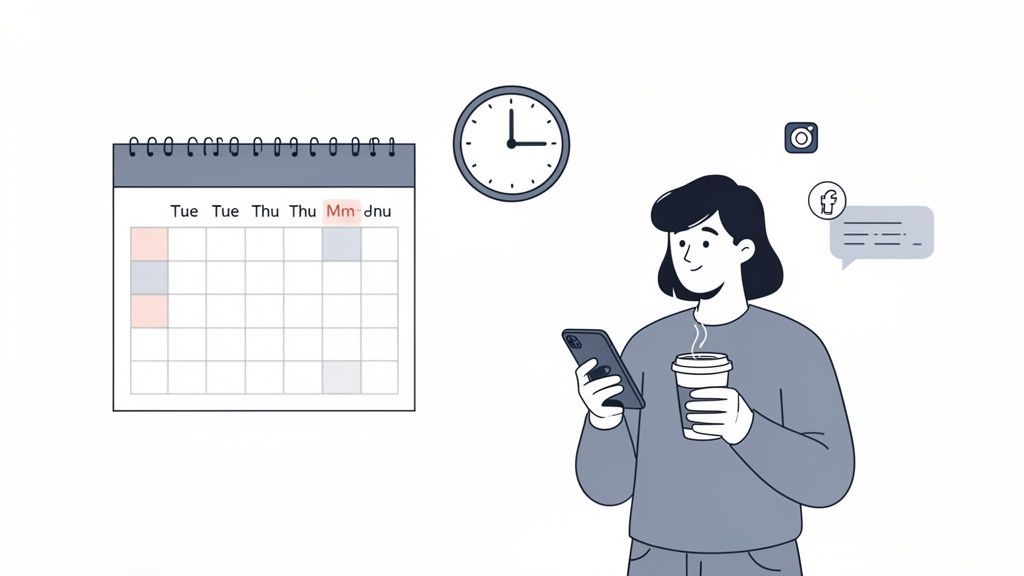
One of the most consistently effective strategies for finding the best time to post on Facebook is to target the mid-morning window on weekdays. This approach, popularised by industry leaders like HubSpot and Hootsuite, centers on capturing your audience during their first real break of the workday. Between 9 AM and 11 AM from Tuesday to Thursday, professionals are often settling in, grabbing a coffee, and taking a moment to check social media before diving into their biggest tasks.
Check PostFast vs Hootsuite comparison
Posting during this peak activity period means your content appears when users are most receptive. Unlike the frantic rush of early mornings or the wind-down of late afternoons, this mid-morning slot offers a brief but powerful opportunity for connection, often leading to higher rates of comments, shares, and clicks.
Why This Time Window Works
The success of this time slot is backed by substantial data. Industry reports have consistently shown that mid-morning posts from Tuesday to Thursday can receive double the engagement compared to weekend posts. Similarly, many B2B companies have noted a tangible impact, with some seeing up to a 35% increase in lead generation from content published between 10 AM and 11 AM. It’s a classic strategy that has become a cornerstone of many successful social media calendars for a reason: it aligns perfectly with predictable human behavior.
Actionable Tips for Implementation
To make the most of this prime-time window, consider these actionable steps:
- Automate and Optimize: Use a scheduling tool to automatically queue your content for these peak times. This is especially crucial for reaching audiences across different time zones without manual intervention. A platform with smart scheduling features can make this effortless.
- Identify Your Peak Day: While Tuesday to Thursday is the general rule, your specific audience may favor one day over the others. Test posting important content on different days within this window and use your analytics to see which day drives the most conversions.
- Create an Echo Effect: Pair your high-value morning post with re-engagement content later in the day. A follow-up post or story between 3 PM and 4 PM can recapture attention from those who missed the morning update. For more in-depth strategies, explore our complete guide to succeeding on Facebook.
2. Lunch Hour Posts (12-1 PM)
Another highly effective strategy for defining the best time to post on Facebook is targeting the midday lunch break. This concentrated window captures a massive audience as people step away from their work, grab a meal, and turn to their phones for a quick mental reset. Between 12 PM and 1 PM, both office-based and remote professionals are actively scrolling, creating a prime opportunity for light-hearted, entertaining, or inspirational content to cut through the noise.
Posting during this midday peak allows your content to connect with users when they are in a more relaxed and receptive mindset. Unlike the work-focused mentality of the morning, the lunch hour is a personal break. This makes it an ideal time for brands to share content that feels less like a corporate announcement and more like a welcome distraction, often resulting in higher engagement and positive brand association.
Why This Time Window Works
The power of the lunch hour slot is confirmed by data across multiple consumer-facing industries. Food and wellness brands, for example, often report a spike in engagement, up to 25%, when posting recipes or health tips between 12 PM and 1 PM. Similarly, restaurants have noted a 40% boost in location-based interactions when promoting lunch specials right at noon. This time slot succeeds because it aligns perfectly with a universal daily ritual, offering a predictable moment of high user activity.
Actionable Tips for Implementation
To capitalize on this midday opportunity, integrate these specific tactics into your strategy:
- Schedule Light-Hearted Content: Plan and schedule your most entertaining, visually appealing, or inspirational content for this window. Use a scheduling tool to queue up video clips, memes, or user-generated content that aligns with a more casual audience mood.
- Leverage Quick, Consumable Formats: The lunch break is short, so prioritize formats like Stories and Reels that deliver a quick impact. These vertical, fast-paced formats are perfect for capturing attention from users who are scrolling rapidly.
- Drive Immediate Action: Pair your lunch-hour post with a clear call-to-action that encourages immediate engagement. Ask a question, run a quick poll, or link to a limited-time offer to turn passive scrolling into active participation.
- Analyze Performance by Content Type: Use your analytics to track your lunch-hour performance for different content types. You might find that videos excel at 12:30 PM, while image posts perform better closer to 1 PM, allowing you to fine-tune your schedule for maximum impact.
3. Evening Peak Hours (5-7 PM)
Capitalizing on the evening peak is a powerhouse strategy for determining the best time to post on Facebook. This window, typically between 5 PM and 7 PM, captures your audience as they transition from their workday to personal time. Whether they are commuting home, unwinding on the sofa, or catching up on the day's events, users are highly active and primed for engagement during these hours.
This period represents a shift from a professional to a relaxed mindset, making it ideal for content that is entertaining, community-focused, or visually compelling. Since users have more leisure time, they are more likely to watch videos, browse stories, and interact deeply with posts that catch their eye, making this a crucial time for almost any brand.

Why This Time Window Works
The effectiveness of the 5-7 PM slot is consistently validated by data. Meta’s own research often points to this period as having the highest concentration of active users, with some reports showing interaction rates doubling compared to other times of the day. For visual content, the impact is even more pronounced; studies have shown that Reels and videos can achieve up to 45% higher views when published between 5 PM and 7 PM. This is because the algorithm prioritizes fresh, engaging content when the largest audience is online to see it.
Actionable Tips for Implementation
To harness the power of this evening rush hour, apply these specific tactics:
- Reserve Your Best Content: Schedule your most valuable or highest-performing content types (like major announcements or video premieres) for this 5-7 PM window to guarantee maximum exposure.
- Strategically Space Your Posts: If you have multiple pieces of content, use a scheduling tool to queue them strategically across this two-hour window. For instance, post a Reel at 5:15 PM and a linked article at 6:30 PM to avoid overwhelming your audience while maintaining visibility.
- Leverage Multi-Format Reach: Pair a primary feed post with complementary Instagram or Facebook Stories. This creates a multi-touchpoint experience that captures users who may prefer one format over another, maximizing your reach.
- Monitor Live Engagement: If you can, keep an eye on how your posts are performing during this window. Watching the initial engagement can provide valuable insights for optimizing future content and timing.
4. Saturday Morning Sweet Spot (8-10 AM)
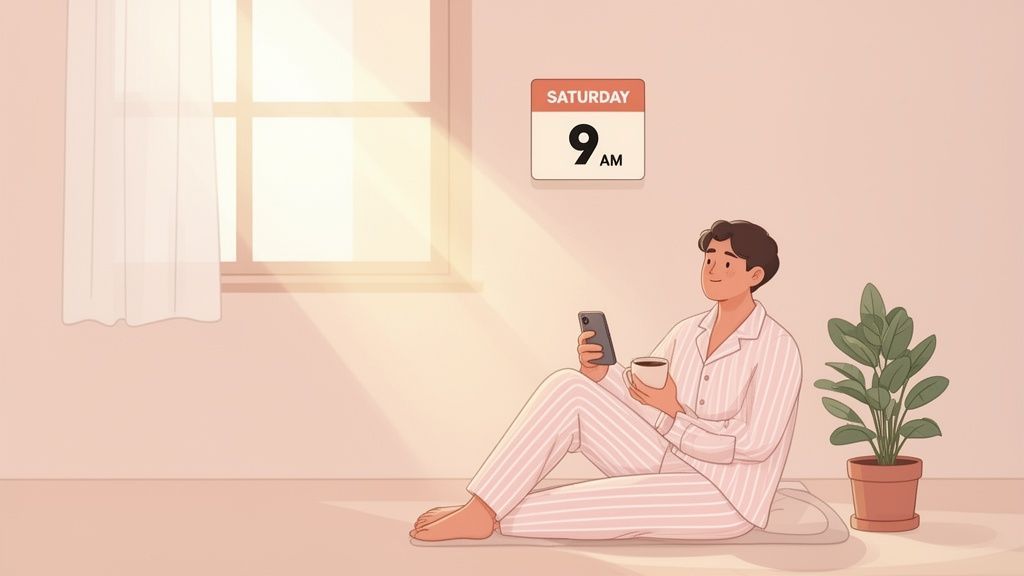
While weekdays dominate discussions about the best time to post on Facebook, savvy marketers know not to discount the power of the weekend. The Saturday morning sweet spot, from roughly 8 AM to 10 AM, offers a unique opportunity to connect with an audience that is relaxed, receptive, and has more time to engage deeply with content. This window captures users as they ease into their day, scrolling intentionally rather than during a quick work break.
This shift in mindset from weekday rush to weekend relaxation often translates into higher-quality interactions. Instead of a fleeting "like" between tasks, Saturday morning users are more inclined to read long captions, watch full videos, and click through to browse products, leading to more meaningful engagement.
Why This Time Window Works
The effectiveness of this time slot is rooted in user behavior. E-commerce brands, for instance, often see a surge in browsing as people plan their weekend shopping or leisurely explore new products. Similarly, many lifestyle and DIY creators report up to 30% higher engagement on Saturday morning content, as their followers finally have time to dive into new projects. For industries like travel and home improvement, engagement can peak between 9 AM and 10 AM as users dream up their next adventure. It’s a prime time for content that inspires action.
Actionable Tips for Implementation
To capitalize on this relaxed weekend audience, integrate these strategies into your plan:
- Schedule Inspirational Content: Use this window to post your most engaging "how-to" guides, inspirational stories, or detailed tutorials. These formats thrive when the audience has time to absorb them fully.
- Embrace Long-Form Storytelling: With more time on their hands, users are more receptive to longer, story-driven captions. Use this opportunity to build a deeper connection with your community by sharing behind-the-scenes narratives or customer testimonials.
- Plan Ahead with a Calendar: Weekends can be unpredictable for social media managers. A good content calendar allows you to schedule and approve all your Saturday morning content in advance, ensuring you never miss this valuable slot.
- Launch User-Generated Content Campaigns: Kick off a weekend campaign by asking your audience to share photos or stories related to your brand. A Saturday morning launch gives them the entire weekend to participate, maximizing involvement.
5. Late Evening Posts (8-10 PM)
Another highly effective strategy for determining the best time to post on Facebook is to target the late evening hours. This approach captures your audience during their second significant activity peak of the day, when they have finished with dinner and chores and are settling down to relax and consume content. The window between 8 PM and 10 PM is prime time for casual browsing, making it perfect for light-hearted, engaging, and shareable posts.
Posting during this period allows you to connect with users when they are in a recreational mindset, often leading to high engagement on content designed to entertain rather than sell. Unlike the business-focused daytime slots, the late evening is dominated by scrolling for fun, which presents a unique opportunity for brands in entertainment, lifestyle, and consumer goods.
Why This Time Window Works
The effectiveness of the 8 PM to 10 PM slot is rooted in user behavior patterns. As the day winds down, people turn to Facebook for a mental break, making them highly receptive to humorous or visually appealing content. Data from entertainment and media pages consistently shows engagement rates spiking during these hours, with some seeing a 35% higher interaction rate. For example, meme accounts often see their content peak around 9 PM, while streaming services frequently use this window to promote new releases. This is also when video content performs exceptionally well, often achieving up to 30% better reach.
Actionable Tips for Implementation
To capitalize on this relaxed, late-night audience, consider these actionable steps:
- Reserve Entertainment for the Evening: Schedule your most entertaining and shareable content, like memes, funny videos, or engaging questions, for this 8 PM to 10 PM slot. Keep the tone light and focus on generating reactions and shares.
- Leverage Stories and Reels: This is the perfect time for casual content like behind-the-scenes glimpses, Q&As, and interactive polls via Facebook Stories. Reels with viral potential also have a much higher chance of success when posted during this entertainment-focused window.
- Focus on Engagement, Not Hard Sells: Avoid posts with heavy calls-to-action or direct sales pitches. The goal here is to build community and brand affinity through entertainment. A user who enjoys your content at 9 PM is more likely to remember and engage with a promotional post the next morning.
6. Early Morning Pre-Work Posts (6-8 AM)
Another powerful strategy for finding the best time to post on Facebook is to target the pre-work window. This approach captures your audience during their first moments online, as they check their phones upon waking, during their commute, or over their first cup of coffee. Between 6 AM and 8 AM, users are often looking for quick, digestible content that can inform, motivate, or entertain them before the workday begins.
Posting during this early bird period allows your content to be the first thing your audience sees, setting the tone for their day. Unlike the crowded mid-day slots, this window offers a less competitive environment, giving your posts a greater chance to stand out in the feed and drive initial engagement that boosts visibility for the rest of the day.
Why This Time Window Works
The success of this early slot is rooted in modern daily routines. Many wellness and fitness influencers have discovered this, with some reporting 25-35% higher engagement on workout or motivational content posted between 6 AM and 7 AM. Similarly, news outlets leverage this window to deliver morning briefings, achieving strong readership as people catch up on current events. It’s an effective strategy because it aligns perfectly with the "first-scroll" habit that has become a staple of many people's mornings.
Actionable Tips for Implementation
To capitalize on this early morning opportunity, consider these practical steps:
- Align Content with Morning Mindsets: Schedule motivational quotes, quick tips, news updates, or wellness content for this slot. Content that encourages daily habits performs exceptionally well here.
- Test Your Specific "Golden Hour": The 6-8 AM window is broad. Use your analytics to test whether your audience is more active at 6 AM, 7 AM, or closer to 8 AM, and then refine your schedule for maximum impact.
- Reach a Global Audience: If your audience is spread across different time zones, manually posting in the morning for each region is impossible. Using a scheduling tool with smart queueing can automatically publish your content during the 6-8 AM window in each follower's local time, ensuring global reach without the logistical headache. For more ideas on content that resonates, check out our guide to creating a successful Facebook strategy.
7. Time Zone Optimization Strategy
Instead of relying on a single “golden hour,” a more sophisticated approach to finding the best time to post on Facebook is to implement a time zone optimization strategy. This method acknowledges that a global or geographically diverse audience doesn't operate on one clock. It involves scheduling content across multiple time zones to maximize reach and engagement across different regions.
Global brands have long understood that peak engagement in London doesn't align with peak times in New York or Tokyo. By staggering posts to hit the prime morning, lunch, or evening windows in each key market, they ensure their content is consistently visible to a fresh segment of their audience, rather than being buried in the feed for users just waking up.
Why This Time Window Works
The power of this strategy lies in its audience-centric logic. If a significant portion of your followers is in North America, Europe, and Asia, a single post at 10 AM EST will inevitably miss the mark for two-thirds of your audience. Data from multinational corporations shows that time zone-specific posting can increase overall daily engagement by as much as 50% compared to a one-size-fits-all schedule. It transforms your posting schedule from a single event into a continuous wave of content delivery that meets followers where they are.
Actionable Tips for Implementation
To effectively deploy a time zone optimization strategy, consider these focused steps:
- Identify Your Key Markets: Use your Facebook Insights or a dedicated analytics tool to identify the top 3-4 countries or regions where your followers are located. These are your primary targets for staggered posting.
- Automate Across Regions: Manually posting across different time zones is impractical. A good scheduling tool can let you set up your content queue once and have it automatically deployed at the optimal local time for each target region.
- Adapt Content Subtly: While you can post the same content, consider making minor tweaks for each region. This could be as simple as changing the currency in a product post or referencing a local event to increase relevance.
- Create Time Zone Templates: For agencies managing international clients, setting up timezone-based templates can streamline the process, ensuring consistent, optimized posting schedules for each client without reinventing the wheel. For a deeper dive into multi-platform scheduling, check out our guide on how to schedule a social media post to multiple platforms.
8. Audience-Specific Peak Times (Behavioral Segmentation)
An advanced strategy for determining the best time to post on Facebook involves moving beyond generalized schedules to focus on behavioral segmentation. This data-driven approach acknowledges that not all followers are the same. It uses audience analytics to identify when distinct demographic or interest-based segments of your audience are most active and tailors posting times to match those unique patterns.
This method requires a deeper dive into your analytics but yields far more precise and effective results. By aligning your content delivery with the specific online habits of different audience groups, like professionals, students, or parents, you can significantly increase relevance and engagement. It’s about speaking to the right people at exactly the right time for them.
Why This Time Window Works
The power of this strategy lies in its precision. While a general 9 AM post might work for a B2B audience, an e-commerce brand might find its Gen Z followers are most active after 8 PM, while its Gen X customers browse most during their lunch break. By segmenting, you avoid a one-size-fits-all approach that inevitably misses large portions of your audience.
Marketing agencies and enterprise social teams have adopted this model to maximize ROI. For instance, a brand could see a 40% higher click-through rate on product posts targeted at younger demographics in the evening compared to standard daytime slots. This level of customization turns broad assumptions into a targeted, high-performance content strategy.
Actionable Tips for Implementation
To effectively implement behavioral segmentation, follow these steps:
- Dive into Your Insights: Use Facebook's native Insights tool to analyze your audience by age, gender, and location. Export this data to identify when your most valuable demographic groups are online.
- Create Segmented Schedules: Develop different posting schedules for your top 2-3 audience segments. For example, a "Professional" segment gets content at 9 AM on weekdays, while a "Young Consumer" segment sees posts at 7 PM.
- Utilize Advanced Analytics: To streamline this process, leverage a platform with robust analytics. Exploring detailed audience analytics features can help you easily view engagement patterns by segment and build data-backed schedules directly within the tool.
- Test and Refine Continuously: Audience behavior changes. Regularly review your segment performance every month or quarter to see if peak times have shifted, and adjust your schedules accordingly to maintain optimal engagement.
Best Time to Post on Facebook by Day of the Week: What 16,166 Real Posts Show
General windows are useful, but most people plan content day by day, so here is our own first-party data: 16,166 Facebook posts published through PostFast by 215 workspaces in the 90 days to September 4, 2026. Every post is scored against its own Page's median impressions, so 1.00 means that Page's normal result and one large Page cannot tilt an hour for everyone. Metrics come from the first snapshot at least 48 hours after publishing. Facebook's post insights expose reactions but no comment or share counts; the index here is built on impressions, as on the other platforms.
The control is not cosmetic. Scored the naive way, Facebook's hour-of-day effect looks like a 43x swing; scored against each Page's own normal it is 2.2x, and even that comes from two thin pre-dawn rows; among hours with at least 300 posts the spread is 0.91x to 1.18x.
What the controlled numbers say:
- Mid-afternoon in your own time zone wins: 3 PM at 1.18x (1,272 posts) and 5 PM at 1.17x (928 posts), with 4 PM at 1.04x. Everything else from 7 AM to 2 PM and from 6 PM onward is flat, and 9 AM is the weakest daytime hour at 0.91x (1,210 posts).
- In UTC, 1 PM is the strongest hour at 1.23x (804 posts), then midnight at 1.19x and 5 PM at 1.13x. The weakest UTC hours are 10 PM (0.81x), 2 AM (0.82x) and 1 AM (0.86x).
- Wednesday is the weakest day at 0.96x; Sunday (1.02x) and Monday (1.01x) edge ahead, and Tuesday, Thursday, Friday and Saturday sit at normal.
| Day | vs your Page's normal | Posts |
|---|---|---|
| Sunday | 1.02x | 1,863 |
| Monday | 1.01x | 2,517 |
| Tuesday, Thursday, Friday, Saturday | 1.00x | 1,861 to 2,540 each |
| Wednesday | 0.96x | 2,493 |
The strongest single day-and-hour cells (local time, at least 100 posts each): Sunday 3 PM at 1.51x, Monday 5 PM at 1.42x, Friday 4 PM at 1.35x, Monday 8 AM at 1.30x and Wednesday 3 PM at 1.26x. The weakest: Thursday 4 PM at 0.74x, Tuesday 1 PM at 0.81x, Wednesday 6 PM at 0.82x and Wednesday noon at 0.83x.
Does the curve reproduce? Split into random halves 25 times, the overall Facebook hour curve correlates at 0.44 in local time and 0.74 in UTC, which we rate stable. By format the picture splits: video posts reproduce (0.52 local) and peak at 8 PM local (1.26x on 222 posts) and 5 PM (1.17x on 389 posts), with Monday at 1.12x; Reels reproduce in UTC; but photo posts, the largest format at 7,246 posts, do not reproduce at all (0.10 local), so we make no hour claim for photos. On the same Page, a video earns a median 4.31x the impressions of a photo (41 Pages), which matters more than any hour. Two early-morning local hours (1 AM and 5 AM) show spikes above 1.7x, but on 91 and 111 posts; we do not treat them as findings.
How to read this: treat 0.95x to 1.05x as flat, prefer hours with at least 300 posts, ignore any day-and-hour cell under 100, and remember the index is conservative by construction. The practical version is short: post between 3 PM and 5 PM in your audience's time zone, avoid 9 AM, and do not save your best post for Wednesday.
8-Point Comparison: Best Times to Post on Facebook
| Strategy | Implementation Complexity (🔄) | Resource Requirements (⚡) | Expected Outcomes (⭐📊) | Ideal Use Cases (💡) | Key Advantages (⭐) |
|---|---|---|---|---|---|
| Weekday Mid-Morning Posts (Tue–Thu, 9–11 AM) | Low, simple scheduling; timezone tweaks | Low–Medium ⚡, scheduling + analytics | Higher engagement (≈20–35%); improved CTRs ⭐📊 | B2B, professional services, agencies 💡 | Consistent traffic & conversions; lower feed competition ⭐ |
| Lunch Hour Posts (12–1 PM) | Low, regular daily slot 🔄 | Low ⚡, mobile-first content | Good mobile engagement; predictable daily uplift (≈+25%) ⭐📊 | Food, lifestyle, wellness, influencers 💡 | Predictable audience behavior; great for light/quick content ⭐ |
| Evening Peak Hours (5–7 PM) | Medium, requires consistent timing & staging 🔄 | Medium–High ⚡, top creative + monitoring | Highest reach & engagement (≈30–50%); extended visibility ⭐📊 | All industries; time-sensitive promos & announcements 💡 | Max algorithmic distribution; broad audience reach ⭐ |
| Saturday Morning Sweet Spot (8–10 AM) | Low–Medium, weekend planning needed 🔄 | Low ⚡, longer-form or inspirational content | Higher-quality interactions; longer dwell time 📊 | E‑commerce, lifestyle, DIY, travel creators 💡 | Meaningful comments and community building; less weekday competition ⭐ |
| Late Evening Posts (8–10 PM) | Low, target leisure-minded audiences 🔄 | Low ⚡, entertainment-focused assets | Strong entertainment engagement (≈20–40%); good for virality ⭐📊 | Entertainment, meme pages, streaming brands 💡 | Great for shareable content; captures global audiences ⭐ |
| Early Morning Pre‑Work Posts (6–8 AM) | Low, routine-based scheduling 🔄 | Low ⚡, motivational/fitness assets | Good engagement for routines, news, fitness 📊 | Fitness, wellness, news, motivation creators 💡 | Low competition; effective for habit-forming content ⭐ |
| Time Zone Optimization Strategy | High, multi-window coordination 🔄 | High ⚡, multi-posting or repurposing + tools | Maximizes global reach; near 24/7 presence ⭐📊 | Global brands, multinational agencies, international influencers 💡 | Reaches regional peaks; increases total impressions and reach ⭐ |
| Audience‑Specific Peak Times (Behavioral Segmentation) | High, data analysis + dynamic scheduling 🔄 | High ⚡, advanced analytics & segmentation tools | Significantly higher engagement per segment; better relevance ⭐📊 | Brands with diverse audiences, enterprise/social teams 💡 | Personalized timing improves relevance, CTRs, and ROI ⭐ |
Stop Guessing and Start Scheduling: Your Path to Perfect Timing
Navigating the landscape of Facebook engagement can feel complex, but as we've explored, finding the best time to post on Facebook isn't about uncovering a single secret. Instead, it’s about crafting a bespoke strategy rooted in data, observation, and intelligent adaptation. The journey begins with understanding foundational peak hours, like the weekday mid-mornings (9-11 AM) and the lunchtime scroll (12-1 PM), which serve as reliable starting points.
From there, your strategy evolves. You can layer on industry nuances and test powerful windows like the early morning pre-work slot (6-8 AM) or the focused Saturday morning sweet spot (8-10 AM). This guide has provided you with a comprehensive toolkit, not a rigid set of rules. The real power lies in combining these general insights with the specific data from your own Facebook Insights. This is where guesswork transforms into a calculated, data-driven approach.
From Insight to Implementation: Your Actionable Roadmap
The most crucial takeaway is that your audience’s behavior is the ultimate source of truth. The data points we've discussed are your map, but your analytics are your real-time GPS, guiding you to the precise moments your community is most active.
Here’s how to translate this knowledge into a powerful, ongoing strategy:
- Start with the Averages: Begin by scheduling posts during the widely recognized peak times we covered, like Tuesday to Thursday mornings. This establishes a solid baseline for engagement.
- Segment and Test: Don't treat your entire audience as a single entity. Use your analytics to see if your followers in London engage differently from those in New York. Implement a time zone optimization strategy to ensure your key messages land during prime hours for each major segment.
- Analyze and Refine: The process is cyclical. After a few weeks of consistent posting, dive back into your analytics. Did the evening peak hour (5-7 PM) posts outperform your mid-morning content? Did a late-night post unexpectedly go viral? Use these insights to continuously refine your posting calendar. Your schedule should be a living document, not a static one.
- Embrace Automation: Manually posting at 6 AM or coordinating across multiple time zones is not a sustainable long-term strategy. It leads to burnout and missed opportunities. This is where automation becomes your strategic partner.
Key Insight: The goal is not just to find the best time to post, but to build a flexible, multi-layered scheduling system that adapts to your audience's rhythm, ensuring your valuable content is always seen by the right people at the right moment.
By moving beyond generic advice and committing to a cycle of testing, analyzing, and refining, you turn your Facebook presence from a passive channel into a proactive engine for connection and growth. This methodical approach ensures your hard work in creating brilliant content pays off with maximum visibility and engagement. The path to mastering the Facebook algorithm begins with mastering your own posting schedule.
Frequently Asked Questions
What is the best time to post on Facebook in 2026?
Weekday mid-mornings (9 to 11 AM), the lunch hour (12 to 1 PM), and the early evening (5 to 7 PM) tend to drive the most engagement in industry studies. Our own data from 16,166 posts puts the strongest hours at 3 PM and 5 PM in your audience's time zone, with Wednesday the weakest day. These are averages, so confirm them against your own Facebook Insights.
What is the best day to post on Facebook?
Industry studies usually name Tuesday, Wednesday and Thursday, with Wednesday often the single best day and Sunday the weakest. Our own controlled data from 16,166 posts puts Sunday and Monday slightly ahead and Wednesday last at 0.96x, with every day within 4 percent of normal. Most pages do well posting consistently on weekdays and lighter on weekends.
What is the best time to post on a Facebook page?
For most Facebook pages the same windows apply: 9 to 11 AM and 12 to 1 PM on weekdays for reach, and 5 to 7 PM for video and entertainment content. Check your page's Insights for the exact hours your followers are online.
How often should you post on Facebook?
For most pages, 3 to 5 posts a week is a sustainable, effective cadence. Consistency matters more than volume, so a steady weekly rhythm beats occasional bursts that flood the feed.
Does posting time still matter with the Facebook algorithm in 2026?
Yes. Early engagement still signals value to the algorithm, so posting when your audience is active gives a post its best chance to gain initial traction and reach further. Timing is a head start, not a guarantee.
How do I find my own best time to post on Facebook?
Open your Facebook Page, go to Insights, and check when your followers are online by day and hour. Test those windows for a few weeks, then compare which slots earn the most reach. A scheduling tool with smart timing can automate this for you.
Can I schedule Facebook posts in advance?
Yes. With a tool like PostFast you can batch your content and schedule Facebook posts, Reels and Stories to publish automatically at the best times, including across multiple time zones, so you never have to post manually at 6 AM.
Put Your Facebook Posting on Autopilot
You do not have to choose between perfect timing and your sanity. PostFast turns the schedule above into effortless execution: batch a week of Facebook posts, Reels and Stories, and let Smart Scheduling publish each one at the proven best time for your audience, across every time zone.

Start your free 7-day trial, no credit card required, and schedule your first perfectly-timed post in minutes.
Related
Facebook scheduling with PostFast
Pages, Reels, Stories, carousels
Best Time to Post on Social Media in 2026: 61,008 Posts Scored Against Their Own Normal
61,008 posts with clean metrics, each scored against its account's normal: Instagram 3 PM local, Facebook 3 to 5 PM, YouTube 1 PM or evenings, TikTok flat.
Your Complete Guide to Facebook Cover Photo Size
Master the cover facebook size for Facebook Pages and Profiles with quick tips to optimize visuals and boost engagement.
Complete Guide to Succeeding on Facebook in 2026
Facebook marketing in 2026: a practical playbook for Pages, Reels, Stories, and link posts, plus a weekly scheduling system that stays consistent.

Download private video from facebook safely: A quick, ethical guide
Learn how to download private video from facebook safely, with practical steps, browser tips, and ethical considerations to protect creators.
How to Connect Claude to Instagram: Post, Schedule, Reply
Connect Claude to Instagram so it can schedule posts, Reels and Stories, answer comments and report post stats. Setup steps, prompts that work, and limits.