A Complete Guide to Social Media Optimisation
Discover the art of social media optimisation (SMO). Our guide explains how to grow your audience, boost engagement, and drive results on all major platforms.
On this page (6)
Picture your social media profiles as your digital storefronts. Social Media Optimisation (SMO) is everything you do to make those storefronts inviting, easy to find, and genuinely effective at bringing people inside. It’s the shift from just posting things at random to strategically building your brand’s presence, connecting with the right people, and hitting your business goals.
What Social Media Optimisation Really Means
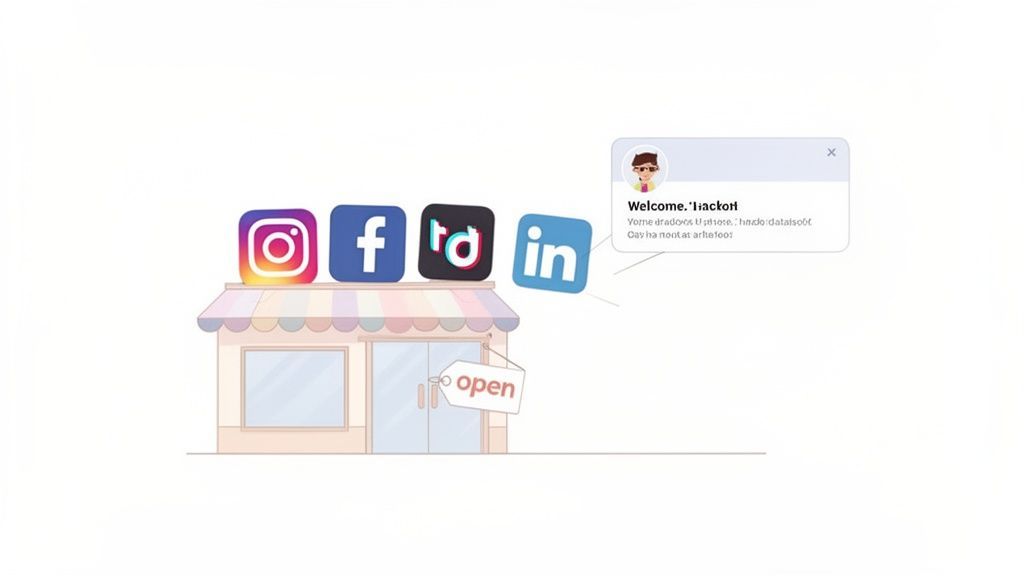
If your social account is a shop, simply posting content is like occasionally tossing a few items in the window. Social Media Optimisation is the art of designing the entire shopfront. It involves picking the perfect sign (your username and bio), arranging a compelling window display (your content), and making sure the doors are wide open when your customers are walking by (your posting schedule).
Without optimisation, you’re just hoping for the best. With it, you're intentionally setting up your profiles to perform. This means you’re systematically tweaking everything, from your bio to your hashtags, to boost your reach, engagement, and, ultimately, your conversions.
Why SMO Is a Non-Negotiable Today
In today's crowded digital space, just showing up isn't enough to get noticed. You need a smart, optimised approach to stand out. Take Bulgaria, for example. At the start of 2025, there were 4.37 million active social media users, which is about 75% of all internet users in the country. With that much noise, cutting through requires more than just luck. You can dig deeper into Bulgarian social media trends over at novinite.com.
Social Media Optimisation isn’t about trying to game the algorithm. It’s about aligning your strategy with how these platforms are built to connect people with great content, and making sure your brand is part of that connection.
This is where a methodical process pays off. Instead of guessing what your audience wants, you use data to figure it out. One of the main goals of SMO is to learn how to increase social media engagement and build a community that genuinely cares about what you have to say.
The Relationship Between SMO and SEO
People often get SMO and Search Engine Optimisation (SEO) mixed up, but it's better to think of them as two sides of the same coin. They’re different, but they work best together.
To put it simply:
- Search Engine Optimisation (SEO) is all about getting your website to rank higher on search engines like Google.
- Social Media Optimisation (SMO) is about making your brand more visible and engaging on social networks like Instagram, Facebook, and TikTok.
Here’s a quick breakdown to make the distinction even clearer.
SMO vs. SEO At a Glance
| Aspect | Social Media Optimisation (SMO) | Search Engine Optimisation (SEO) |
|---|---|---|
| Primary Goal | Build brand awareness, community, and engagement. | Drive organic traffic to a website by improving search rankings. |
| Main Platform | Social networks (e.g., Instagram, TikTok, LinkedIn). | Search engines (e.g., Google, Bing). |
| Key Activities | Profile setup, content creation, hashtag strategy, community interaction. | Keyword research, on-page optimisation, link building, technical fixes. |
| Success Metrics | Reach, likes, shares, comments, follower growth. | Keyword rankings, organic traffic, bounce rate, conversions. |
| Content Lifespan | Typically short-lived and dynamic. | Evergreen content can perform well for years. |
While they operate in different arenas, their efforts are deeply connected. A strong, optimised social presence can drive a ton of traffic to your website. Plus, social shares can signal to search engines that your content is valuable, giving your SEO a nice boost.
Think of SEO as optimising your main headquarters (your website) and SMO as optimising all your satellite branches (your social profiles). You need both to build a powerful digital footprint and ensure your audience can find you, no matter where they’re looking.
The Core Components Of An Effective SMO Strategy
A great social media optimisation strategy isn’t just one thing; it’s a collection of interconnected pieces working together. Think of it like tuning a high-performance engine. Every component needs to be perfectly calibrated for the whole system to run smoothly and powerfully. From the first impression you make to the content you share, every detail matters.
Getting these components right is what separates brands that just exist on social media from those that actually thrive. It all starts with building a solid foundation people can trust and recognise instantly.
Optimising Your Profile For First Impressions
Your social media profile is your digital handshake. It's often the very first contact a potential follower has with your brand, and it needs to be firm, clear, and inviting. A messy, confusing profile can send people clicking away before they even see your content.
Here are the essential bits to nail down:
- Username and Handle: Keep it consistent and easy to find across all platforms. Ideally, just your brand name.
- Profile Picture: Use a high-quality logo or a professional headshot. This is your visual anchor for brand recognition.
- Bio and Description: Say who you are, what you do, and who you help. Weave in relevant keywords naturally so people searching for your services can find you.
- Link Strategy: Don't waste that link-in-bio spot. Send users to your main website, a key landing page, or a curated link page showing off your most important stuff.
Together, these elements build instant credibility and tell your audience, "You're in the right place."
Mastering Content And Cadence
Once your profile is ready, your content strategy takes the spotlight. This is where you grab attention, deliver value, and build a real community. Great SMO requires a thoughtful approach to what you post, when you post, and how you post it.
A huge part of a successful strategy is simply staying on top of platform changes. For instance, reading up on things like TikTok's 2025 algorithm update and optimization strategies ensures your content doesn't suddenly become invisible.
The goal isn't just to create content. It's to create the right content, for the right platform, at the right time. This alignment is the heart of a successful optimisation loop.
Posting consistently is essential. If you post sporadically, your visibility will suffer. A steady cadence keeps your brand top-of-mind. This doesn’t mean you need to post five times a day everywhere. It's about finding a sustainable rhythm your audience can count on.
Using a platform that simplifies social media scheduling helps you maintain that consistency without living on your phone. Good tools can even pinpoint the best times to post based on when your specific audience is most active, taking the guesswork out of the equation.
Tailoring Your Approach For Each Platform
Social media platforms are not all the same. A one-size-fits-all content strategy almost never works. Each network has its own vibe, its own audience expectations, and its own best-performing content formats. Real social media optimisation means customising your message to fit the unique environment of each one.
This is especially critical when targeting specific regions. Take Bulgaria, for example. In January 2025, there were an estimated 4.30 million Facebook users, 1.95 million on Instagram, and 1.50 million on LinkedIn. For a local brand, this data screams opportunity. You'd focus on Meta's platforms to reach urban consumers and save LinkedIn for your B2B marketing. You could take one core idea, like a new product launch, and repackage it. Turn it into a slick video for Facebook, an eye-catching carousel for Instagram, and a detailed case study for LinkedIn.
This table is a quick guide to help you start tailoring your content.
Platform-Specific Content Optimisation Tactics
| Platform | Optimal Content Format | Key Optimisation Tactic |
|---|---|---|
| High-quality visuals, Reels, Stories, Carousels | Focus on aesthetics and use a mix of relevant and niche hashtags to maximise discovery. | |
| Videos, community-building posts, links to articles | Encourage conversation with questions and polls to boost engagement within groups and on your page. | |
| Text-based posts, articles, professional videos | Share industry insights, career advice, and company news to establish thought leadership. | |
| TikTok | Short-form vertical videos | Tap into trending sounds and formats while showcasing your brand's personality in an authentic way. |
By respecting each platform's unique culture and tailoring your content, you show that you understand the community you’re trying to connect with. That simple act builds trust and dramatically increases your chances of getting engagement.
A Step-by-Step Framework for Optimising Your Social Media
Knowing the pieces of social media optimisation is one thing. Putting them together into a repeatable process is where the magic happens. A solid framework turns abstract ideas into concrete actions, giving you a clear roadmap from where you are to where you want to go. This isn't about guesswork; it's about building a system for growth.
This practical framework breaks down the entire process into manageable stages. Each step builds on the last, making sure your efforts are logical, informed by data, and tied to your business goals right from the start.
Start With a Social Media Audit
Before you can get better, you have to know where you stand. A social media audit is a complete health check of your current profiles. It’s where you take an honest look at what’s working, what isn’t, and where your biggest opportunities are hiding.
Your audit should answer a few key questions:
- Which platforms are you on? Are they still the right places to find your audience?
- Is your branding consistent? Do your profile pictures, bios, and links all tell the same story?
- What’s your best-performing content? Look for patterns in the posts that got the most love (likes, comments, shares).
- Who is your audience? Dive into your follower demographics and see who you’re actually talking to.
This initial review gives you a baseline to measure all your future wins against. It flags the quick fixes and helps shape the goals you'll set next.
Define Clear and Measurable Goals
Once you have your baseline, you need to decide what you're aiming for. Vague goals like “get more followers” won’t cut it. Your social media optimisation goals need to be specific, measurable, and connected directly to your bigger business objectives.
A goal without a measurement is just a wish. For SMO to work, you have to define what success looks like in hard numbers.
For example, instead of “increase engagement,” a much better goal is “Increase the average engagement rate on Instagram posts by 15% over the next quarter.” Other strong goals could be driving 500 website clicks per month from LinkedIn or generating 20 qualified leads through Facebook. Clear targets focus your energy and make it obvious if your strategy is actually working.
This simple flow shows how the core pieces, profile, content, and engagement, work together.
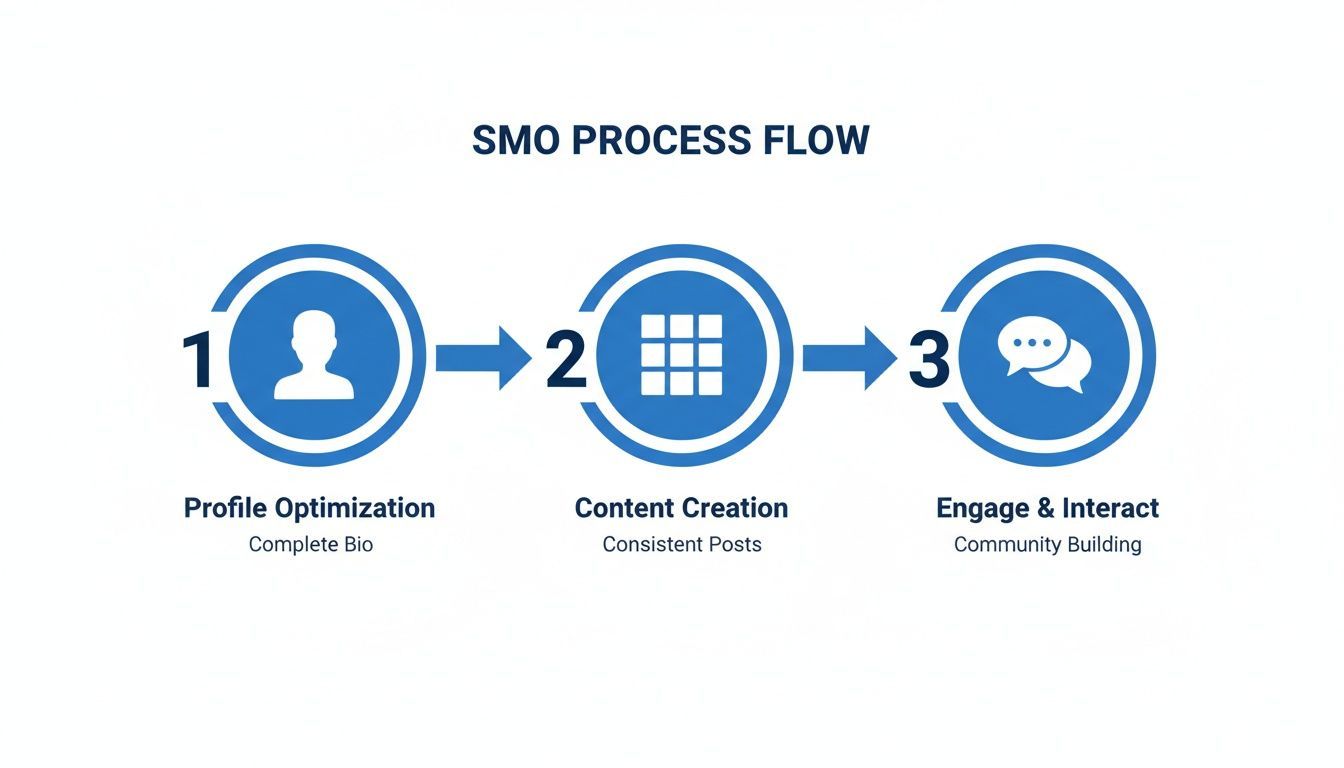 A polished profile pulls people in, great content keeps them around, and real engagement builds a loyal community.
Research Your Audience and Competitors
With your goals locked in, it’s time to look outside your own bubble. You need to get inside your audience's head to create content that truly connects. Go beyond basic demographics: what are their interests, their problems, their online habits? What kind of content do they share? What questions do they ask?
At the same time, scope out the competition. Pick your top three competitors and study their social media game. Take note of their content strengths, their engagement numbers, and the tactics they’re using. This isn't about copying them. It’s about finding gaps you can fill and learning from their wins and losses.
Create a Content Calendar and Implement
This is where the plan comes to life. A content calendar is your master plan for what you’ll post, where, and when. It keeps you consistent and saves you from the daily panic of "what should I post today?" Planning your content ahead of time also ensures you have a healthy mix of helpful, fun, and promotional posts.
Using a tool with a visual calendar makes this whole process way smoother. You can map out your entire month, schedule posts for the perfect times, and keep a cohesive look across all your channels. For anyone managing multiple accounts, learning how to schedule a social media post to multiple platforms efficiently is a total game-changer. You can stay active everywhere without burning out.
Engage, Analyse, and Refine Your Approach
Social media optimisation is not a "set it and forget it" job. It's a constant loop of doing, measuring, and tweaking. Once your content goes live, the real work begins.
- Engage Authentically: Jump on comments and messages quickly. Join relevant conversations and actively build a community. Real, human interaction is what builds loyalty.
- Analyse Your Performance: Keep a close eye on your key metrics. Are you hitting the goals you set earlier? Which posts are getting the most attention? What times seem to work best?
- Refine and Repeat: Use what you learn to fine-tune your strategy. Do more of what’s working and try new things to fix what isn’t. This feedback loop is the engine that drives continuous improvement.
How to Measure Your Social Media Optimisation Success
You can't fix what you don't measure. That’s the simple truth at the heart of any real social media optimisation effort. Without a scorecard, you’re just flying blind, making decisions based on hunches instead of hard evidence.
Measuring your SMO success is about looking past the shiny "vanity metrics." A big follower count looks impressive, but it tells you almost nothing about how healthy your social presence actually is. Real success is buried in the data that connects directly to your business goals.
Focusing on Key Performance Indicators
To get a clear picture of what's actually working, you need to zero in on your Key Performance Indicators (KPIs). These are specific, measurable metrics tied directly to your goals. They show you what your audience is really doing.
Here are the essential KPIs you should have your eyes on for any serious SMO work:
- Engagement Rate: This is your most important metric for gauging audience connection. It’s the percentage of your audience that actually interacts with your content, think likes, comments, shares, and saves.
- Reach and Impressions: Reach tells you how many unique people saw your post. Impressions count the total number of times it was seen. Both are crucial for understanding your brand awareness.
- Click-Through Rate (CTR): This number tracks how many people clicked the link in your post. CTR is a direct signal of how good your content and calls-to-action are at driving traffic.
- Conversions: For most businesses, this is the finish line. Conversions track how many people took the action you wanted, like signing up for a newsletter, downloading an ebook, or buying something after clicking your social post.
Keeping a close watch on these KPIs helps you see which content formats connect, what topics get people talking, and how well you’re guiding your audience from your social feed to your business goals.
Setting Up Your Analytics Dashboard
Trying to juggle the native analytics from every single platform is a fast track to burnout. A centralised dashboard is the only sane way to monitor your KPIs without getting lost in a dozen browser tabs. A single view lets you spot trends and compare performance across channels effortlessly.
The point of measurement isn’t just to collect data; it’s to find actionable insights. A good dashboard turns a pile of numbers into a story, showing you exactly where to double down and where you need to pivot.
This is where a dedicated tool is a game-changer. For example, the social media analytics features in a tool like PostFast can pull all these metrics into one clean, easy-to-read view. It saves you countless hours of digging through data manually, freeing you up to act on the insights you find.
Running Experiments for Data-Driven Decisions
The fastest way to learn what works is to run controlled experiments. This analytical approach takes the guesswork out of optimisation and gives you hard proof of what your specific audience responds to.
A simple and powerful method is A/B testing. You just create two versions of a single post to see which one performs better. You can test almost anything:
- Headlines: Does a question get more clicks than a bold statement?
- Visuals: Does a video outperform a beautiful image or a carousel?
- Posting Times: Is your audience more engaged at 9 AM or 6 PM?
- Calls-to-Action: Does "Learn More" beat "Shop Now"?
By testing one thing at a time, you build a powerful internal playbook of what truly resonates with your followers. This turns social media optimisation from a creative guessing game into a scientific process of continuous improvement, proving your investment and keeping your strategy sharp.
Real-World Examples of Great Social Media Optimisation
Theory is one thing, but seeing social media optimisation in action is where the lessons really click. Let's break down how different brands use SMO to hit their goals. These examples prove that a smart strategy, not a monster budget, is what wins on social media.
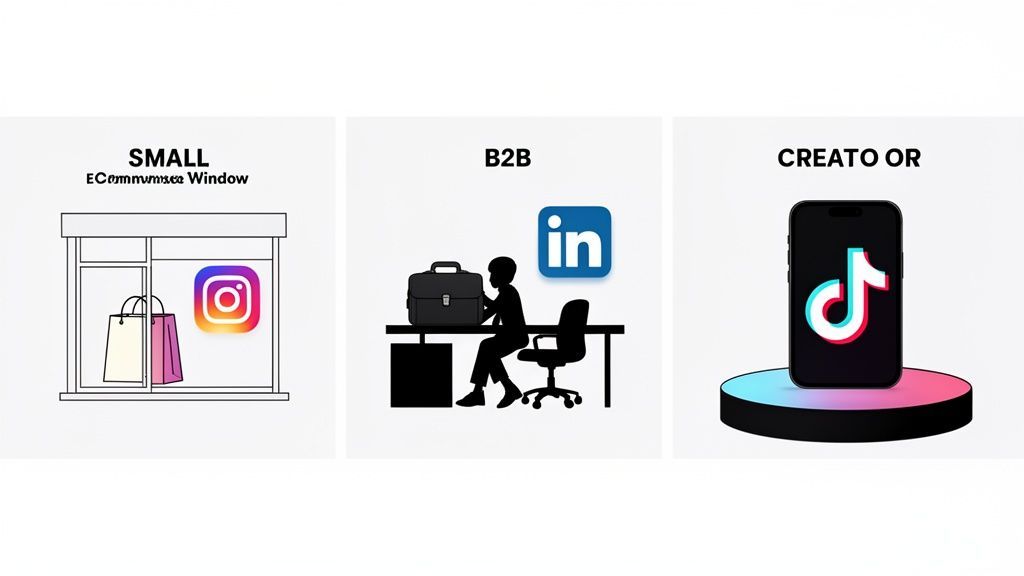
We’ll look at a few distinct cases: a small e-commerce brand turning Instagram views into sales, a B2B company building authority on LinkedIn, and a creator who absolutely cracked the TikTok algorithm. Each one applies the principles we've covered, just in their own way.
Their success shows that with the right approach, any business can get serious results.
The E-commerce Brand Mastering Instagram
Picture a small, local jewellery brand. Their big challenge is standing out against huge retailers without a massive ad spend. Their solution? A masterclass in Instagram optimisation.
First off, their profile is dialled in. It has a crystal-clear, keyword-rich bio ("Handcrafted Silver Jewellery | Sofia, Bulgaria"), a high-quality logo, and a link-in-bio page pointing followers straight to new collections and bestsellers. This setup nails the first impression and tells visitors exactly what they’re about.
Their content strategy stands on two solid pillars:
- Optimised Reels: They create short, snappy videos showing the crafting process or styling tips. By using trending audio, they boost visibility and then drop clear calls-to-action in the captions, like "Tap the link in bio to shop this look!"
- Informative Carousels: They use multi-image posts to teach their audience something new. A post might explain the difference between silver types or offer a ring sizing guide, positioning them as experts and building trust with potential buyers.
This brand wins through consistency. They post five times a week, always in the early evening when their analytics show their audience is most active. A scheduler would let them map this content out weeks ahead, so they never miss a primetime posting slot. Their engagement is simple but effective, always replying to comments and featuring customer photos in their Stories.
The B2B Company Building Authority on LinkedIn
Now, let's switch gears to a B2B software company. Their goal isn't direct sales from social media. Instead, they want to be seen as industry thought leaders and generate high-quality leads. For that, LinkedIn is the perfect stage.
While their company page is a solid resource hub, the real work happens on the personal profiles of their key executives. These profiles are fully optimised with detailed summaries, professional headshots, and featured sections linking to whitepapers and case studies. This personalises the brand and builds instant credibility.
Their content is all about value, no sales pitches. They share:
- In-depth text posts breaking down industry trends.
- Short videos of their CEO explaining a complex topic.
- Links to company blog posts with their own insightful commentary.
The core of their strategy is to give away valuable information for free. This builds an audience of professionals who trust their expertise, making them the first call when a need for their software arises.
They post three to four times a week during business hours. Crucially, their engagement strategy isn't just about responding to comments on their own posts. They're also actively participating in conversations inside relevant industry groups, expanding their network and cementing their authority with every interaction.
The Creator Conquering TikTok
Finally, let's look at a content creator who built a massive following around a niche hobby, like urban gardening. Their success is built on a deep understanding of TikTok's unique culture and algorithm.
Their profile is clean and simple: a catchy username, a one-line bio explaining their niche, and a link to their YouTube channel. The real focus is the content. They post one to two short, vertical videos every single day. No exceptions.
Their optimisation strategy is all about trends and consistency.
- Trend Awareness: They are masters at spotting trending sounds and video formats and cleverly adapting them to their gardening niche.
- Hook Optimisation: The first three seconds of every video are meticulously designed to grab attention, often starting with a sharp question or a surprising visual.
- Hashtag Strategy: They use a smart mix of broad hashtags (like #gardening) and niche ones (like #urbangardensofia) to reach both wide and hyper-targeted audiences.
This creator’s growth comes from a relentless focus on what the TikTok algorithm rewards: high watch time and constant output. A tool that offers fully automated publishing for platforms like TikTok would be a game-changer here. It would help them maintain this demanding schedule, batch-create content, and ensure their videos go live at the perfect moment to catch the next viral wave.
A Few Common Social Media Optimisation Questions
Even with a great plan, a few questions always pop up. Social media changes fast, and last year’s best practices might not get you very far today. We get it. To save you some time, we’ve answered some of the most common questions people ask when they start digging into their social media strategy.
Think of this as your quick-reference cheat sheet. The answers are straight to the point, so you can get the clarity you need and get back to growing your brand.
How Often Should I Post on Social Media?
Honestly, there’s no magic number that works for every single account. The right posting frequency comes down to which platform you’re on and when your audience is actually online. It’s better to aim for a consistent rhythm than a specific number, but these benchmarks are a solid place to start.
A good baseline schedule might look something like this:
- Facebook: 3 to 5 times per week
- Instagram: 3 to 5 feed posts per week, plus daily Stories
- X (formerly Twitter): 1 to 3 times per day
- LinkedIn: 2 to 4 times per week
But the most important part of social media optimisation isn’t how often you post, it’s how consistently you show up. Start with these numbers, then get into your analytics. The data will tell you when your audience is most engaged. Remember, quality always beats quantity.
What’s the Difference Between SMO and SMM?
This one trips a lot of people up, but it’s actually pretty simple. Think of Social Media Marketing (SMM) as the whole car. Social Media Optimisation (SMO) is the expert mechanic fine-tuning the engine to get the best possible performance out of it.
Social Media Marketing (SMM) is the big picture. It’s everything you do to market your brand on social platforms, including paid ads, running campaigns, and community management. The goal is to promote a product or service.
Social Media Optimisation (SMO) is a specialised part of SMM. It’s all about improving your organic, non-paid presence to naturally boost your visibility and engagement. You can’t have a truly powerful SMM strategy without great SMO making sure your organic content pulls its weight.
Can I Do Social Media Optimisation Myself on a Small Budget?
Absolutely. At its heart, social media optimisation is about being smart and consistent, not about having expensive tools. While a great platform can save you a ton of time and give you better data, the core principles don't cost a thing.
You can start right now with a manual audit of your profiles. Use the search bar on each platform to research hashtags, and plan out your content in a simple spreadsheet. Every social network also has its own free analytics tools that give you more than enough data to get started.
The secret to budget-friendly SMO is just being methodical. Track your results, see what works, and be patient. As you grow, you can decide if investing in tools to automate the repetitive stuff makes sense.
Which Metrics Actually Matter for Measuring SMO?
To know if your social media optimisation is working, you need to look past vanity metrics like your follower count. The KPIs that really matter are the ones tied directly to your business goals.
If you’re trying to build brand awareness, keep your eye on Reach (how many unique people see your content) and Impressions (the total number of times your content is seen).
Want to build a strong community? Track your Engagement Rate. This combines your likes, comments, shares, and saves into one number that shows how well your content is landing with your audience.
If your goal is to get people to your website, watch your Click-Through Rate (CTR) and total website clicks. And for conversions, you’ll want to track things like contact form submissions or sales that came directly from your social channels. A solid SMO strategy keeps an eye on a mix of these to paint a full picture of what’s really working.
Ready to put these optimisation principles into action without all the guesswork? PostFast brings all your scheduling, analytics, and collaboration into one clean dashboard. Stop jumping between platforms and start building a powerful, consistent presence. Try PostFast free for 7 days and see how much time you can get back.
Related
A Complete Guide to Creating Videos for Instagram That Convert
Master videos for Instagram with our complete guide. Learn formats, specs, creative tips, and how to schedule Reels to grow your audience and convert followers.
Instagram Reel Cover Size & Safe Zones (2026)
Exact Reel cover sizes, safe zones, and a quick PostFast workflow so your thumbnails look clean in the grid and Reels tab.

The Ultimate Guide to LinkedIn Post Sizes for Maximum Impact
Master LinkedIn post sizes with our complete guide. Get the correct dimensions for images, videos, carousels, and ads to boost your professional brand.

How to Connect Claude to Instagram: Post, Schedule, Reply
Connect Claude to Instagram so it can schedule posts, Reels and Stories, answer comments and report post stats. Setup steps, prompts that work, and limits.