Analyzing the competition: a practical workflow for analyzing the competition
Discover how analyzing the competition can boost your content strategy with a practical workflow to uncover gaps and opportunities.

On this page (5)
Doing competitor research is about more than just peeking at what your rivals are up to. It’s about digging into their strategies to see what’s working, what’s falling flat, and where they’re leaving gaps you can fill. Think of it as gathering market intelligence to sharpen your own marketing, content, and even business decisions.
Why Keeping an Eye on the Competition Is Non-Negotiable
A lot of brands treat competitor analysis like a one-time project. They’ll do a big report when they launch a product and then forget about it. That's a huge mistake. The real magic happens when you make it a consistent habit, because the digital world your audience lives in is always changing.
It’s less about copying what others are doing and more about smart, informed innovation. When you regularly check in on your competitors, you start to spot patterns and uncover insights that can reshape your entire strategy.
Find Out What Your Audience Really Wants
Your competitors are already in a conversation with your target customers. Watch their content closely. Which topics get people fired up? What questions pop up in the comments over and over? What problems are they solving that get tons of praise? This is basically free, unfiltered consumer research.
Maybe a competitor's most-shared video reveals an underlying customer need you haven't even thought about. This constant feedback loop helps you move beyond guesswork and create content you know will hit the mark.
Benchmark Your Performance and Set Smarter Goals
Your own metrics are just numbers floating in space without any context. Knowing that a top competitor posts twice a day and pulls in 200 likes on average gives your own data meaning. This is how you benchmark, it helps you set goals that are both realistic and ambitious.
By comparing your performance against established players, you can see where you’re leading and where you’re lagging. This lets you put your resources where they’ll make the biggest impact.
A solid grasp of the competitive landscape is key for the long game.
Ultimately, this isn’t just about spying. It’s a proactive strategy to find your unique voice, identify underserved niches, and make faster, smarter decisions. And when you have a tool like PostFast to schedule and analyze your own content, you get the baseline data you need to make these comparisons truly actionable.
Set Your Goals and Pick Your Competitors
Before you start scrolling through your rivals' social feeds, you need to know what you’re looking for. A good analysis always starts with a clear purpose. If you don't have a goal, you're just collecting random data, and you'll get overwhelmed fast.
So, what are you actually trying to do? The answer will shape your entire process. Are you trying to boost your own engagement rates? Find new content ideas your audience will love? Figure out how to grab more market share?
Getting specific is what matters. A vague goal like "get better at social media" is useless. Aim for something you can actually measure.
Figure Out Your "Why"
Clear goals act like a filter, helping you ignore the noise and focus on information that actually helps. This is how you turn a pile of data into real, usable insights.
Ask yourself what you want to improve:
- Content Strategy: Look for gaps in a competitor’s content that you can fill. Maybe they never use polls in their Instagram Stories, which is a perfect opening for you to engage your audience directly.
- Engagement Levels: Benchmark your likes, comments, and shares against theirs to set realistic targets for your own performance.
- Audience Growth: See which platforms and content types are driving follower growth for others in your niche.
A simple way to think about this is: Discover, Benchmark, and Differentiate. This little framework helps keep the whole process on track.
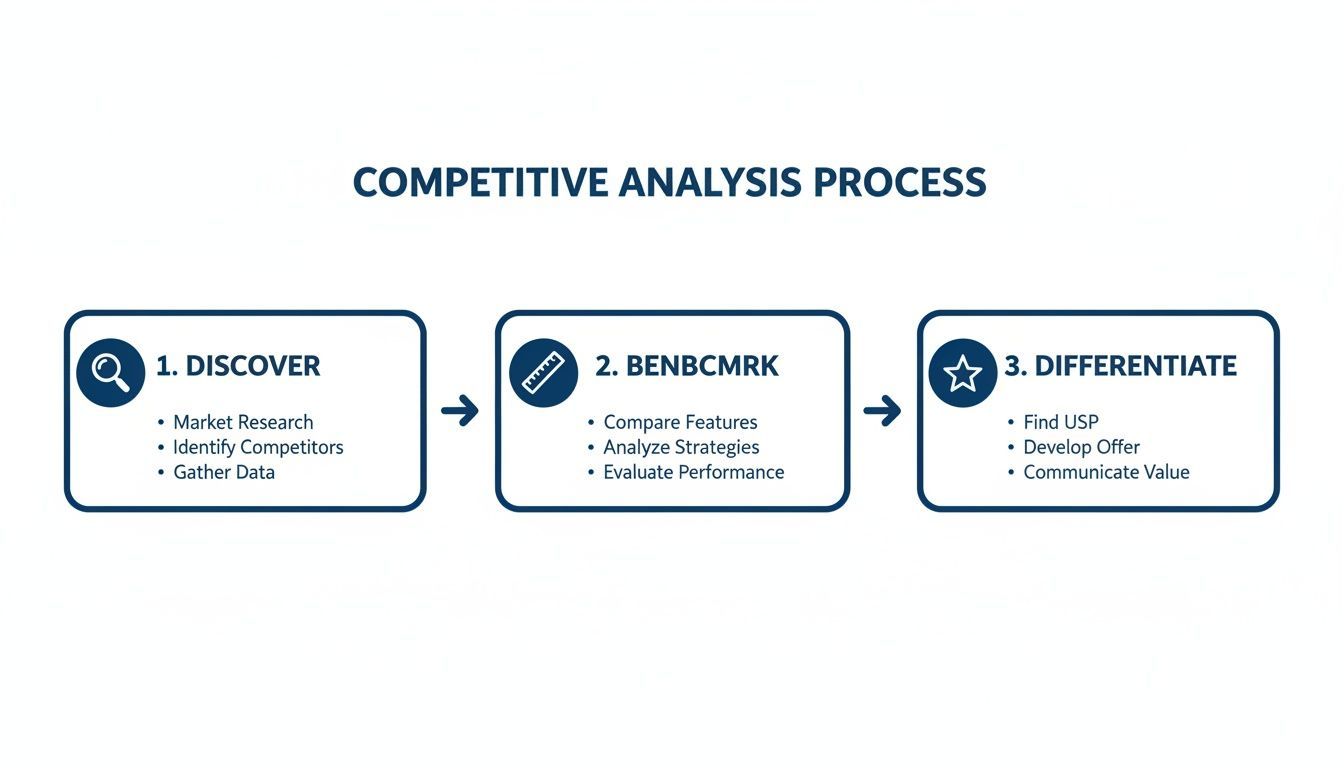
This isn't just about spying. It’s about gathering intelligence to find your unique edge.
Who Are You Really Competing Against?
Once you have your goals, it’s time to figure out who you’re actually up against. It's easy to just look at the big, obvious names, but that’s a rookie mistake. A proper analysis looks at the entire competitive landscape, not just a sliver of it.
To get a full picture, you need to think beyond the obvious rivals. I recommend sorting your competitors into a few distinct buckets.
Competitor Identification Framework
Use this table to categorize competitors for a more focused analysis, ensuring you look beyond just direct rivals.
| Competitor Type | Description | Example Brand (for a local coffee shop) |
|---|---|---|
| Direct | Brands offering a very similar product to the same audience. | The other coffee shop on the next street. |
| Indirect | Businesses solving the same problem with a different solution. | A smoothie bar or a trendy tea house. |
| Aspirational | Brands mastering social media, even in a different industry. | A national coffee chain known for viral marketing. |
Looking at these different types forces you to think bigger. You stop just reacting to your closest rivals and start pulling inspiration from the best, anticipating threats from related industries, and truly understanding your audience's other choices.
Think about the local context, too. In a market like Bulgaria, "analyzing the competition" means understanding a very dense audience. There are 4.37 million social media users, which is 64.9% of the whole population. Almost all of them, about 94%, are on Facebook, with YouTube a distant second at around 5%. If you're competing there, any strategy that doesn't prioritize these two platforms is dead on arrival.
By setting clear goals and mapping out a broad set of competitors, you build a solid foundation. This ensures every bit of data you collect leads to a smart, actionable insight. It’s what makes this whole exercise worth the effort.
When you start digging into competitor analysis, it’s easy to get lost in a sea of numbers. Likes, follower counts, comments, click-through rates… the list is endless. Honestly, trying to track everything is a surefire way to burn out.
The real trick is knowing which numbers actually tell a story. You need to focus on the metrics that reveal your competitor's strategy, not just their vanity stats. This is how you shift from simply collecting data to finding insights that will genuinely shape your own social media plan.
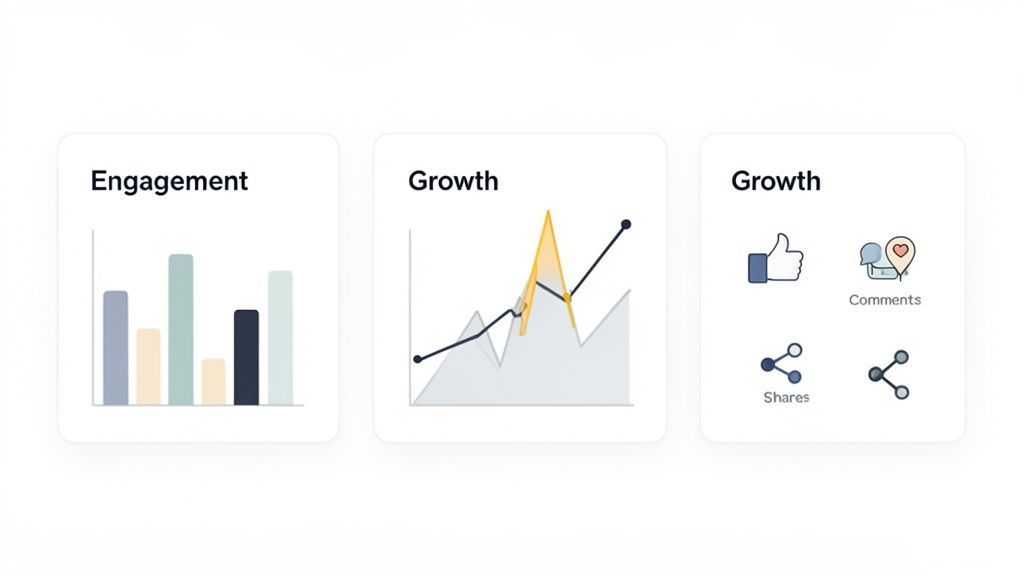
Unpacking Their Engagement Signals
Engagement is more than just a number, it’s a direct line to how well a competitor is connecting with their audience. But not all engagement is created equal. You have to look at the different types to get the full story.
Start by tracking these key signals:
- Likes and Reactions: This is the most basic level of interest, showing immediate appeal. A consistently high like count suggests their visuals or emotional hooks are landing well.
- Comments: Now we're getting somewhere. Comments show the content was interesting enough to spark a conversation. Pay attention to the quality of the comments. Are they just fire emojis, or are people asking real questions and sharing their own thoughts?
- Shares and Saves: These are pure gold. A share means someone found the content so good they were willing to put their own name on it and show it to their network. Saves tell you the content is useful and evergreen, something the audience wants to come back to.
If you see a big spike in shares around a certain topic, that’s a massive clue. It points directly to a content pillar that’s hitting a nerve with the audience, one you might want to explore for your own brand.
Don’t just count the numbers; interpret what they mean. A post with a handful of likes but a dozen thoughtful comments might be far more valuable for building a loyal community than one with thousands of likes but zero actual conversation.
Auditing Their Content Strategy and Cadence
Beyond how individual posts perform, you need to zoom out and look at their entire content machine. This reveals their priorities and how much effort they’re putting in to stay visible. A competitor’s posting schedule can tell you the baseline effort required just to stay in the game in your niche.
Your audit should focus on three key areas:
- Posting Frequency: How often are they posting on each platform? If a brand posts three times a day on X but only once a week on LinkedIn, you know exactly where they believe their audience lives.
- Content Formats: What’s their go-to mix? Are they all-in on video, or do they lean into carousels, single images, or simple text posts? Their format choices reveal what they think works best for their message.
- Key Themes and Pillars: Look for recurring topics. Most successful brands build their content around a few core pillars. Identifying these themes shows you the narrative they’re trying to own in the market.
For instance, you might notice a competitor drops a "behind-the-scenes" video every single Friday. That consistency trains their audience to expect it and shows they’re committed to building a human connection. This kind of tactical insight is priceless.
Tracking Audience Growth and Momentum
Finally, keep an eye on their audience growth over time. A static follower count doesn't tell you much, but steady month-over-month growth is a clear signal that their strategy is working to attract new people. A sudden jump could point to a viral post, a successful ad campaign, or a collaboration worth digging into.
This is also where you can get a clear benchmark for your own performance. Understanding what a "good" growth rate looks like in your industry helps you set realistic goals. Of course, this is way easier when you have solid data on your own profiles. Using a tool with built-in reporting, like the ones you'll find in PostFast's analytics features, gives you a simple dashboard to compare your own growth against the benchmarks you’ve uncovered.
By focusing on these core areas, engagement signals, content strategy, and audience growth, you turn a messy pile of data into a clear story. You can see what your competitors are doing, understand why it's working, and start making smarter, more informed decisions for your own brand.
Decoding Their Platform-Specific Strategies
A brilliant Instagram strategy will almost certainly fall flat on LinkedIn. That's just the truth of social media today. Each platform has its own unwritten rules, its own culture, and its own audience expectations. Real competitor analysis means going beyond what rivals post and digging into how they adapt their message for each specific channel.
It’s not enough to just notice a competitor uses video. You have to decode why their TikToks work differently from their YouTube content. Picking up on these platform-specific signals is the secret to building a multi-channel strategy that feels native and effective everywhere you show up.
This level of detail might sound like a lot of work, but it’s where the gold is. It helps you understand the subtle choices that separate a brand that's just present from one that's actually connecting with people.
Identifying Video Hooks on TikTok and Reels
Short-form video is its own beast, and success here comes down to the first three seconds. When you’re looking at what the competition is doing on TikTok and Instagram Reels, your main focus should be their video hooks.
Pay close attention to how they kick off their content. What patterns do you see?
- Problem-Agitation Hooks: Do they lead with a relatable problem? A business coach might open with, "You're posting content every day but not getting any clients." It hits a nerve immediately.
- Curiosity Gaps: Are they creating a little bit of intrigue? A hook like, "This is the one marketing mistake 90% of small businesses make" makes you want to stick around for the answer.
- Trend-Based Openings: How are they using trending audio or formats? Note which trends they jump on and, more importantly, how they bend them to fit their own brand message.
By cataloging these opening lines, you're not just swiping ideas. You’re building a library of proven formulas that grab attention in a fast-scrolling world. It's about understanding the psychology of the hook, not just the words.
How They Build Community with Instagram Stories
While Reels are for discovery, Instagram Stories are for nurturing the audience you already have. This is where your competitors let their brand personality show and build genuine connections. When you look at their Stories, check for how they foster a sense of community.
Are they using interactive stickers like polls, quizzes, and "Add Yours" prompts to get people involved? How often do they feature user-generated content or answer questions from their DMs? This is the behind-the-scenes stuff that often reveals a brand's true voice and how they handle talking directly to customers.
A competitor with high engagement on their grid posts but dead Stories might be great at grabbing attention but poor at building loyalty. That's a weakness you can exploit by focusing on authentic community-building yourself.
Leveraging LinkedIn for B2B Authority
LinkedIn is a completely different world. The goal here is usually thought leadership and professional authority, not viral entertainment. When analyzing the competition on LinkedIn, you have to shift your focus to how they build credibility.
Look at the content they share. Is it long-form articles, text-only posts with personal stories, or just company news? Pay attention to how senior leaders within the company use their personal profiles to boost the brand's message. For a deeper dive, our guide on how to succeed on LinkedIn offers more specific tactics to look for.
Understanding how your competitors position themselves as experts is crucial for carving out your own space in the B2B market.
Adapting to Regional Platform Dominance
Your analysis has to account for local market dynamics, too. For instance, a 2024–2025 study of Eastern Europe found that in Bulgaria, Facebook is used by 89% of the online population aged 18–54, and YouTube by 80%. The same report noted that Threads usage sits at 10% but is most concentrated in the 18–24 age group.
This completely changes how you evaluate competitors. You need to track how rivals perform on the dominant platforms while also monitoring how quickly they adopt features for emerging networks like Threads, because that's where future audience shifts will happen.
Ultimately, tailoring content for each platform is a common challenge. Having a central place to manage it all, like the PostFast dashboard, makes it far easier to adapt a single piece of content for different channels without starting from scratch each time. It transforms a complex task into a manageable workflow.
Turning Your Analysis into an Actionable Content Plan
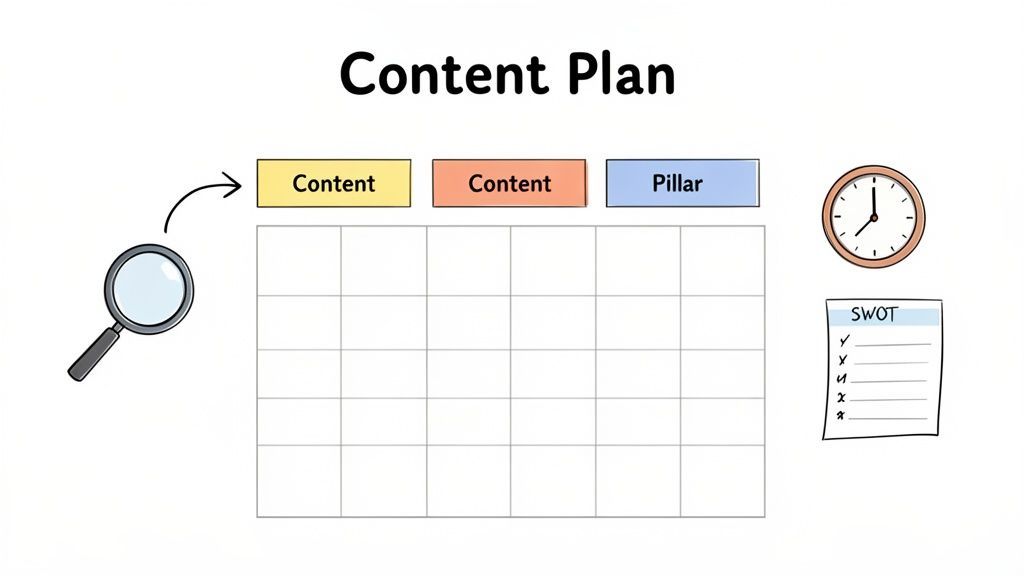
All that data you've gathered is impressive, but insight without action is just trivia. The final, and frankly most important, step is turning those spreadsheets and notes into a tangible plan that actually moves the needle for your brand. This is where you connect the dots and build a real roadmap for your social media content.
The whole point is to move from observer to executor. You've seen what works, what falls flat, and where the gaps are. Now it's time to build a strategy around those discoveries.
A Quick and Dirty SWOT Analysis
A great way to untangle your thoughts is with a simple SWOT framework: Strengths, Weaknesses, Opportunities, and Threats. Forget the stuffy corporate version; this is fast, practical, and based entirely on the social media data you just pulled.
It just forces you to look at your research from four different angles. You won't miss a thing.
- Strengths: What are your competitors absolutely nailing? Maybe their video editing is top-notch, or their brand voice is incredibly consistent. Acknowledge what they've mastered.
- Weaknesses: Where are they dropping the ball? Perhaps they take days to respond to comments, or their content feels way too salesy and lacks personality. These are immediate openings for you.
- Opportunities: Based on their weak spots, what can you do better? If a rival ignores questions in their comments, your opportunity is to become the most responsive, helpful brand in the space.
- Threats: What are they doing that could chip away at your market share? A competitor's sudden success with a new content format is a threat if you don't adapt.
This simple exercise brings so much clarity to what can feel like a mountain of data. It helps you pinpoint exactly where to focus your energy for the biggest impact.
From Insights to Concrete Content Ideas
With your SWOT complete, you can start brainstorming actual content. This is where you translate abstract "opportunities" into real posts, videos, and Stories. You need to draw a straight line from your research to your content calendar.
For example, your analysis showed a competitor is terrible at responding to comments. The opportunity is to showcase your brand's killer customer engagement. This translates into concrete actions, like scheduling weekly Q&A sessions in your Stories or creating posts that actively ask for questions.
Here’s a simple table to help you map your findings directly to what you'll do in a tool like PostFast.
From Insight to Action Plan
| Competitor Insight | Identified Opportunity/Threat | Actionable Step in PostFast |
|---|---|---|
| Competitor gets high engagement on "how-to" carousels. | Opportunity to own the educational content space. | Schedule a series of "how-to" carousels using the visual calendar to establish a new content pillar. |
| A rival's video content uses outdated audio trends. | Opportunity to appear more current and culturally relevant. | Use PostFast to schedule Reels and TikToks featuring trending audio, hitting their optimal posting times. |
| A major competitor posts inconsistently on weekends. | Opportunity to capture audience attention when others are quiet. | Plan and queue a weekend content series using Smart Scheduling to fill the gap and maintain presence. |
This methodical approach makes sure every single piece of content you create is backed by data and serves a purpose. No more posting just for the sake of it; you're now executing a plan designed to win. Our own guide to effective social media optimisation goes even deeper into refining your strategy once this plan is locked in.
Your content calendar should become a direct reflection of your competitive analysis. Every post should be an answer to an opportunity you uncovered.
When you look at a market like Bulgaria, this analysis also means following the money. Social media advertising spend there is projected to hit about US$106 million in 2025. With 4.48 million Facebook users, the largest chunk being 25–34 year-olds, the battle is all about performance marketing for that demographic.
Bulgarian agencies weighing up social media tools will be asking if a platform like PostFast helps them attribute their work to a measurable slice of that spend. You can see the full breakdown of social media advertising revenue in Bulgaria from Statista.
By linking your analysis directly to your content plan, you create a powerful feedback loop. You can test new content pillars, experiment with those posting times you spied on, and measure your results, all within a single, organized workflow.
Frequently Asked Questions
Even with a solid plan, a few questions always pop up when you start digging into what your competitors are doing. It can feel like a lot at first. Here are some straightforward answers to the most common hurdles, designed to get you from wondering to acting.
How Often Should I Be Analyzing the Competition?
There’s no magic number, but a great rhythm is a deep-dive analysis once a quarter, with lighter check-ins every week.
Think of the quarterly review as your time for big-picture strategy. This is when you spot major shifts, see how their big campaigns landed, and get a feel for broader changes in the market.
The weekly check-ins are much quicker. They’re for catching viral trends, noting a rival's post that really took off, and just keeping a pulse on the conversation. This two-speed approach keeps you in the loop without leading to burnout. A visual calendar makes it easy to see your own consistency next to what competitors are doing week-to-week.
What Tools Can I Use for Competitor Analysis?
You can absolutely start by just visiting competitor profiles and tracking what you find in a spreadsheet. It’s free, but it gets incredibly time-consuming once you start tracking more than a couple of rivals. For better efficiency and much deeper insights, a good social media platform is a game-changer.
Tools like PostFast are built to help you schedule and publish your own content, but they also give you the analytics that are half of the competitive analysis equation. When you can track your own performance on a clean dashboard, you have a solid benchmark to measure against what you're seeing from everyone else. For looking outward, there are also dedicated tools that track things like share of voice and top-performing content across an entire industry.
Should I Analyze Competitors Outside My Direct Industry?
Absolutely. In fact, this is one of the best ways to find fresh ideas and break out of the echo chamber that can form in any niche. Look at 'aspirational' brands, companies that are just killing it on social, even if they're in a totally different field.
Analyze how they build community, break down the creative hooks in their videos, and pay attention to their brand voice. You can often adapt their successful formats and strategic plays to your own industry. This is how you get a real edge, because you’re not just recycling the same ideas as everyone else in your space.
By looking outside your immediate circle, you import fresh ideas. A tactic from the fashion world might be the perfect way to make your software brand feel more human and relatable.
My Competitor Is Much Larger. How Can I Realistically Compete?
First off, don't try to beat them at their own game, especially if their game involves a massive budget. Instead, zero in on your unique advantages: agility, authenticity, and niche expertise. A bigger company is almost always slower to react and can come across as corporate and impersonal.
Your analysis should focus on finding their weaknesses.
- Are their customer responses slow and generic? Great. Your opportunity is to be personal and incredibly responsive.
- Is their content super polished and corporate? Be more human. Show the people behind your brand.
- Are they trying to be everything to everyone? Double down on a specific sub-niche they might be overlooking.
Your goal isn't to outspend them; it's to outmaneuver them by being nimbler, more relevant, and more connected to a dedicated slice of the market. That's a game you can definitely win.
Ready to turn these insights into a winning content strategy? PostFast gives you the tools to schedule, analyze, and automate your social media so you can focus on outsmarting the competition, not just outworking them. Start your free 7-day trial today and see the difference.
Related
How to Create a Social Media Content Calendar That Actually Saves You Time
Create a social media content calendar that saves hours weekly. Step-by-step guide to plan, batch, and automate posts across platforms with PostFast.

8 Instagram Bio Tips to Hook New Followers (2026)
Your Instagram bio has 7 seconds to make a first impression. 8 proven tips with examples for creators, bloggers, and businesses.

SaaS Marketing Automation: The Social and Email Stack We Run at PostFast
SaaS marketing automation from our own stack: what we automate on social and in lifecycle email, the event behind each sequence, and the tools by job.
Your Agency Marketing Digital Playbook for 2026
Struggling with agency marketing digital strategy? This playbook offers actionable steps to define your niche, attract clients, and scale your agency's growth.

Claude for Social Media: Skills, Connectors and What It Can Post
How to use Claude for social media: skills that plan and write posts, a connector that publishes to 11 platforms with your approval, and what Claude can do on each.