How Is Twitter Used: A Practical Guide for Brands and Creators
Discover how is twitter used by leading brands for news, marketing, and community building. Get practical tips to boost engagement and growth.
On this page (6)
Twitter, now known as X, is all about what’s happening right now. It’s the world’s digital town square for breaking news, live conversations, and following events as they unfold.
The 6 Primary Ways People Use Twitter (X)
At its heart, Twitter is built for speed and brevity. It’s not the place for perfectly arranged photo albums or long, polished videos. It’s for the immediate, the here and now. This is where trends catch fire, news breaks by the second, and you get a direct, unfiltered channel to your audience.
This live, conversational feel is what sets it apart. It’s not just a megaphone for your brand; it’s a space to listen, chat, and connect. Think of it as a place for:
- Instant Feedback: Float a new idea and see what people think in minutes.
- Customer Support: Jump in to answer questions and solve problems out in the open.
- Community Building: Join real conversations and build genuine relationships with your followers.
The Power of Real-Time Engagement
This is the platform’s main strength. While other networks show you what your friends did yesterday, Twitter shows you what’s happening this very second. That immediacy is a huge opportunity.
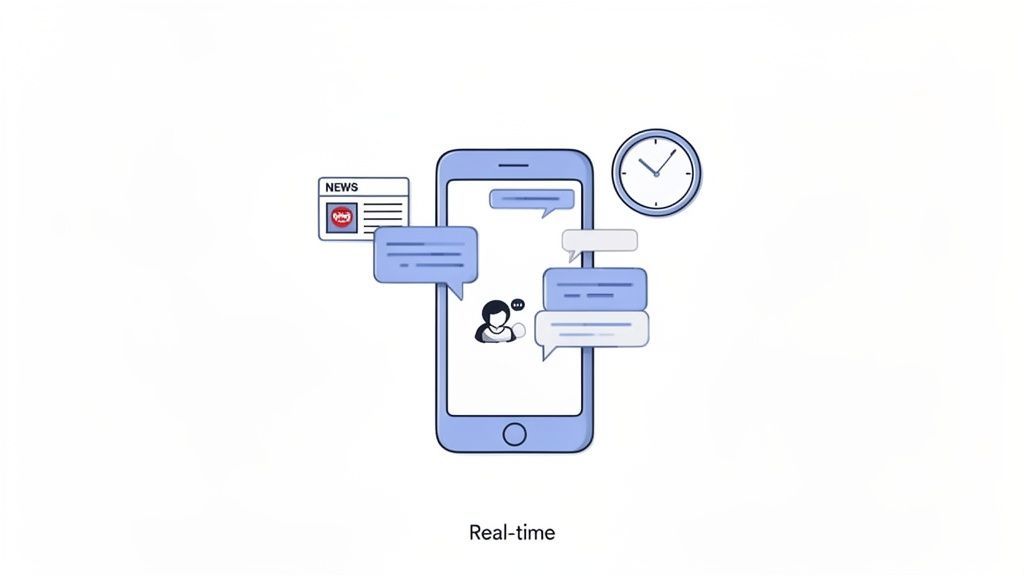
Take the Bulgarian market, for instance. With a user base of over 766,900, businesses there are finding Twitter to be an absolute powerhouse for customer engagement. Why? Because brands often get responses three times faster than on Facebook. That kind of speed is a game-changer, especially for small businesses and agencies using tools like PostFast to manage their replies and keep their content schedules full.
To get the most out of Twitter, you have to lean into its live, conversational nature. Timing matters as much as tone, and our best time to post on X breakdown shows when those conversations actually happen. Once you master this fast-paced environment, you can build a seriously powerful and responsive online presence.
Core Functions of Twitter at a Glance
This table breaks down the main ways Twitter is used, helping you quickly identify where your brand or personal strategy fits in.
| Use Case | Who It's For | Primary Goal |
|---|---|---|
| Personal Broadcasting | Individuals, Creators, Public Figures | Share real-time thoughts, updates, and perspectives. |
| Community Engagement | Brands, Niche Groups, Hobbyists | Foster conversations and build loyal followings. |
| Customer Service | SaaS, E-commerce, Service-Based Businesses | Provide quick, public support and resolve issues. |
| News and Discovery | Journalists, Media Outlets, Curious Users | Disseminate and consume breaking news and trends. |
| Influencer Marketing | Agencies, Marketers, Influencers | Promote products through trusted voices. |
| Campaign Amplification | Non-profits, Brands, Political Campaigns | Drive awareness and participation for initiatives. |
Ultimately, whether you're building a personal brand or running a global campaign, these core functions are the building blocks for a successful strategy on X.
The Building Blocks of a Powerful Twitter Strategy
To really get how Twitter works, you need to see its core features as more than just buttons on a screen. Think of them as tools in your workshop. Each one has a specific job, and learning how to use them together is what separates a forgettable account from one that people actually follow and talk about.
It’s a bit like learning to cook. You start with the basic ingredients. A single tweet is like one ingredient, but a well-planned thread? That's the finished dish.
From Simple Tweets to Engaging Stories
The Tweet is your foundational block. It’s a short, punchy message that goes out to your followers and, potentially, the world. Its biggest strength is its brevity, but that’s also the challenge: saying something meaningful in just a few characters.
A Thread is where you get to stretch your legs. It lets you chain multiple tweets together to tell a longer story, break down a complex idea, or walk people through a tutorial. You can’t just wing a good thread; planning it out beforehand is key to keeping your story clear and your audience hooked from one tweet to the next.
A classic rookie mistake is using Twitter purely as a megaphone. The real magic happens in the back-and-forth. Replying to others, jumping into conversations, and adding your two cents is how you go from just talking at people to being part of the community.
Joining and Creating Conversations
Hashtags are Twitter's filing system. They're basically keywords that categorize your content and make it discoverable for anyone interested in that topic. Slapping a few relevant hashtags on your tweet connects it to much bigger conversations, giving it a shot at being seen by people way outside your immediate circle.
For a more curated experience, you have Lists. These let you create your own custom timelines. You could make a private list to keep an eye on competitors or a public one to spotlight industry leaders you admire. It's a great way to cut through the noise.
Then there’s Spaces, which is all about live audio. Picture a live podcast or a virtual panel discussion where you can chat with your audience in real-time. It's perfect for hosting Q&As or just having a more personal, interactive conversation.
Putting It All Together
Since Twitter is such a major player, you can't just show up without a plan. A solid first step is mastering social media strategy planning, as it’s the foundation for everything else you’ll do. While each of these features is useful alone, they really shine when you combine them. In Bulgaria, for instance, Twitter is a niche but powerful platform, accounting for about one in every 500 social media interactions among the country's 5.84 million internet users.
Keeping all these moving parts in sync takes serious planning. This is where the right tools come in and save your sanity. For example, our guide on Twitter scheduling walks through how you can prep entire threads, schedule tweets with the right hashtags, and keep a consistent presence without being glued to your screen 24/7.
Six Proven Ways to Use Twitter for Growth
Knowing the features is one thing, but the real magic on Twitter happens when you weave them into a focused strategy. While you could approach the platform a million different ways, the most successful accounts tend to lean on a handful of proven playbooks to build their audience and get results.
These aren't just abstract ideas, they're actionable methods for turning your Twitter presence into a genuine asset. Each one serves a different purpose, so you can mix and match to fit your goals. Whether you want to become the go-to expert in your field or build a vibrant community, there's a clear path forward.
Become a Real-Time Information Hub
One of the most powerful ways to grow is to become the trusted source for news and updates in your niche. This isn't about just retweeting, it's about curating and sharing valuable information as it breaks. Think of a financial analyst live-tweeting market shifts or a tech blogger dropping instant updates from a big conference.
The key here is consistency and accuracy. When you reliably deliver timely info, you train your audience to check your feed first. That's how you build real authority and a loyal following that sees you as an indispensable resource, not just another account shouting into the void.
A solid strategy connects all the core Twitter elements, like your individual tweets, threads, and hashtags, so they all work together toward a single goal.
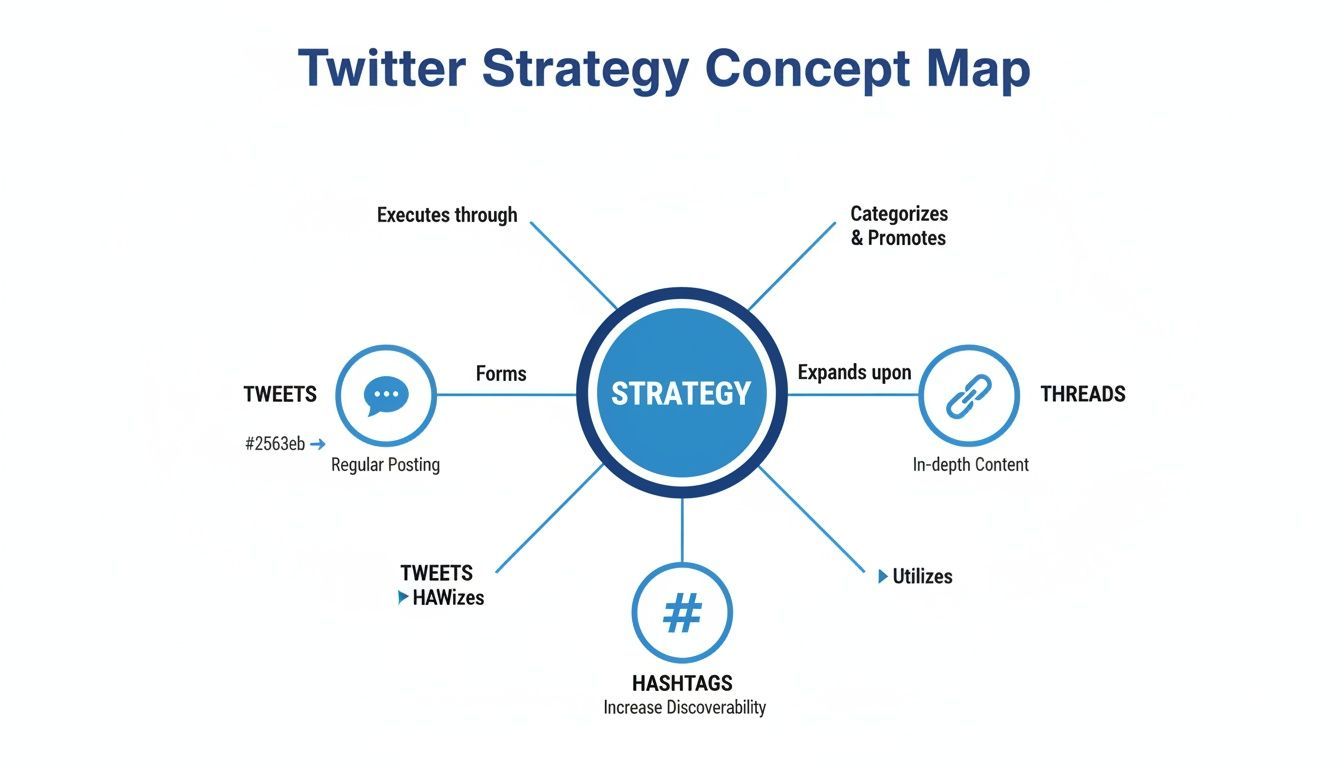
This shows that you need a thoughtful mix of different content formats to really make your strategy work.
Build and Nurture Your Community
Twitter has always been brilliant at fostering genuine connections. Instead of just broadcasting your message out, this strategy is all about sparking conversations. You can do this by asking open-ended questions, running polls, hosting Twitter Spaces, or just taking the time to reply thoughtfully to people who engage with you.
A thriving community is built on interaction, not just content. When people feel heard and valued, they’re far more likely to become dedicated followers and advocates for your brand. This turns a simple follower list into an active, engaged network.
Good community management means listening just as much as you talk. Try setting up searches for keywords related to your industry to find relevant conversations you can jump into. In fact, we put together a complete walkthrough on how to do this in our guide to using Twitter's advanced search features.
Offer Proactive Customer Service
These days, many customers head straight to Twitter for support, and they expect a fast response. Turning your account into a reliable customer service channel is a surprisingly powerful way to build trust. When you solve a problem publicly, it sends a clear message to everyone that you care about your customers and stand behind what you sell.
This approach flips a potentially negative experience into a public win. Brands like airlines and tech companies are masters of this, often using dedicated support accounts to handle questions quickly and efficiently.
Broadcast Your Personal Brand
For creators, consultants, and anyone building a public profile, Twitter is an unmatched platform for sharing your expertise. It gives you a direct line to a global audience, letting you share your unique voice, opinions, and insights without a filter.
Think of it as your own personal stage. You can share behind-the-scenes glimpses of your work, drop quick tips, or comment on industry news. Consistently sharing your perspective is what establishes you as a thought leader and a go-to expert in your field.
The other two major strategies, Influencer Collaboration and Campaign Amplification, build on these foundations. Partnering with established voices lets you tap into their trusted audiences. Likewise, when you launch a product or event, you can use Twitter to generate buzz and drive participation, pushing your message far beyond your own followers. Getting these campaigns organized and scheduled ahead of time with a tool like PostFast ensures everything runs smoothly.
There’s no single "right" way to use Twitter. The best approach boils down to what you’re trying to achieve. A content creator trying to build a name for themselves will use it very differently than a marketing team launching a new product. Nailing your strategy means first getting clear on your goal.
For instance, a solo creator’s main game is building a loyal, engaged audience. Their entire strategy is about sharing personal insights, posting behind-the-scenes stuff, and jumping into niche conversations to become a trusted voice. They’re building a community around who they are and what they know.
A small brand, on the other hand, is probably more focused on the commercial side of things. They’ll likely mix in a bit of customer service, show off their products, and run promotions to drive sales. For them, Twitter is a direct line to building relationships and boosting the bottom line.
For Content Creators
If you’re a creator, your voice is everything. Your goal is to build a community that hangs on your every word because they trust your perspective.
- Share What You Know: Post threads that break down tricky topics in your field. It proves you know your stuff and gives people real value.
- Engage for Real: Don’t just post and run. Reply to comments, ask questions, and get into relevant chats. It shows you’re actually part of the community.
- Let Your Personality Shine: People follow people, not faceless accounts. Don't be afraid to share your opinions and what’s happening behind the scenes.
For Small Brands
For a small business, Twitter is a direct line to your customers for sales, support, and feedback. It’s your chance to punch above your weight by being quick and personal.
The real edge for a small brand on Twitter is speed. You can answer a customer’s question, launch a flash sale, or get feedback on a new idea in minutes. That’s how you build a reputation for being responsive and putting customers first.
Your strategy should be a blend of promotion and genuine conversation. Run polls to see if people are interested in a new product, share photos from happy customers to build trust, and use the platform as a public help desk. That kind of transparency builds an incredible amount of loyalty.
For Marketing Teams and Agencies
Once you scale up to a full marketing team or an agency juggling multiple clients, the game changes. The core ideas of engagement are still there, but now it’s all about efficiency and collaboration. Your focus shifts to running bigger campaigns, digging into performance data, and keeping the brand’s voice consistent everywhere.
For agencies, this gets even trickier. Managing a bunch of client accounts means you need one central place to plan, schedule, and get content approved without a million back-and-forth emails. This is where a platform like PostFast comes in. It lets teams set up simple approval flows and manage different content calendars from one dashboard. You can deliver consistent, high-quality results without getting swamped by administrative chaos. It’s how you turn individual strategies into a smooth, scalable machine.
Measuring What Matters on Twitter
Posting on X without checking your performance is like driving with your eyes closed. You’re moving, sure, but you have no idea if you’re even on the right road. To build a strategy that actually works, you have to look past vanity numbers like follower counts and focus on the metrics that tell you what’s hitting the mark.
These numbers tell a story about your content and your audience. When you track the right data, you can stop guessing and start making informed decisions that fuel real growth. It’s the difference between shouting into the void and starting a meaningful conversation.
Core Metrics for a Healthy Strategy
To really understand how your content is landing, you need to dig into engagement. This goes way deeper than just likes; it’s about how people are actually interacting with what you share.
The goal isn’t just to be seen, but to be remembered and discussed. High engagement means your content is sparking a reaction, and that’s the first step to building a loyal community.
Start by getting a grip on these key performance indicators:
- Engagement Rate: This is the big one. It measures the percentage of people who saw your post and then did something: liked, replied, reposted, or clicked. A high engagement rate is a clear signal that your content is connecting.
- Link Clicks: If your goal is to drive traffic to your website, blog, or shop, this metric is your best friend. It shows you exactly how many people took the action you wanted them to.
- Replies and Conversation Trends: This metric reveals the quality of the conversations you're starting. Are people just dropping quick comments, or are you sparking genuine discussions and building real relationships?
All these metrics give you a clear picture of what’s working, so you can stop guessing and start creating content that consistently performs.
Below is a quick breakdown of the essential metrics you should be tracking to understand your impact on the platform.
Key Twitter Performance Metrics to Track
| Metric | What It Measures | Why It Matters |
|---|---|---|
| Impressions | The total number of times a post has been seen. | It's your top-of-funnel reach. It tells you how widely your content is being distributed. |
| Engagement Rate | The percentage of impressions that result in an interaction (likes, replies, etc.). | This is the clearest indicator of content quality and audience resonance. |
| Link Clicks | The number of clicks on any URL in your post. | Essential for measuring traffic-driving goals and calculating conversion rates. |
| Replies | The number of direct responses to your post. | A strong signal of community-building and whether your content sparks conversation. |
| Profile Visits | The number of times people visited your profile after seeing a post. | Shows if your content is compelling enough to make people want to learn more about you. |
| Follower Growth | The net change in your follower count over a specific period. | Tracks your audience growth and the overall health of your account. |
Tracking these numbers consistently is the only way to know if your strategy is actually moving the needle.
Turning Data into Action
X has its own built-in analytics that offer a solid starting point for finding these numbers. But let’s be honest, digging through different tabs to piece everything together can be a real time-drain, especially if you’re managing more than one account.
This is where a consolidated dashboard becomes a lifesaver. Bringing all your key metrics into one place doesn't just save you time; it helps you spot patterns you might otherwise miss. You can quickly see which topics get the most link clicks or which formats spark the best conversations.
For a deeper look, PostFast’s advanced analytics features show how you can centralize this data to sharpen your strategy. By seeing what works at a glance, you can double down on your best content and stop wasting time on what falls flat.
Common Twitter Mistakes and How to Avoid Them
Getting traction on Twitter often means learning from what doesn't work. I've seen countless accounts with great potential stall out, not because their content is bad, but because they stumble into a few common traps that kill momentum before it even has a chance to build.
Knowing what these pitfalls are is half the battle.
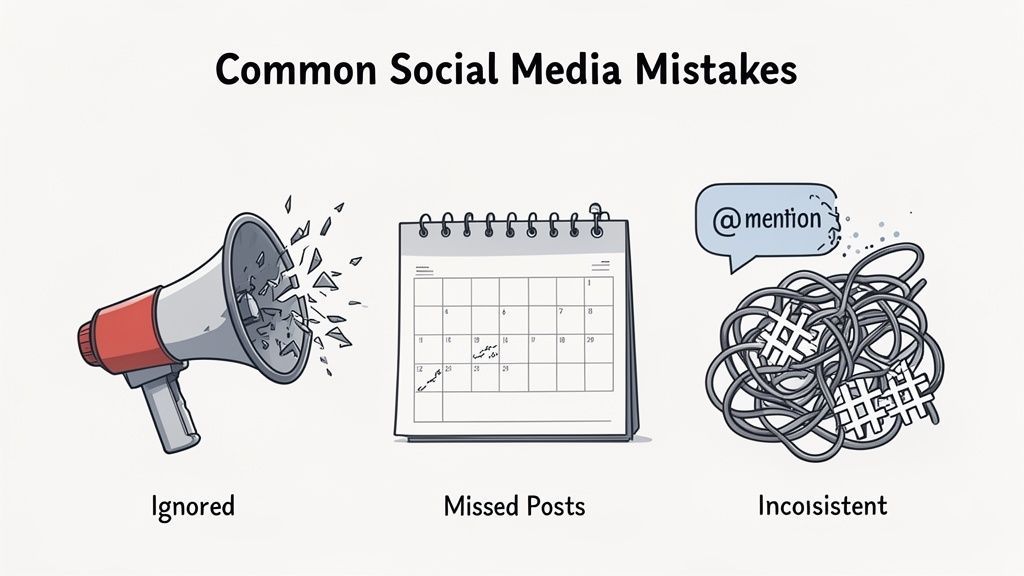
The biggest mistake? An inconsistent posting schedule. When you disappear for days or weeks at a time, you’re basically training your audience to forget you exist. The fix is to plan ahead. A scheduler lets you batch-create your posts and keep up a steady, professional rhythm without being glued to your phone all day.
Another classic error is broadcasting without engaging. Just dropping links and walking away makes your account feel like a robot. Twitter is a conversation, plain and simple. Taking a few minutes to reply to mentions and jump into relevant discussions is what actually builds a community.
Finally, stuffing your posts with irrelevant hashtags or flat-out ignoring your audience will cap your reach. Stick to a few targeted hashtags that make sense for the post, and always make a point to acknowledge comments and messages.
The most successful accounts treat Twitter like a two-way street. They listen just as much as they talk, creating a feedback loop that builds real loyalty and keeps their content sharp. Sidestepping these common mistakes is how you go from just using the platform to truly connecting with it.
Your Top Twitter Questions Answered
Jumping into Twitter can feel like there are a million unwritten rules. Don't worry, there aren't. Here are some quick answers to the questions we hear most often, so you can get your strategy sorted with a bit more confidence.
How often should I be posting?
There’s no magic number here, but consistency is way more important than frequency.
Most brands do well posting anywhere from one to five times a day. The real goal is to share good stuff and actually talk to people. A scheduling tool is a lifesaver for keeping that steady rhythm without having to be glued to your screen.
What’s the secret to getting more followers?
Slow and steady wins the race. The best way to grow your follower count is by being a real, engaged user. Jump into conversations, reply to people with thoughtful comments, and share content that's genuinely helpful.
Also, make sure your profile is filled out properly, it’s your digital handshake. Whatever you do, don't buy followers. They're just empty numbers that kill your credibility.
Think of it like this: building a following is a marathon, not a sprint. Every real interaction you have is a small investment in your community. Just focus on adding value, and people will want to stick around to hear what you have to say next.
Is Twitter actually good for B2B?
Absolutely. It’s one of the best spots online for B2B. You can connect directly with industry leaders, share company news that people actually care about, and drop links to insightful articles.
It's also a fantastic tool for listening. By following industry hashtags, you can join important conversations and even offer quick customer support, which is a great way to build your authority and network with the right people.
Ready to put all this into practice without the extra work? PostFast lets you plan, schedule, and see what's working on Twitter from one simple dashboard. Grab your free 7-day trial and see how easy it is to get your presence growing.
Related
X scheduling with PostFast
Tweets, images, videos, threads

Best Time to Post on X (Twitter) in 2026: A Practical, Data-Informed Guide
The best time to post on X (Twitter) in 2026: day-by-day windows, when 9,339 real scheduled posts actually publish, and how to find your own peak hours.

A Practical Guide to the Twitter Card Validator
Master the Twitter card validator to fix broken link previews on X. This guide shows you how to debug cards, solve common errors, and ensure perfect shares.
Twitter (X) Advanced Search in 2026: Every Operator That Still Works
A practical guide to Twitter (X) Advanced Search in 2026: how to open it, every useful search operator, and copy-paste recipes for brand monitoring, leads, and content ideas.
Social media tools to improve your workflow
A quick guide to the best social media tools. See how social media tools fit your daily workflow without wasting time.

Claude for Social Media: Skills, Connectors and What It Can Post
How to use Claude for social media: skills that plan and write posts, a connector that publishes to 11 platforms with your approval, and what Claude can do on each.