Customer Care Services: Build Loyalty with Exceptional Support
Discover how customer care services drive loyalty with practical strategies, tools, and best practices for exceptional customer experiences.
On this page (7)
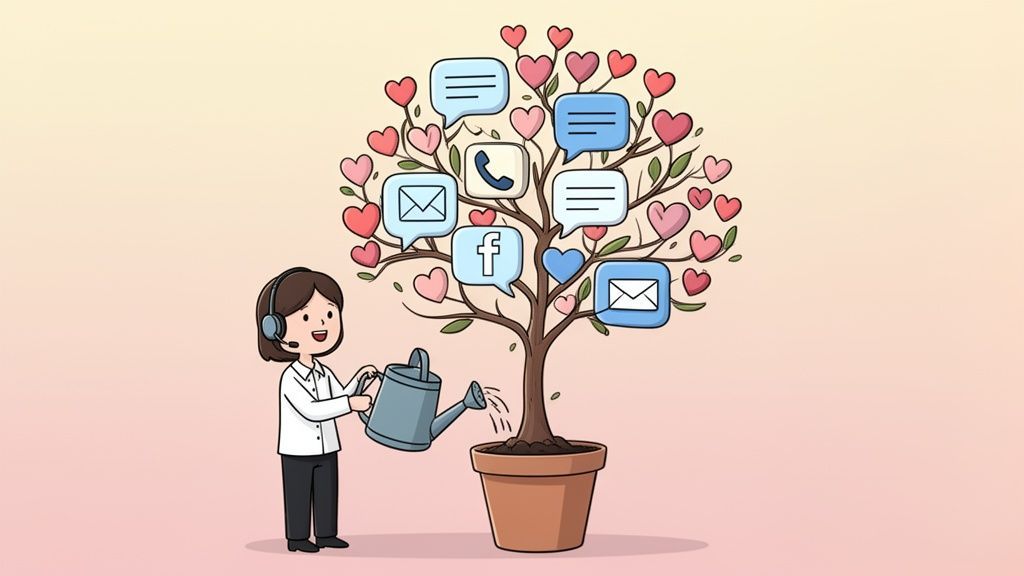
Customer care is all about the long game. It’s not about just closing a ticket or fixing one-off problems; it’s about building a genuine, lasting relationship with your audience. Think of it as the difference between a single transaction and a true partnership.
What Exactly Are Customer Care Services?
Let's use an analogy. Traditional customer service is like calling a mechanic when your car breaks down. You call, they fix the immediate issue, and the interaction is over. Done.
Customer care, on the other hand, is like that trusted local garage. They don't just fix the problem; they remind you about your next oil change, ask how that family road trip went, and give you a heads-up that your tires are looking a bit worn. One is a reaction; the other is a relationship.
This proactive approach is what separates good support from great care. It’s about forging an emotional connection that turns a simple purchase into a loyal commitment. When a brand remembers your past issues or preferences, it shows they’re actually listening. It makes you feel like more than just another ticket number.
Moving Beyond Simple Fixes
The whole philosophy of customer care services is built on empathy and looking ahead. It’s not just about what the customer is asking for right now, but what they might need next. That's the mindset that makes you stand out.
The shift is moving from measuring operational outcomes focused on efficiency to measuring success by experience and outcome-based KPIs like resolution quality and customer satisfaction.
Exceptional care isn't one thing; it's a few key elements working together:
- Anticipating Needs: Using data and past conversations to predict future questions or challenges before the customer even thinks of them.
- Personalizing Interactions: Using a customer's name, referencing their history with your brand—small things that make them feel seen and valued.
- Building Community: Creating spaces where customers can connect with each other and with you, fostering a real sense of belonging.
- Seeking Feedback: Actively asking for input and actually using it to improve the entire customer journey, not just a single touchpoint.
Why This Mindset Matters Today
In a crowded market, anyone can match your product features or your pricing. The one thing that truly sets you apart is the experience you deliver. A strong customer care strategy becomes your moat, a powerful differentiator that builds loyalty that competitors can't just copy.
It's the reason someone chooses your brand again and again, even when cheaper alternatives pop up. To really get a handle on this, it helps to understand the nuances between terms like customer support vs customer service. This knowledge clarifies how "care" wraps around both but ultimately aims for a much deeper, more human connection.
The Key Channels for Delivering Great Customer Care
Great customer care is all about meeting people where they are. Today, that means being available across a whole mix of channels, each with its own rhythm and expectations. Just having a phone number and an email address doesn't cut it anymore. Brands need to be ready to engage everywhere, from fast-paced social media threads to detailed online forums.
The real magic isn't just being present on every platform, but weaving them together into a seamless experience. Imagine a customer starts a conversation on X (formerly Twitter) about a delivery issue. If they need to switch to email for privacy, they shouldn't have to repeat their story from scratch. That smooth handoff is the bedrock of a modern customer care strategy.
This journey—from a simple, one-off interaction to a lasting partnership built on trust—is what it's all about.
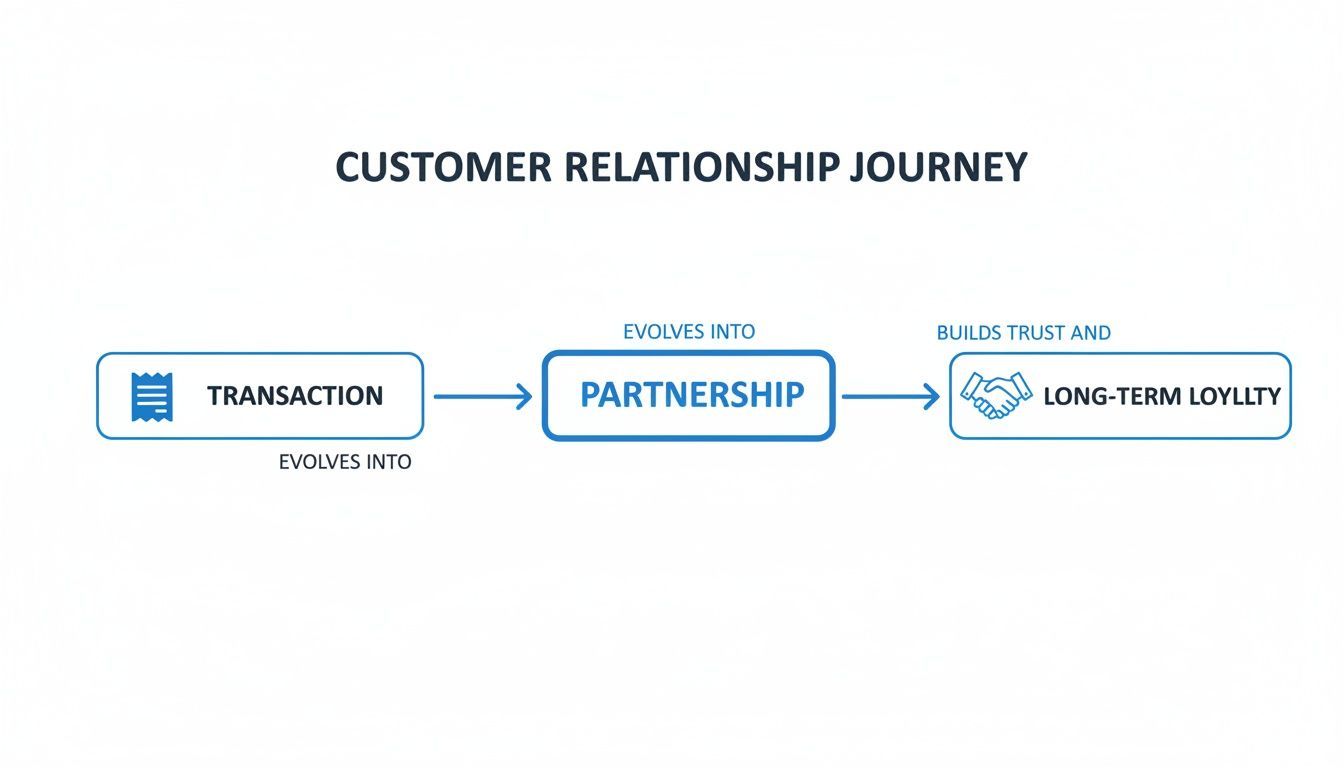
As you can see, the goal is to guide that relationship past the initial transaction and turn it into something deeper: a genuine, collaborative partnership.
Comparing Your Channel Options
The channels you choose will literally shape your customer's perception of your brand. Each one serves a different purpose, and knowing their strengths helps you build a smarter communication strategy. The key is to match the channel to the customer's need in that specific moment.
Here’s a quick comparison of the most common customer care channels you'll be juggling today.
Customer Care Channel Comparison
| Channel | Best For | Expected Response Time | Key Benefit |
|---|---|---|---|
| Complex, non-urgent issues; detailed documentation. | 24-48 hours | Creates a written record; allows for thorough, thoughtful replies. | |
| Phone | Urgent, sensitive, or complicated problems. | Immediate | Direct human connection; ideal for resolving high-stakes issues. |
| Live Chat | Quick questions during browsing or purchase. | Under 1 minute | Real-time help that doesn't interrupt the user's flow. |
| Social Media | Public praise, quick questions, and visible problem-solving. | Under 1 hour | High visibility; turns good service into public social proof. |
| Community Forum | Peer-to-peer support and technical deep dives. | Varies | Builds a self-sustaining community and empowers brand advocates. |
Choosing the right mix comes down to understanding your audience and the types of conversations they need to have with you. A balanced approach ensures no one is left behind.
The Classics: Phone and Email
Phone and email are the reliable workhorses of customer care. They're perfect for complex or sensitive issues that need detailed explanations or a bit of back-and-forth. While they might feel slower, they offer a sense of formality and thoroughness that many customers still appreciate for important matters.
The Instants: Live Chat and Chatbots
For immediate, on-the-spot help, nothing beats live chat. It delivers the instant gratification modern consumers expect, making it perfect for quick questions during a purchase or while they're browsing your site. Chatbots can handle the first line of defense, answering common questions 24/7 and freeing up your human agents for the trickier problems.
This shift is happening everywhere. In Bulgaria, the Call Centers industry, a core part of customer care, has been growing at a rate of 12.9% annually from 2020 to 2025. This isn't just about more phone calls; it's driven by businesses moving to digital options like online chat, which is now a massive channel for customer engagement. You can dig into more of this industry data over at ibisworld.com.
The Public Square: Social Media and Communities
Social media completely changed the game. It’s a public stage where your interactions are visible to everyone, turning a single support request into a powerful branding moment.
A conversation in a direct message or a public comment thread isn’t just about solving one person’s problem. It’s about showing your entire audience that you listen, you care, and you’re on top of it.
Managing these conversations well is non-negotiable. Platforms like Instagram, Facebook, and X demand quick, empathetic responses. A public complaint handled with grace can win you more fans than a polished marketing campaign. This is where a unified dashboard becomes a lifesaver, letting your team see every mention and message in one place so nothing slips through the cracks. For a step-by-step guide, check out our article on how to add social accounts in PostFast.
Finally, don't overlook community forums and dedicated groups. These spaces are goldmines for peer-to-peer support. Your role here is less about direct intervention and more about being a facilitator, empowering your most passionate users to help others. By nurturing these communities, you not only ease your support load but also cultivate a loyal tribe of brand advocates who feel a real sense of ownership.
Essential Practices for High-Performing Teams
Knowing the theory is one thing, but putting it into practice is what separates good customer care from the truly great stuff. It all comes down to giving your team practical, repeatable strategies that create positive experiences, time and time again. This isn't about fluffy advice; it's about building a solid framework your team can lean on every single day.
That framework starts with two fundamental skills: active listening and empathetic communication. Active listening is more than just hearing words, it’s about tuning into the context, the emotion, and the unspoken needs behind what a customer is saying. It’s the difference between hearing a complaint and truly understanding the frustration behind it.

When your team really listens, empathetic communication follows naturally. It’s about responding in a way that makes the customer feel heard and shows you’re on their side. Nail these two, and you turn a potentially negative moment into a chance to build a stronger relationship.
Building Reliable Workflows
Consistency is everything in customer care. Without clear, defined workflows, even your best people will eventually stumble. Two of the most critical systems to lock down are your escalation paths and your shared knowledge base.
An escalation path is just a clear, documented process for what to do when a frontline agent can't solve a problem alone. It maps out exactly who gets the issue next and why. This simple process stops customers from getting bounced around and makes sure the problem lands with someone who can actually fix it, fast.
A shared knowledge base is your team's single source of truth. Think of it as a central library filled with product info, troubleshooting guides, and approved answers to common questions. It’s the key to making sure every customer gets the same accurate information, no matter who they talk to.
A well-organized knowledge base doesn’t just speed up response times. It empowers your team to solve problems with confidence, which directly improves both employee morale and customer satisfaction.
These systems provide the structure your team needs to perform at their best, especially when things get chaotic. They take the guesswork out of the equation and let your agents focus on what they do best: helping people.
Mastering Social Media Care
Social media is where modern customer care is won or lost. Because every interaction happens out in the open, each reply is a live demonstration of your brand's values. A thoughtful response can win over a crowd of onlookers, but one wrong move can spiral into a PR headache.
The trick is to have a clear game plan. Here’s a simple but powerful workflow for managing public conversations:
- Acknowledge Publicly: Always jump on public comments or mentions quickly and with empathy. A simple, "We're sorry you're running into this, and we're here to help" immediately shows you're paying attention.
- Transition to Private: For anything that needs personal info or detailed troubleshooting, guide the conversation to a private channel like DMs or email. This protects the customer's privacy and keeps the clutter out of the public thread.
- Close the Loop (If Appropriate): Once you've sorted things out privately, you can pop back to the original public comment with an update like, "Glad we could get this sorted for you in DMs!" This shows everyone you follow through.
Trying to manage this without the right tools is a recipe for disaster. When your team can see all their mentions, comments, and DMs in one unified inbox, it's so much easier to stay on top of everything. For instance, using a solid content manager assistant ensures no public query ever falls through the cracks, turning your social channels into a powerful tool for building trust. This organized approach is how you manage public-facing customer care with poise and precision.
Measuring What Truly Matters in Customer Care
You can't improve what you don't measure. It’s an old saying, but in customer care, it’s the absolute truth. Without the right data, you’re just guessing at what makes your customers happy and what sends them running.
The trick is to look past the simple efficiency numbers and start tracking the metrics that actually tell you about the health of your customer relationships. These aren’t just figures on a spreadsheet; they're the voice of your customer, translated into data. They show you exactly where your team is shining and where you have a chance to build even better experiences.
The Big Three Customer Care Metrics
While you could track dozens of things, there are three core metrics that consistently paint the clearest picture of your customer's experience. Think of these as the foundation of your entire measurement strategy.
-
Customer Satisfaction (CSAT): This is the most direct way to check for happiness. Usually, it's a simple question asked right after an interaction, like, "How satisfied were you with your experience today?" CSAT gives you immediate feedback on a specific moment, helping you see which channels or agents are knocking it out of the park.
-
Net Promoter Score (NPS): This one is all about long-term loyalty. It asks that famous question, "On a scale of 0 to 10, how likely are you to recommend our brand to a friend or colleague?" The answers sort your customers into Promoters, Passives, and Detractors, giving you a bird's-eye view of how people really feel about your brand.
-
Customer Effort Score (CES): CES measures how easy you make it for customers to get help. After they talk to you, you ask something like, "How much effort did you personally have to put in to handle your request?" A low-effort experience is a massive predictor of loyalty. In fact, studies show that 94% of customers who have a low-effort interaction will buy from that company again.
By focusing on making things effortless, you are directly investing in keeping your customers. People stick with brands that respect their time and don't make them jump through hoops.
Nailing these three gives you a balanced perspective. CSAT tells you about the now, CES reveals how easy the process was, and NPS predicts future growth. If you want to go deeper, this guide on the essential metrics of customer service is a great next step.
Beyond Surveys Crucial Operational Metrics
Customer feedback is gold, but you also need to keep an eye on your team's performance to make sure things are running smoothly behind the scenes. These operational metrics are just as critical for delivering a consistently great experience.
One of the most important is First Response Time (FRT). This simply measures how long a customer waits for that first reply. On social media, where everyone expects an instant answer, a quick FRT is non-negotiable. A speedy, empathetic acknowledgement shows customers you're listening, even if a full solution takes a little more time.
Then there’s Average Handle Time (AHT), which is the total time an interaction takes from start to finish. A lower AHT can be good, but never at the expense of a proper resolution. The goal here is efficiency, not just getting people off the line. Looking at AHT alongside CSAT scores gives you a much better sense of your team's real effectiveness.
Keeping track of all this, especially across a dozen social platforms, really requires a single, centralized view. With the right tools, you can monitor response times and team performance all in one place, making sure no customer question ever falls through the cracks. To see what that looks like in action, you can learn more about PostFast's analytics features and see how a unified dashboard can make data-driven decisions much simpler.
Choosing the Right Tools for Your Team
Great customer care at scale isn't about working harder; it's about working smarter. Your team's passion and empathy are the engine, but the right technology is the fuel that lets them actually get somewhere. Without good tools, even the most dedicated team will get bogged down by the sheer volume of modern customer conversations.
The goal here isn't just to buy software. It's about building a tech stack that gets rid of friction, automates the soul-crushing repetitive tasks, and gives your team one clear view of every single customer interaction. When your tools play nicely together, your team can stop fighting with logistics and start doing what they do best: building relationships.
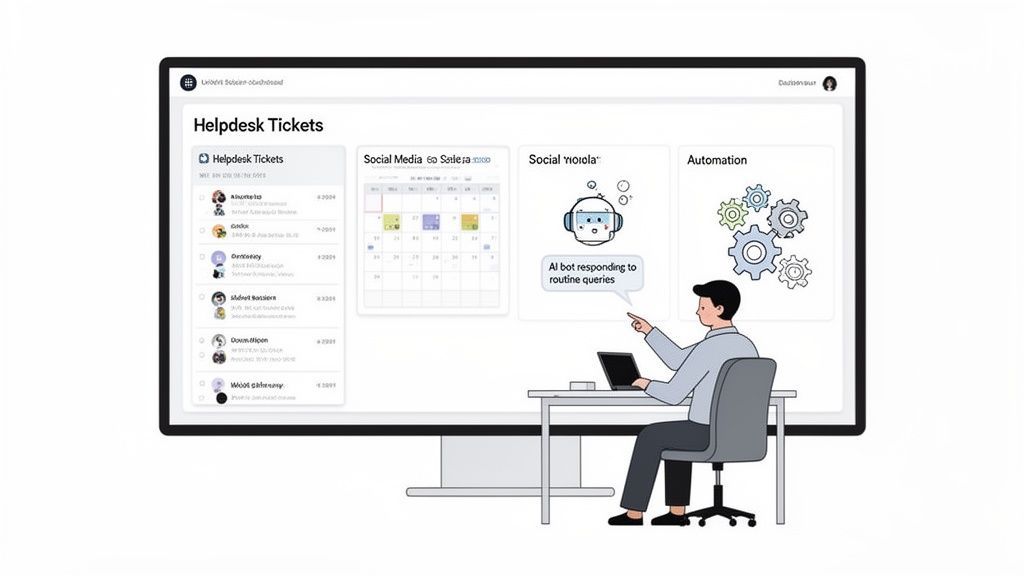
This approach creates a calmer, more organized environment where agents feel empowered, not buried.
Helpdesks and CRMs: The Foundation
At the heart of any serious customer care operation, you'll find two systems: a helpdesk and a Customer Relationship Management (CRM) platform. Think of the helpdesk as the central command center for every incoming query. It takes all the tickets from email, chat, and social media and lines them up in one manageable queue.
A CRM, on the other hand, is your company's memory. It stores every single conversation, purchase, and bit of feedback you've ever had with a customer. When you connect your helpdesk to your CRM, your agents get the full picture. They can instantly see a customer's entire history, letting them provide sharp, personalized support without making people repeat their life story.
This combination is the absolute bedrock for delivering consistent, quality customer care.
Automation and AI: The Efficiency Multipliers
Once that foundation is solid, you can start layering on smart automation. This is where you make huge gains, freeing up your team for the complex, human conversations that actually build loyalty.
AI-powered chatbots, for example, can handle simple, repetitive questions 24/7. They can answer "Where is my order?" or "What are your opening hours?" without needing any human input. This simple move can deflect a huge chunk of your inbound tickets, letting your team focus on issues that need real empathy and critical thinking.
AI should be driven by strategy, not by the fear of missing out. Use it to solve real customer problems, don't just add it because it's a shiny new toy.
Research shows that 35% of organizations plan to automate over 60% of inbound inquiries by 2028. This isn't about replacing people; it's about creating a "hybrid workforce." AI handles the routine, and people handle the relationships. This frees up your most valuable asset, your team's time, to focus on work that really matters.
Social Media Management: The Public-Facing Hub
Today, a massive slice of customer care happens out in the open on social media. A public complaint or a glowing review can reach thousands of people in minutes. You absolutely have to manage these conversations well, and trying to do it by hopping between different apps is a surefire way to miss messages and look slow.
This is where a unified social media management tool becomes non-negotiable. A platform like PostFast pulls all your social conversations—comments, mentions, and DMs from every platform—into a single inbox. It gives your team a complete command center for public-facing care, ensuring nothing gets lost in the noise.
With a unified dashboard, your team can:
- Respond Faster: See every message in one place without logging in and out of different accounts.
- Work Together: Assign conversations to the right person and leave internal notes so everyone has the context they need.
- Keep a Consistent Voice: Make sure every public reply aligns with your brand's tone.
By bringing social scheduling, publishing, and engagement under one roof, you create an organized base of operations for your brand's public presence. Your team can manage conversations with poise and efficiency, turning every public interaction into a chance to show you care.
Building Your Customer Care Strategy from the Ground Up
A real plan for customer care isn't a one-and-done task; it’s about building a system that lasts. Whether you're a solo creator building a community or an agency juggling clients, a clear strategy makes sure every single interaction feels true to your brand. It’s the blueprint that guides your team, defines success, and shapes how your audience sees you.
First things first: you need to nail down your brand's voice and tone. How do you want to sound? Helpful and professional? Witty and informal? Whatever you choose, it needs to be consistent everywhere, from a private email reply to a public comment on social media.
That consistency is what builds trust. People start to recognize your personality, which makes your interactions feel genuine, not like they're talking to a faceless corporation. A clear voice acts as a North Star for your entire team.
Setting Meaningful and Achievable Goals
Once your voice is sorted, you need to set clear, measurable goals for your customer care. These goals give your strategy a point and let you see if you're actually getting better over time. Don't just aim to "improve"; get specific.
Your objectives should tie directly back to the metrics we talked about earlier. Here are a few practical examples to get you started:
- Improve First Response Time (FRT): Aim to cut your average FRT on social media from two hours down to under one hour within the next quarter.
- Increase Customer Satisfaction (CSAT): Set a target to lift your average CSAT score from 85% to 90% by the end of the year through focused team training.
- Boost Team Efficiency: Roll out a new knowledge base and aim to slash the average time it takes to solve common issues by 15%.
These kinds of concrete goals give your team something real to work towards. They turn a fuzzy mission into a series of achievable steps.
Equipping Your Team for Success
Your strategy is only as good as the people bringing it to life. Investing in your team's training and tools isn't optional if you want to deliver outstanding care. This goes way beyond a simple welcome packet; it’s about giving them continuous support.
Set up regular training sessions that cover both hard and soft skills. Think product knowledge refreshers, practice runs on de-escalation techniques, and workshops on how to keep the brand's voice consistent, even under pressure. Giving your team confidence is everything.
The goal of a great customer care strategy isn't just to solve problems. It's to make customers feel so well-supported that they become your biggest fans. It's a commitment that pays off in loyalty and reputation.
Of course, even the best team can't keep up with modern communication without the right tech. A unified platform is a must for managing the flood of conversations, especially on social media. When your team can see all their mentions, comments, and DMs in one spot, they can act faster and more effectively. This is exactly where a tool like PostFast becomes a game-changer, creating an organized command center for every public interaction.
This structured approach—defining your voice, setting clear goals, and empowering your team—gives you a framework you can scale. It ensures your customer care grows with you, reinforcing that top-notch support is an ongoing commitment, not a finished project.
Frequently Asked Questions
Let's clear up a few common questions about customer care. Here are some quick answers to help you lock in the key ideas and handle the practical side of things.
What’s the Real Difference Between Customer Service and Customer Care?
Think of it like this: customer service is reactive. It’s about solving a specific problem right now, like fixing a billing error or handling a return. It's often a single, transactional moment designed to close a ticket.
Customer care, on the other hand, is proactive and plays the long game. It's about building a genuine relationship by anticipating what your customers need and creating positive feelings throughout their entire time with your brand. You’re not just closing a ticket; you’re building a partnership.
How Can a Small Business Actually Provide Excellent Customer Care?
Small businesses have a secret weapon: they can be incredibly personal. You don't need a massive team to create memorable moments. The key is to focus on genuine interactions and use smart, efficient tools. A unified social media management platform, for example, lets you handle every question from one organized inbox.
Small businesses don't need huge budgets to deliver amazing care. Their biggest advantage is being nimble enough to offer a real, human touch—something massive corporations often struggle with.
Zero in on the channels where your customers hang out the most. Create a simple FAQ page to handle the common stuff, and give your team the freedom to solve problems with real empathy. That personal touch, delivered consistently, makes all the difference.
Why Is Social Media So Important for Customer Care?
Because social media is a public stage. A single conversation on Instagram or X isn't just between you and one customer; it can be seen by thousands of potential ones.
When you provide great care out in the open, you’re not just solving one person’s problem. You’re putting on a powerful, public demonstration of your brand’s values. Great social media care builds your reputation, creates a community around your brand, and turns happy customers into your loudest cheerleaders.
Ready to manage your social media conversations with ease and show your customers you really care? PostFast brings all your comments, mentions, and DMs into one simple inbox, helping you respond faster and build stronger relationships. Start your free trial at https://postfa.st.
Related articles

Best Time to Post on Social Media in 2026: 61,008 Posts Scored Against Their Own Normal
61,008 posts with clean metrics, each scored against its account's normal: Instagram 3 PM local, Facebook 3 to 5 PM, YouTube 1 PM or evenings, TikTok flat.

PostFast MCP Server for Claude, ChatGPT and Cursor: Launch Notes and Changelog (2026)
The launch note for PostFast's MCP server: npm release March 2026, ChatGPT and Claude connectors June 2026, inbox tools August 2026. Setup, tools and changelog.

Can You Schedule Posts on Bluesky? How to Schedule Bluesky Posts in 2026
Yes, with a scheduling tool: Bluesky's own app has no scheduler. What Bluesky offers, the 300-grapheme and media limits, and how to schedule with PostFast.

Can You Schedule Posts on LinkedIn? How to Schedule LinkedIn Posts for Profiles and Pages in 2026
Yes. LinkedIn schedules posts 10 minutes to 3 months ahead (1 hour on Pages). Desktop, mobile, and Page steps, plus where PostFast goes further.

How to Schedule Pinterest Pins in 2026: Pinterest's Scheduler vs PostFast, Step by Step
Two ways to schedule Pinterest Pins: Pinterest's own scheduler (30 days ahead, 10 Pins queued) and PostFast for image, video, and multi-image Pins from desktop.

Best Social Media Schedulers in 2026: 11 Tools Compared on Price, Platforms, and Automation
Eleven social media schedulers compared on September 2026 pricing, platforms, auto-publishing, and API or MCP automation, using each vendor's own pricing page.