Your Agency Marketing Digital Playbook for 2026
Struggling with agency marketing digital strategy? This playbook offers actionable steps to define your niche, attract clients, and scale your agency's growth.
On this page (6)
Great agency marketing isn’t about luck. It's about being deliberate. It means stop being a generalist who takes any project and becoming the go-to specialist for a very specific type of client. This is the work that separates the agencies that struggle from the ones that scale.
Build Your Foundation for Sustainable Agency Growth
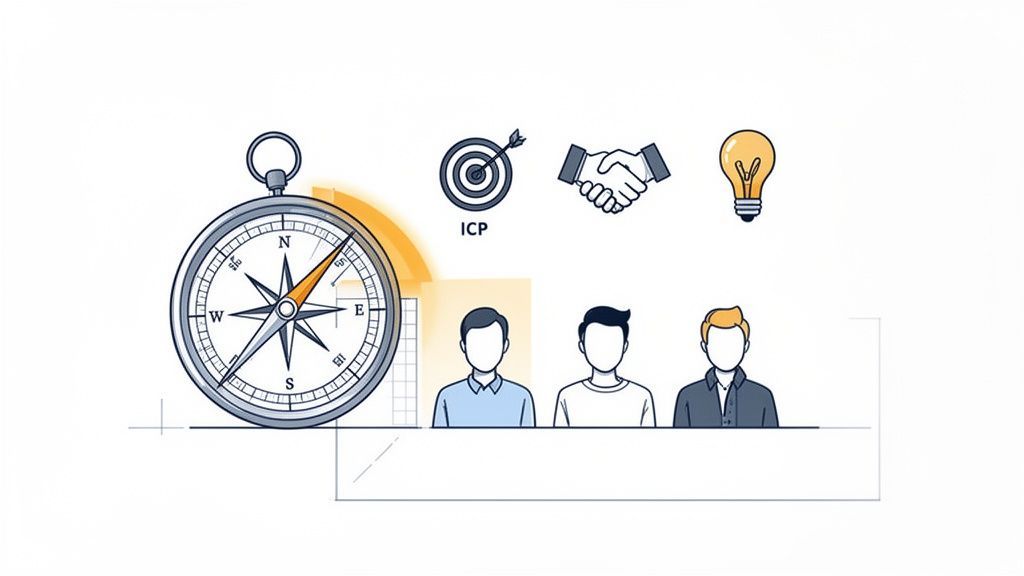
Before you run a single ad for your own agency, you need solid answers to two questions: Who do we serve, and what problem do we solve better than anyone else?
Without that clarity, your marketing will feel scattered. You'll attract low-quality leads that burn through your team's time and energy, and you'll always feel like you're starting from scratch.
From Generalist to Specialist
Pivoting from a "we do everything" agency to a specialist can feel like you're leaving money on the table. Trust me, you're not. It’s the single most powerful move you can make.
Specialization lets you build deep expertise, which means you can refine your services and charge higher prices. Your marketing becomes dead simple because you know exactly who you’re talking to and what keeps them up at night.
Consider niching down by:
- Industry: Focus on a single vertical, like B2B SaaS, healthcare, or e-commerce.
- Service: Master one high-value service, like technical SEO, LinkedIn marketing, or conversion rate optimization.
- Platform: Become the undisputed expert for a platform like TikTok or Shopify.
Find the sweet spot where your team's skills, market demand, and what clients will pay a premium for all overlap. This is the core of any modern agency marketing digital strategy.
Your niche isn't just what you do; it's who you do it for. The more specific your audience, the more powerful your message. This clarity simplifies every marketing decision you make, from the content you create to the channels you use.
Crafting Your Ideal Client Profile
Once you’ve picked your niche, it’s time to define your Ideal Client Profile (ICP). Think of this as a detailed spec sheet for the perfect client. It goes way beyond simple demographics.
Your ICP should get into the operational, financial, and even cultural details of the businesses you want to attract. It acts as a filter, helping you qualify leads in minutes and say no to the bad-fit projects that kill morale and profitability.
For example, an ICP might specify companies with a certain annual revenue, a marketing team of a particular size, or those facing a business challenge you are perfectly built to solve.
The demand for specialized agencies is growing. In Bulgaria, for instance, the advertising agencies market is on track to hit €965.5 million in 2026, with a steady 4.0% CAGR from 2020 to 2025. This tells us one thing: clients are looking for experts.
For agencies juggling multiple clients in a hot market, using tools to automate social media scheduling is no longer a "nice to have," it's essential for staying efficient. You can find more details in the full research about digital trends in Bulgaria.
Alright, you’ve nailed your positioning. Now it’s time to build the machine that brings those ideal clients to your door.
Build a Powerful Omnichannel Marketing Engine
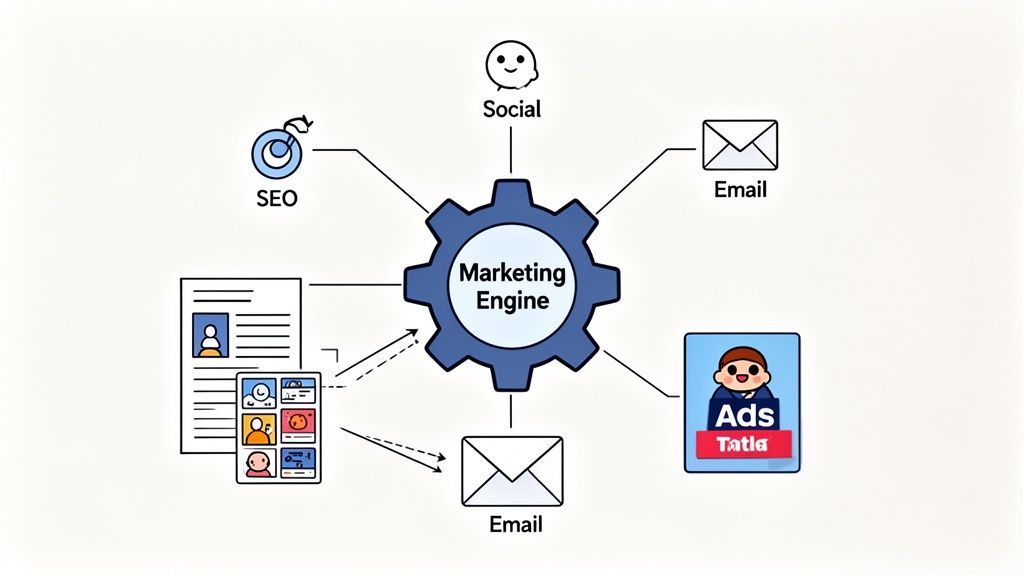
Effective agency marketing digital work isn’t about randomly trying different tactics and seeing what sticks. It's about building an integrated engine where every part works together, amplifying the results of the others.
Forget about siloed channels. We're building a unified system where your content, SEO, social media, and email marketing guide prospects smoothly from their first Google search right to a signed contract.
Start with a Content-First SEO Strategy
For an agency, SEO is not about ranking for vanity terms. It’s about showing up when businesses are actively looking for the exact solutions you offer. This all starts with a content-first approach, where you create genuinely useful resources that solve your ideal client's biggest problems.
Stop writing blog posts like "The Importance of Digital Marketing." It’s generic noise.
Instead, create a super-detailed guide on something like "How MedSpas Can Use Local SEO to Double Their Bookings." The first gets ignored; the second is a magnet for your perfect client.
Your aim is to build a library of pillar content. Think long-form articles, in-depth case studies, or original research that cements your authority on a core topic. These pillars become the heart of your marketing engine, pulling in organic search traffic and giving you fuel for all your other channels. It's an entity-based approach that signals to Google that you're the real deal in your niche.
Don't just make content; build a resource hub. Every single piece you publish needs a job to do, whether it’s attracting new visitors via search or nurturing leads by proving you know your stuff.
Activate Your Social Media Presence
Your social media plan should plug directly into your content and business goals. Don’t burn energy trying to be everywhere. Just be on the channels where your ideal clients actually hang out.
If you’re targeting B2B tech leaders, LinkedIn is your playground. Serving direct-to-consumer brands? Instagram and TikTok are probably better bets.
The real magic of social for agencies lies in distributing your amazing content and building the personal authority of your team. Each piece of pillar content you produce can be sliced and diced into dozens of smaller social posts.
- Pull key stats from a case study and turn them into a sharp infographic for Instagram.
- Film a quick video for TikTok breaking down one key idea from a long-form guide.
- Share the main takeaways on LinkedIn and start a conversation, tagging other experts in your field.
This strategy makes your content work much harder and keeps your agency top-of-mind. When you consistently share valuable insights, you stop being just another agency and become a trusted authority. For a deeper look at the mechanics, see our guide on how to schedule a social media post to multiple platforms.
Integrate Paid Ads and Email Nurturing
Organic is your foundation, but paid advertising is the accelerator. It lets you get in front of your ideal client profile with laser precision.
Use paid ads to amplify your best-performing content, not just for cold prospecting. Boost your in-depth guides and case studies to hyper-targeted audiences on platforms like LinkedIn or Facebook.
Once someone downloads a resource or joins your newsletter, your email marketing takes over. This is where the real relationship building happens. Please, don't just bombard them with sales pitches.
Your email sequence should keep delivering value. Send them other relevant articles, invite them to a webinar, or share a client success story that speaks directly to their challenges. This builds trust and keeps your agency at the front of their mind until they're ready to talk business. Each channel feeds the next, creating a powerful, cohesive system that drives real, sustainable growth.
Use Social Media to Win High-Value Clients
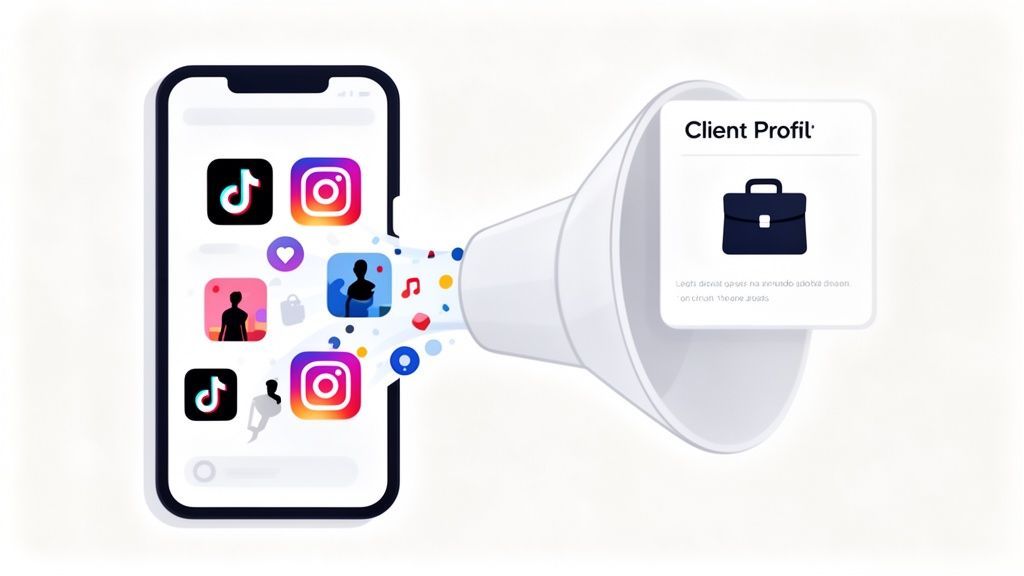
For agencies, social media has moved far beyond a simple brand awareness checkbox. It's now a serious engine for generating business directly. The trick is to stop chasing vanity metrics and start creating content that genuinely showcases your expertise and pulls in qualified inquiries from your ideal clients.
This all starts with choosing your platforms wisely. Instead of stretching your team thin trying to be everywhere, focus your agency marketing digital efforts on the high-growth networks where your target clients actually spend their time.
Look Past Vanity Metrics on Instagram and TikTok
Platforms like Instagram and TikTok aren't just for entertainment anymore; they are powerful channels for client acquisition. The growth numbers alone tell a powerful story. In Bulgaria, both platforms have become essential for business. Between October 2024 and October 2025, Instagram’s ad reach swelled by 100,000 users (+5.4 percent).
Meanwhile, TikTok’s potential ad reach exploded by 463,000 users (+21.4 percent). This makes them incredibly potent advertising channels, especially since smartphones drove over 55% of all e-commerce transactions in 2025. You can dig into more of these digital trends in Bulgaria on DataReportal.com.
But your strategy for each needs to be different. A viral TikTok might get views, but an insightful Instagram carousel can establish your agency as an authority and bring in serious leads.
-
TikTok: Use short-form video to reveal your agency's personality and break down complex topics into quick, digestible clips. Think "day-in-the-life" shorts, quick explainers on marketing jargon, or reactions to industry news. The goal is authenticity and education.
-
Instagram: Lean on carousels and Reels to build out mini-guides and visual case studies. Break down a successful client campaign, share a "how-to" for a specific task, or offer a checklist for your niche. This content has a longer shelf life and proves your strategic depth.
The idea is to create content that solves a real problem or teaches something valuable, turning passive scrollers into prospects who see you as an expert.
Turn Social Authority Into a Sales Pipeline
Building authority is just the first part. The next is converting that authority into actual leads. Think of your social media profiles not just as content galleries, but as gateways into your sales funnel.
Your call to action (CTA) must be crystal clear and consistent everywhere. Don't just say "visit our website." Get specific.
- "Download our free guide to local SEO for dentists."
- "Watch our case study on growing a D2C brand by 300%."
- "Book a free 15-minute strategy call with our team."
Every single piece of content should guide your audience toward a specific next step. And while Instagram and TikTok are powerful, don't sleep on professional networks. For a full breakdown on building your pipeline on other key platforms, check out our complete guide to succeeding on LinkedIn in 2026.
The goal of your social media isn't to be popular; it's to be seen as indispensable by your ideal clients. Every post should be a piece of evidence supporting the idea that you are the best agency to solve their specific problem.
Maintain a High-Quality Presence Without Burning Out
The biggest hurdle for any agency is maintaining a consistent, high-quality social media feed while juggling demanding client work. This is where systemizing your process becomes non-negotiable. Burnout is what happens when your team gets stuck in a loop of manual, repetitive tasks.
A smart social media scheduler is your best defense against this. By planning and queueing up content in advance, you can ensure a steady stream of valuable posts across all your platforms. Tools like PostFast are built for this exact scenario, letting you manage everything from one place.
Automating the publishing of Instagram Reels, Stories, and TikTok videos frees your team from the daily grind. It lets them focus on what actually moves the needle: creating great content and engaging with potential clients. That efficiency is what allows your agency marketing digital strategy to scale without overwhelming your team.
Design Scalable Systems for Content and Clients
Growth is exciting. It’s also where messy processes break down completely. If you’re juggling clients with a web of spreadsheets, shared docs, and endless email chains, you aren’t scaling, you’re just creating a bigger bottleneck.
To move from chaos to control, you need systems. This means building a solid operational backbone that lets your team handle more work with less friction. It frees up your best people to focus on strategy, not admin.
Build Your Content Repurposing Workflow
Creating one great piece of content takes a lot of work. The goal is to squeeze every last drop of value from that effort. A smart content repurposing workflow turns one pillar asset into a full month of marketing material.
It starts with identifying your "pillar" content. This could be an in-depth blog post, a detailed case study, or some original research. From there, you systematically break it down into smaller, platform-specific formats.
Here’s a real-world example:
- Pillar Piece: A 2,000-word guide on "Local SEO for Dental Practices."
- LinkedIn Article: A shorter, 600-word version focusing on the business benefits.
- Instagram Carousel: A 10-slide visual summary of the guide's key takeaways.
- TikTok/Reels Videos: A series of short clips, each explaining one tip from the guide.
- Email Newsletter: A quick summary sent to your subscribers with a link to the full article.
This isn’t just about saving time. It’s about meeting your audience where they are with content that feels native to the platform. To learn more about who handles this, check out our guide on the role and benefits of a content manager assistant.
Organize Smooth Client Onboarding and Approvals
Your client-facing systems are just as critical as your internal ones. A clunky onboarding process or a confusing approval cycle creates friction and erodes client confidence from day one. Your goal is to make working with you feel effortless and professional.
A standard onboarding checklist ensures every new client gets the same great experience. It should include a kickoff call, access to a shared project space, and clear documentation of goals and expectations.
When it comes to approvals, endless email threads with "final_v3_final_FINAL.jpg" are a recipe for disaster. This is where a modern collaboration tool makes all the difference. A platform like PostFast gives clients a shared calendar where they can view, comment on, and approve content directly.
The quality of your client-facing systems is a direct reflection of your agency’s professionalism. A smooth, transparent process builds trust and shows clients you value their time as much as your own.
This simple change ends the guesswork and creates a clear record of feedback, keeping projects moving without the constant back-and-forth.
How to Structure Agency Workflows
Comparing old-school manual methods with modern, systemized approaches shows just how much efficiency is on the table. The right systems don't just save a few hours; they create the capacity you need to grow.
Agency Workflow Optimization
Here's a look at how manual and automated approaches stack up for common agency tasks.
| Task | Manual Approach (The Old Way) | Automated Approach (The Smart Way) |
|---|---|---|
| Content Approvals | Sending files back and forth via email, leading to version control issues. | Using a shared workspace with in-post comments and clear approval buttons. |
| Social Scheduling | Manually logging into each platform to post content daily for every client. | Batch-scheduling weeks of content across all platforms from a single dashboard. |
| Reporting | Manually pulling data from each social platform into a spreadsheet. | Using a tool with built-in analytics that automatically generates performance reports. |
To really nail your client reports, you need specialized tools, especially for video. For instance, to keep your reports sharp and insightful, you'll need tools to analyze Instagram Reels in bulk.
Adopting these kinds of systems is what separates agencies that are just getting by from those built for sustainable growth.
Measure What Matters and Prove Client ROI
In agency life, results are the only currency that matters. Clients don't pay for spreadsheets full of numbers; they pay you for growth. This is where you prove your value and build the trust that keeps them coming back.
It all comes down to moving past vanity metrics like impressions and follower counts. Instead, you need to zero in on the Key Performance Indicators (KPIs) that connect your work directly to their bottom line.
Shift the Focus From Vanity to Value
Let's be honest: your client doesn't really care about their website's bounce rate. They care about how many qualified leads you generated this month. They're not concerned with how many likes a post got, but whether that post actually drove sales or bookings.
So, you need to shift your reporting and your conversations to focus on real business outcomes:
- Lead Quality: Go beyond just counting leads. How many of them became Sales Qualified Leads (SQLs) and, eventually, paying customers?
- Conversion Rates: Track the conversions that truly move the needle, like demo requests, consultation bookings, or completed sales.
- Customer Lifetime Value (CLV): Show how your marketing efforts attract clients who not only convert but also spend more and stick around for the long haul.
This one change transforms the client conversation. It stops being about cost and starts being about investment and return. It's how you go from being just another vendor to becoming a genuine partner in their success.
Don’t just report numbers; tell a story of progress. Your reports should clearly connect the dots between the work you did, the metrics that improved, and the direct impact on your client's business goals.
Craft Insightful Reports That Tell a Story
A great report doesn't just throw data at the wall; it offers insight. Your client should be able to look at it and, in just a few minutes, understand the "what," the "so what," and the "now what."
Keep your reports easy to digest. I always start with a high-level executive summary of key wins, then drill down into the specifics. Use visuals such as charts and graphs to highlight trends and make progress easy to see at a glance.
Translating raw data into a compelling story is a skill in itself.
You can see how this all fits into the bigger picture. Reporting isn't the end of the line; it's what fuels the next cycle of planning and execution.
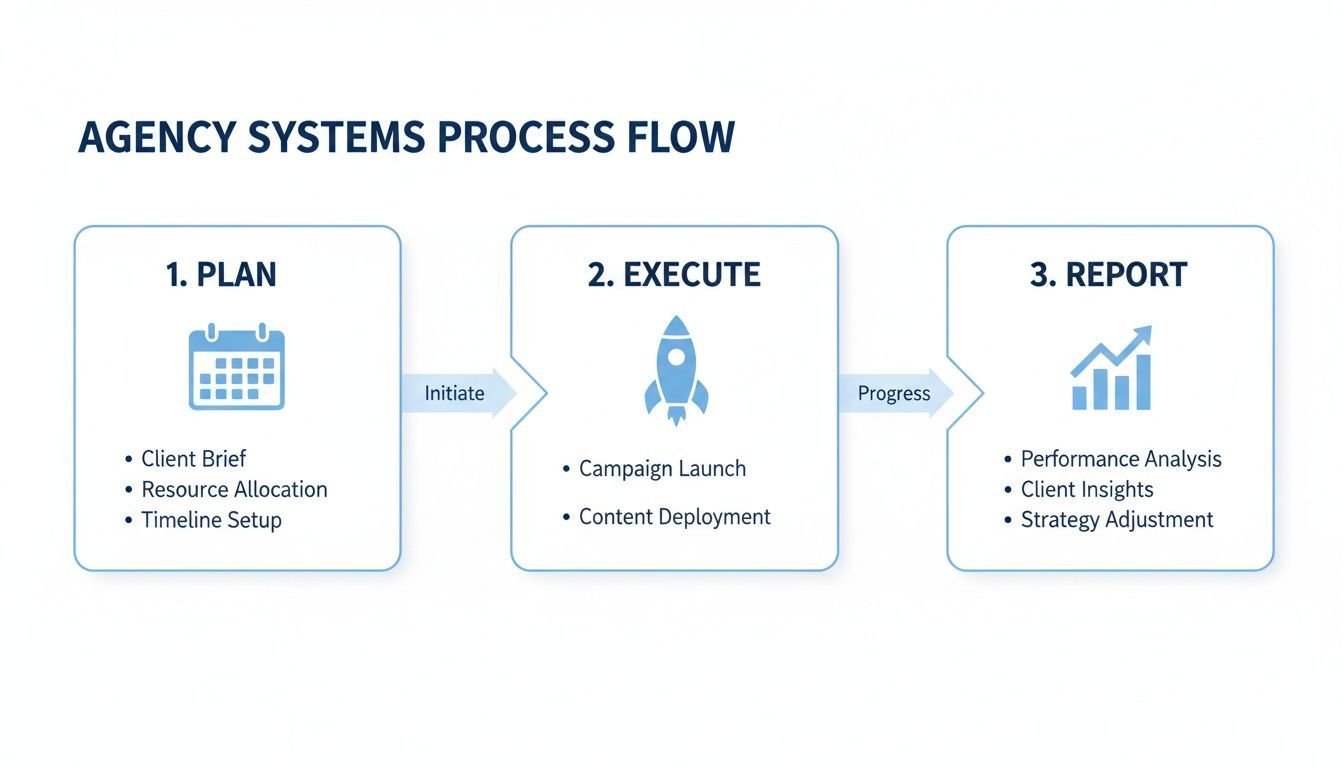
As the diagram shows, each phase flows into the next. The insights from your reporting are what allow you to refine and improve every campaign that follows.
Common Questions About Agency Digital Marketing
Even the best playbook has gaps when you get into the day-to-day grind. Your agency’s marketing is a living, breathing thing, and knowing how to adapt is half the battle. We’ve seen these same questions pop up time and again with agency owners, so let's tackle them head-on.
Here’s a look at the practical side of scaling your own lead generation and building real brand authority.
How Can a Small Agency Compete with Larger Ones?
You don't. At least, not by trying to outspend them. You win by out-thinking them. The secret is specialization. Forget trying to be a one-stop-shop; instead, aim to absolutely dominate a specific niche. Think MedSpas, B2B fintech, or local home service businesses.
This sharp focus lets you build deep expertise and create marketing that speaks directly to your ideal client's biggest problems. Your own agency marketing efforts then become your single best case study, proving you understand their world better than any generalist firm ever could.
Use your size as a weapon. You can test new platforms, pivot your strategy on a dime, and offer a level of personal service that big, bloated agencies simply can't replicate.
Don't see being small as a weakness. See it as a strategic advantage. Your agility and deep niche expertise are the superpowers that let you win high-value clients tired of the cookie-cutter approach.
A customized, high-touch experience is a massive differentiator. It’s how you build a reputation that brings in clients through referrals, which is consistently one of the top lead sources for agencies.
What Are the Most Important KPIs for My Agency's Marketing?
It’s easy to get lost in a sea of metrics. The key is to ignore the vanity numbers and zero in on the Key Performance Indicators (KPIs) that actually track progress toward signing new business.
You should have these core metrics on your dashboard:
- Marketing Qualified Leads (MQLs): This tells you if your content is generating interest at the top of the funnel.
- Sales Qualified Leads (SQLs): This measures lead quality. How many are actually worth a sales conversation?
- Client Acquisition Cost (CAC): This is your efficiency score. Is your marketing spend profitable?
- Key Website Conversion Rates: Think "Book a Consultation" form fills or demo requests, actions that signal real intent.
Analyze your content engagement not just for likes and shares, but as a leading indicator of what topics and formats are truly resonating. These are the numbers that tell the real story of your marketing engine’s performance and guide what you do next.
How Often Should My Agency Post on Social Media?
Here’s the golden rule for social media: consistency trumps raw frequency, every time. Three high-value, insightful posts a week are infinitely better than ten rushed updates that nobody sees or cares about.
For most agencies, a great starting point is posting 3-5 times per week on your main platforms, like LinkedIn. You can then add more spontaneous, in-the-moment content through formats like Instagram Stories.
The only way to maintain this pace without burning out is to build a sustainable schedule. This is where batching your content creation and using a scheduling platform becomes non-negotiable.
You can sit down and map out weeks or even a full month of content in one go. Then, you let a tool handle the publishing automatically. This ensures you have a consistent brand presence even when your team is buried in client work. It's a simple system that keeps your marketing running in the background.
What's the First Hire I Should Make for Agency Marketing?
When you're small and growing, your first marketing hire should not be a narrow specialist. You need a "T-shaped" marketer.
This is someone with a broad understanding across multiple channels, the top bar of the "T," covering areas like SEO, social media, and email. Crucially, they also have deep, hands-on expertise in one or two areas that matter most for your growth right now.
For most agencies, this means deep skills in content creation and SEO. This person can own the overall strategy while personally executing the highest-impact work. They can write the blog posts that fuel your search traffic, manage the social channels that distribute it, and even oversee basic ad campaigns to get more eyes on your best stuff.
As your agency and revenue grow, you can then hire specialists to work under their direction, a dedicated paid ads manager, a social media coordinator, etc. You build out the team logically, knowing a solid strategic leader is already in place.
Building and scaling your agency’s marketing requires the right strategy and the right systems. PostFast provides the tools to execute that strategy efficiently, from scheduling content across all major platforms to collaborating seamlessly with your team and clients. Save hours every week and grow your agency without the chaos. Start your 7-day free trial today.
Related

Best Social Media Tools for Solo Founders: 50 Surveyed, 9 We'd Pay For (2026)
We surveyed 50 social media tools for solo founders with real Ahrefs data and live pricing, then picked the 9 worth paying for. Real spend, no fluff.

How to Make Money on Instagram in 2026 (Real Numbers, No Hype)
How to make money on Instagram in 2026: the real follower thresholds for gifts and subscriptions, why brand deals pay most, and the math at every audience size.
Analyzing the competition: a practical workflow for analyzing the competition
Discover how analyzing the competition can boost your content strategy with a practical workflow to uncover gaps and opportunities.

Can ChatGPT Post to Instagram and Facebook? Yes, Here Is How
Yes, with a connected app. Use PostFast to schedule Instagram and Facebook posts, Reels and Stories from ChatGPT, with approval before publishing.