Unlock SEO Success with a Proven, Transparent Agency
Find a seo optimization agency that delivers measurable growth. Learn how to vet partners, avoid red flags, and drive real results.
On this page (6)
An SEO optimisation agency is a team of specialists you hire to get your business seen on search engines. They dive deep into a mix of technical site health, content that actually answers questions, and building your website's authority so Google sees you as a credible source. The end game? More organic traffic that turns into real customers.
Set Your Goals Before You Even Start Looking
Before you type “SEO optimisation agency” into a search bar, pause. The most critical work you'll do happens right inside your own business. A successful agency partnership boils down to one thing: knowing exactly what you want to achieve.
If you skip this step, you’re just throwing money at a problem without knowing what a solution even looks like. You risk spending a fortune on activities that don’t actually grow your bottom line.
From Vanity Metrics to Valuable Outcomes
It’s easy to get fixated on flashy but ultimately meaningless numbers, like hitting rank #1 for a vague keyword. It feels good, but that top spot is worthless if it doesn't bring in business.
The real goal isn't just getting more clicks; it's getting the right clicks from people ready to buy what you’re selling. This means shifting your focus from traffic volume to KPIs that directly reflect business health.
Before talking to any agency, sit down and define the metrics that will prove their work is paying off. These are the numbers that connect SEO efforts directly to your company's financial success.
Essential Metrics to Define Before Engaging an Agency
| Metric Category | Example KPIs | Why It Matters for Your Bottom Line |
|---|---|---|
| Acquisition Efficiency | Customer Acquisition Cost (CAC) from Organic | Measures how much you spend to get a new customer through search. A good agency will drive this number down over time. |
| Visitor Quality | Organic Conversion Rate | Shows the percentage of search visitors who take a valuable action (buy, sign up, request a demo). This proves you're attracting the right audience. |
| Sales Pipeline Impact | Qualified Lead Volume | Tracks the number of sales-ready leads coming from organic search. This is a direct measure of SEO's contribution to revenue. |
| Competitive Standing | Share of Voice for Target Keywords | Compares your brand’s visibility against competitors for high-intent search terms. It tells you if you're winning your market. |
Defining these KPIs first changes the entire conversation. You'll enter those initial calls asking not just what an agency can do, but showing them exactly what you need them to do. Our guide on a winning digital marketing strategy for agencies offers a solid framework for this kind of goal-setting.
Run a Quick Digital Self-Audit
With your goals in hand, take a quick look at your current digital presence. You don’t need to be an SEO whiz for this.
A simple self-check helps you spot obvious weaknesses and opportunities. This gives you a list of smart, specific questions to ask potential partners.
The Bulgarian SEO agency scene is packed, with Clutch.co listing 154 firms as of February 2026. Agencies like Serpact and KIPLAR are known for delivering measurable results. For example, Serpact drove a 280% surge in organic traffic for bTV Media Group by nailing their content strategy. It’s a perfect example of what a focused approach can achieve.
The best agency relationships are built on shared, measurable goals. An agency can’t define success for you; they can only help you achieve the version of success you’ve already defined for your business.
Getting this clarity upfront ensures you’re not just buying a service. You’re investing in a partnership designed for real, measurable growth from day one.
Finding and Vetting Potential SEO Partners
Alright, you've got your goals locked in. Now comes the hard part: finding an agency that can actually hit those targets. This isn't about a quick Google search; it's about finding a real partner who gets what you're trying to build.
Simply searching for an "seo optimization agency" will give you a list of companies good at buying ads. We're looking for proof they can deliver, not just spend.
Where to Look for a Great SEO Agency
Your best leads won't come from the top of the search results. They come from trust.
Start with your own network. Ask colleagues, mentors, or even partners in other fields who they use and, more importantly, why. A genuine recommendation from someone who has already seen results is worth its weight in gold.
Next, dig into review platforms like Clutch or G2. Don't just look at the star ratings. Read the actual reviews. You're searching for patterns in what clients say about communication, reporting, and whether the agency drove real business growth.
Dissecting Case Studies and Their Own SEO
Once you have a shortlist, it's time to do some digging. An agency’s case studies are their highlight reel, so you need to look past the flashy numbers and find the substance.
A solid case study will always:
- Outline the client’s original problem and goals. This shows they think in terms of business outcomes, not just SEO tasks.
- Detail the specific strategy. "We optimised their content" is a huge red flag. You want to see things like, "We restructured their blog architecture and targeted long-tail keywords for their service pages."
- Show proof of results. The metrics should match the goals you set earlier. Are they showing growth in qualified leads or a better customer acquisition cost?
The most telling sign of all? Look at the agency’s own website. Do they rank for their own competitive keywords? If an SEO agency can't get visible for themselves, it's a fair question to ask how they'll do it for you. A great way to start is by analysing their competitive positioning in their own market.
This process is fundamental. Any competent agency will start by understanding where you are, defining what success looks like, and then setting a clear goal.
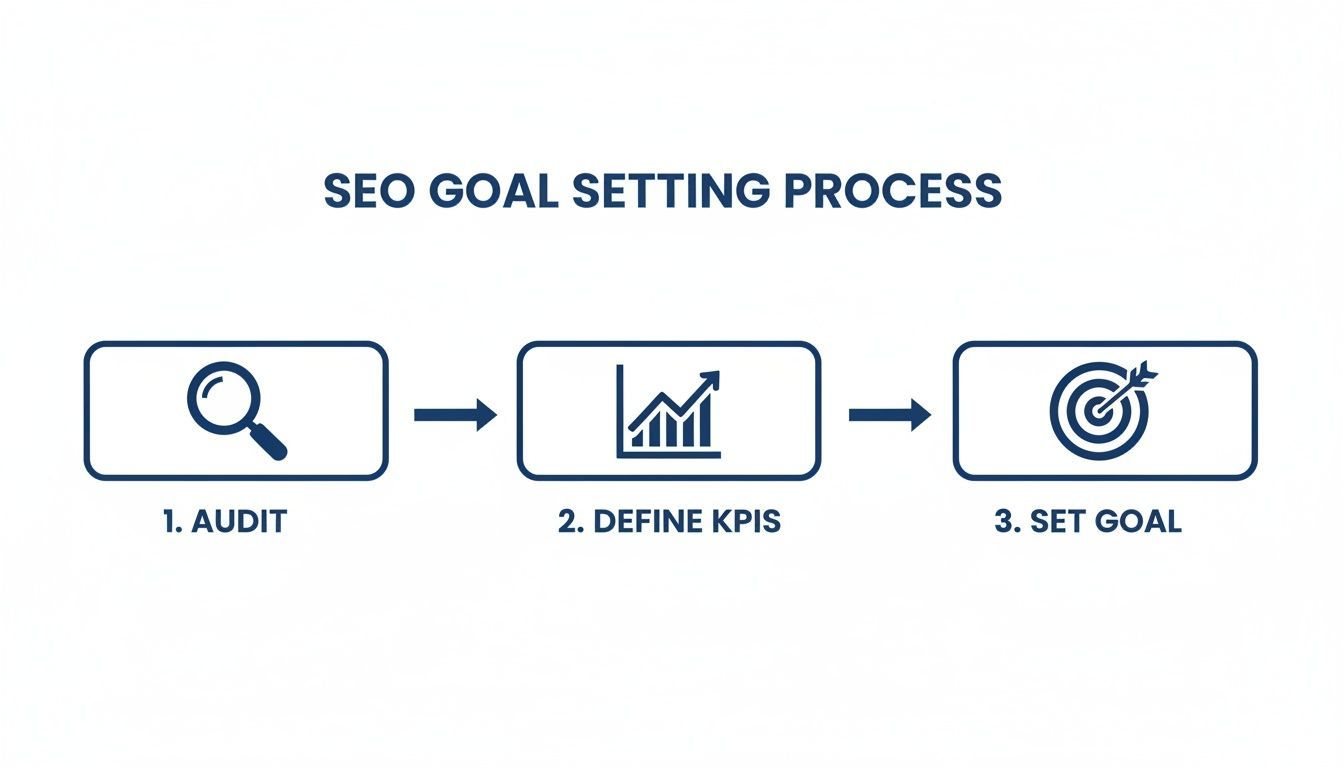
A good partner always builds a strategy from data, not guesswork. This diagnostic approach is non-negotiable.
Gauging Their Technical and Creative Balance
Modern SEO isn't just one thing. It's a mix of deep technical know-how and sharp content creation. A technically perfect website with bland content is useless. So is amazing content on a broken site that Google can't find.
As you talk to potential agencies, try to get a feel for their strengths in both areas.
A truly effective SEO optimisation agency doesn't just get you more traffic; they get you the right traffic with content that converts. They should feel like a genuine extension of your marketing team, not just a vendor.
The end goal here is to find an agency that not only has a proven track record but also fits with your company's culture. That's the foundation for a partnership that lasts.
Understanding Agency Pricing Models and Contracts
Talking money with an SEO optimisation agency can feel a bit murky. Prices and contracts vary wildly, but once you get a handle on the basic structures, it’s much easier to find a partner who’s upfront about their costs. Let's walk through the common models so you know what to look for.
Decoding Common Pricing Structures
Most agencies use one of a few standard pricing models. Each has its own benefits and drawbacks, and the best fit depends on what you need, whether it’s a one-off technical audit or a long-term growth plan.
-
Monthly Retainer: This is the most common setup. You pay a set fee every month for a defined list of services, like content writing, link building, and technical monitoring. It's ideal if you're serious about long-term growth, because good SEO takes time.
-
Project-Based Fees: If you have a single, well-defined goal, like a website migration or a one-time backlink cleanup, a project fee is perfect. You agree on one price for a specific set of deliverables and a clear deadline. It’s great for targeted tasks but doesn't include ongoing optimisation.
-
Hourly Consulting: This is a flexible option if you have an in-house team that just needs some expert guidance or you want a second opinion on your strategy. You simply pay for the agency's time as you use it.
In Bulgaria’s competitive market, a good SEO optimisation agency is a must-have, especially when organic traffic accounts for nearly 47% of all website visits. With 154 SEO companies listed on Clutch, you’ll find a wide range of pricing. Hourly rates can be anywhere from $25-$49, and project fees often land between $10,000-$49,000, which shows just how much the scope of work matters.
You can dig into the specifics by reviewing the latest data on Bulgarian SEO firms to compare their specialities and client reviews.
What to Look for in a Contract
Think of the contract as the official rulebook for your partnership. It’s where all the verbal promises are put into writing, protecting both you and the agency. Don't skim it. A few minutes of careful reading now can save you months of frustration later.
A good contract is always clear. Vague language is a huge red flag. If a term or clause is confusing, insist on having it clarified in writing.
A transparent contract is the foundation of a healthy agency relationship. If an agency is hesitant to define deliverables, reporting schedules, or termination terms clearly, consider it a warning sign.
Before you sign anything, make sure these key components are included.
Key Components of a Strong SEO Contract
Your agreement should leave no room for guesswork. Look for these specific sections to ensure everything is covered.
| Contract Clause | What It Should Contain | Why It's Critical |
|---|---|---|
| Scope of Work (SOW) | A detailed list of all activities the agency will perform, like keyword research, on-page optimisation, content creation, and technical fixes. | This prevents "scope creep" and ensures you know exactly what you're paying for each month. |
| Deliverables | Specific, tangible outcomes. For example, "four 1,500-word blog posts per month" or "a comprehensive backlink audit report by day 30." | Deliverables turn abstract activities into measurable results, making it easy to track progress. |
| Reporting Cadence | A clear schedule for performance reports (e.g., monthly) and what metrics will be included (organic traffic, keyword rankings, conversions). | Regular, data-driven reporting keeps the agency accountable and shows you the return on your investment. |
| Termination Clause | The terms for ending the contract. This should outline the required notice period (usually 30 days) and any fees involved. | A fair termination clause provides an exit strategy if the partnership isn't working, without locking you into a long, unproductive relationship. |
Reading the fine print isn’t just a formality; it’s how you make sure the partnership starts on the right foot. A clear contract is often the first sign that you’re dealing with a professional SEO optimisation agency that values transparency as much as you do.
Asking the Right Questions and Spotting Red Flags
The pitch meeting is where you separate the real deal from the slick talkers. It’s your chance to look past the polished case studies and figure out how an agency really thinks and operates under pressure.
Asking a few sharp, specific questions is the best way to see if an SEO optimisation agency is a good fit. You need to get past the generic "What can you do for me?" and dig into their actual process.

Questions That Reveal True Expertise
When you sit down with a potential partner, your questions should make them think on their feet. This isn’t an interrogation; it's a strategy session. You want to see real expertise, not a rehearsed sales pitch.
Here are a few questions designed to cut through the fluff:
- "Walk me through your process for building a strategy for a client in a competitive niche like ours."
- "A major Google algorithm update just dropped. What are the first three things your team does?"
- "How do you measure the ROI of your content work beyond just traffic and rankings?"
- "Tell me about a time a campaign didn't go as planned. How did you tell the client, and what did you do to pivot?"
A strong partner will talk about data, competitor analysis, and tying SEO directly to your business goals. A weak one will fall back on vague talk about "best practices" and "optimising content."
Spotting the Glaring Red Flags
Knowing what questions to ask is only half the battle. You also have to recognise the warning signs in their answers. Some agencies are incredible at marketing themselves but completely drop the ball on execution.
Listen closely to how they talk about their methods. If it sounds too good to be true, it is.
The biggest red flag of all? Guaranteed results. No one can promise a #1 ranking on Google. An honest SEO optimisation agency talks about growth, improvement, and progress, not impossible guarantees.
Here’s a look at what you should be asking and the red flags you should be watching for in their answers.
Agency Vetting Questions vs Hidden Red Flags
The table below breaks down good questions to ask versus the hidden warnings their answers might contain.
| Area of Inquiry | A Good Question to Ask | Potential Red Flag to Watch For |
|---|---|---|
| Strategy & Methodology | "Can you explain your approach to keyword research and content strategy?" | A "secret sauce" or "proprietary method" they can't explain. Good SEO is transparent, not a black box. |
| Results & Guarantees | "What kind of results have you achieved for clients with similar goals to ours?" | Any promise of specific rankings, especially in a short timeframe (e.g., "We'll get you to #1 in 90 days"). |
| Communication & Reporting | "What does your monthly reporting look like, and how often will we meet to discuss progress?" | Vague answers or a focus on vanity metrics (like raw traffic) without connecting them to your business KPIs. |
| Client Relationships | "Could you provide references from one or two current clients we could speak with?" | Hesitation or an outright refusal. A confident agency has happy clients who are willing to talk. |
| Flexibility & Customisation | "How would you adapt your standard process to fit our unique brand voice and market position?" | A rigid, one-size-fits-all strategy. Every business is different, and their approach should reflect that. |
If you spot several of these red flags, it’s a clear sign to walk away. The initial thrill of a low price or a big promise disappears fast when the results don't show up and the communication goes silent. You're not just buying a service; you're choosing a partner. Make sure they're a transparent, data-driven one who's in it for the long haul.
Integrating the Agency into Your Marketing Workflow
You’ve signed the contract. It feels like the hard part is over, but this is where the real work begins. Your new SEO optimisation agency can’t just be a line item on your budget; they need to become an extension of your team.
The biggest mistake I see companies make is treating SEO as a separate, isolated task. It’s not. To get real results, SEO insights must fuel your content, and your content must support your SEO goals. It's a two-way street.
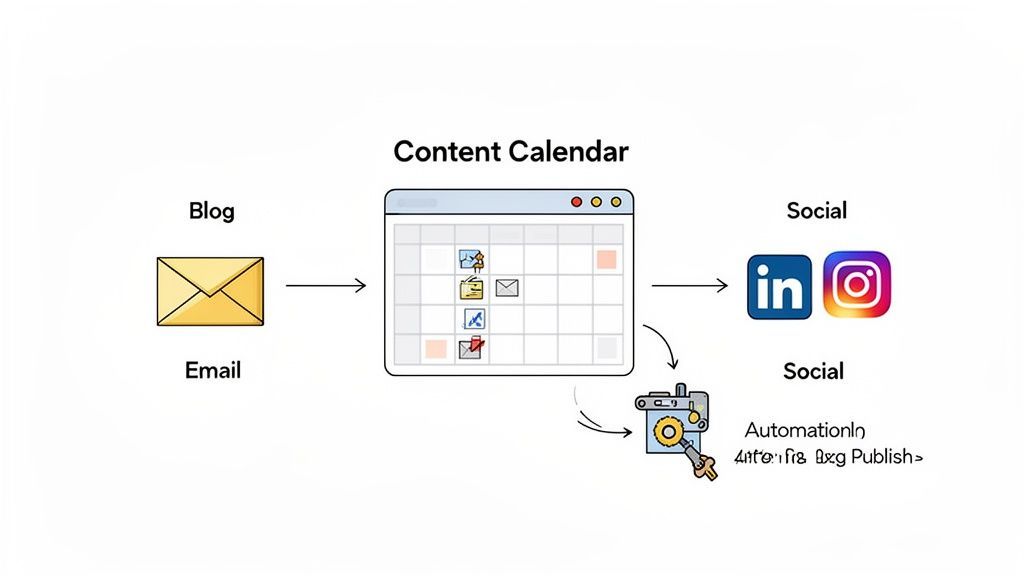
Building a Unified Content Engine
Your first move should be a shared content calendar. This isn’t just a schedule; it's a strategic map where your agency’s keyword research becomes the foundation for your blog posts, social media updates, and email campaigns.
Let's say your agency uncovers a valuable keyword cluster around "quiet dishwashers for open-plan kitchens." Don't just hand it off for a single blog post. Turn it into a campaign.
- Blog Post: The agency helps you build out a definitive guide, like "The Best Quiet Dishwashers for Modern Homes."
- Social Media: Your team takes that content and creates short-form videos for Instagram and TikTok, actually showing how quiet the dishwasher is.
- Email Campaign: A targeted email goes out to your list of subscribers who've shown interest in home renovation, pulling them back to the guide.
This way, every piece of content reinforces the others, maximising your impact and establishing your authority on the topic.
From SEO Insights to Social Media Action
Great content is only half the battle. You have to get it in front of people. An SEO-driven article is built for the long term, but its initial boost almost always comes from social promotion.
Think about it. When your agency delivers a new, perfectly optimised blog post, what’s next? If your workflow is disconnected, it just sits there, waiting for Google to notice. An integrated approach is much smarter.
SEO finds the audience, and social media brings the audience to you. When an optimised blog post goes live, it shouldn't be the end of the process, it should be the start of your promotional and social media optimisation efforts.
This is where planning in your content calendar pays off. The moment a blog post is published, a pre-planned promotional sequence should kick in.
A tool like PostFast is perfect for this. Before the article is even finished, you can load up a full week of social posts. Schedule a direct link on LinkedIn, an engaging carousel for Instagram highlighting key stats, and a few thought-provoking questions for X (formerly Twitter) to get a conversation going. You set it up once, and the tool ensures you get that critical, day-one traction.
Setting Up Communication and Reporting Loops
To keep everything running smoothly, you need a solid communication rhythm. Silos will kill your momentum faster than anything else.
-
Have a central point of contact. Designate one person on your team as the main liaison with the agency. This prevents crossed wires and keeps communication clear and efficient.
-
Hold regular strategy sessions. A weekly or bi-weekly call is non-negotiable. Use this time for more than just reporting; use it to brainstorm. The agency's data can spark your next social campaign, and your social engagement metrics can give them fresh content ideas.
-
Use a shared project management tool. Whether it’s Asana, Trello, or Monday.com, get everyone on a single platform. This creates one source of truth for tracking content from idea to promotion.
When you merge your agency’s expertise directly into your marketing workflow, you stop treating SEO as a box to tick. You turn it into a powerful engine for consistent, measurable growth.
Frequently Asked Questions About Hiring an SEO Agency
Even after all the research, you probably still have a few questions about bringing an SEO optimisation agency on board. That's totally normal. Here are some of the most common questions we hear from business owners, with straightforward answers to clear things up.
How Long Does It Take to See Results From SEO?
Patience is key in search engine optimisation. While you might see some quick wins from technical fixes in the first couple of months, real, meaningful impact takes time. Expect to wait 6 to 12 months for significant growth.
That's the typical window to see a jump in organic traffic, higher rankings for your most valuable keywords, and a genuine increase in leads. This timeline isn't set in stone, though. It depends on:
- Your starting point: A brand new website will always take longer to build authority than an established one.
- Industry competition: Ranking for "local dog walker" is a lot faster than trying to rank for "business insurance provider."
- Strategy intensity: The more resources you put in, the quicker you'll see progress.
A good SEO optimisation agency will be direct about these timelines. They should set clear expectations from day one, outlining both short-term milestones and long-term goals.
What’s the Difference Between On-Page, Off-Page, and Technical SEO?
Think of these as the three legs of a stool, if one is weak, the whole strategy wobbles. A great agency masters all three.
On-Page SEO This is everything on your actual website pages. It covers the quality of your content, your title tags and headings, how you use images, and your internal linking. It’s all about making your site clear and useful for both people and search engines.
Technical SEO This is the foundation. It’s about making sure search engines can find, crawl, and index your site without any trouble. This includes site speed, mobile-friendliness, site architecture, and fixing crawl errors. If your technical SEO is a mess, even the best content won't get seen.
Off-Page SEO This covers all the work done outside of your website to build its authority. The biggest piece of this puzzle is earning high-quality backlinks from other reputable sites. These links are like votes of confidence, telling search engines your site is a credible source.
The biggest mistake is focusing on just one area. Great content (on-page) won't matter if your site is slow (technical) or has no backlinks (off-page). A solid SEO optimisation agency will build a strategy that hits all three.
Is It Better to Hire an Agency or Do SEO In-House?
This is the classic "build vs. buy" question. Doing SEO yourself is possible, but it demands a huge time investment to keep up with an industry that changes constantly.
For most businesses that are serious about growth, hiring an SEO optimisation agency is the smarter move. An agency brings a few things to the table that are tough to replicate in-house:
- A team of specialists: You get experts in technical SEO, content, link building, and analytics all at once.
- Access to expensive tools: Top agencies spend thousands every month on software for research, auditing, and reporting.
- Diverse experience: They’ve seen what works (and what doesn't) across dozens of industries and client accounts.
Hiring an agency is an investment in expertise and efficiency. It frees up your team to focus on what they do best while the experts handle the complexities of search.
What Should I Budget for an SEO Optimisation Agency in 2026?
There's no single price tag for SEO. Your budget depends entirely on your goals, how competitive your market is, and the scope of work you agree on.
In a competitive market like Bulgaria, you can expect monthly retainers to range from $1,500 to over $5,000. In major global markets, top-tier agencies often charge much more. The key is to stop seeing SEO as a cost and start seeing it as an investment in a primary revenue channel.
Be wary of anyone offering services for a rock-bottom price. That usually means they’re cutting corners, using outdated tactics, or outsourcing work to low-quality providers, all of which can hurt your site in the long run. A reputable SEO optimisation agency will focus on delivering a sustainable return, not just being the cheapest option.
Finding the right agency is the first step, but integrating their work is what makes it all click. Once your new optimised content is ready, use PostFast to schedule a full week of promotional posts across all your social channels. You can turn one blog post into a LinkedIn article, an Instagram carousel, and a series of engaging tweets in just minutes. This ensures your SEO efforts get the immediate visibility they need to start working. Try PostFast for free and see how it connects your content and social strategy.
Related

6 Best YouTube Shorts Editors in 2026
Looking for a YouTube Short editor? Find the best editing software for YouTube Shorts in 2026 for faster cuts, captions, reframing, and export.

Planable vs Later vs PostFast: 2026 Comparison
Planable from $33 per workspace, Later from $18.75, PostFast from €10 a month (billed yearly). Approval workflows, pricing, and features compared for 2026.

Master Instagram Photography: Tips to Capture Stunning Phone Photos
Master Instagram phone photography in 2026. Practical tips on lighting, composition, and editing to capture stunning photos that grow your brand on Instagram.

Can ChatGPT Post to Instagram and Facebook? Yes, Here Is How
Yes, with a connected app. Use PostFast to schedule Instagram and Facebook posts, Reels and Stories from ChatGPT, with approval before publishing.