11 Best Sprout Social Alternatives for 2026 (Agency-Ready, Without Per-Seat Pricing)
Sprout Social is excellent. It is also priced for enterprise. The new 2026 Essentials tier lands at $79 per seat per month annual ($99 monthly), Standard is $199 per seat per month, Professional $299, Advanced $399. For a 5-strategist agency on Advanced, that is roughly $24,000 a year. Every price on this page was re-checked against each vendor's own pricing page on August 26, 2026, mapping each figure to its tier rather than reading a range off the top of the page. If you are researching an alternative to Sprout Social or any serious Sprout Social competitor, the 11 tools below close most of the feature gap at a fraction of the cost. For reference, a Sprout Standard seat for one user costs more than PostFast Growth or SocialPilot Ultimate, both of which handle the full agency workflow at flat pricing. PostFast is priced per plan, not per channel and not per seat, with users included, all 11 platforms on every plan, and a REST API and MCP server on every plan from €10/mo on annual billing (€12/mo monthly).
What is Sprout Social?
Sprout Social is a social media management suite founded in Chicago in 2010 and publicly traded on NASDAQ. It sits at the enterprise and upper-mid-market end of the category, and it is a genuinely strong product: publishing and a content calendar, a consolidated inbox that covers comments, direct messages and reviews, social listening, sentiment analysis, review management across Google and Facebook, helpdesk integrations with Zendesk and Freshdesk, and a Salesforce integration on the enterprise tier. It publishes to 7 networks: Facebook, Instagram, X, LinkedIn, TikTok, Pinterest and Threads.
What people outgrow is almost never the product. It is the per-seat model. Sprout charges per seat per month, so the bill is a function of headcount rather than of how much social media you actually publish. A team of five on the Advanced tier is roughly $24,000 a year before anyone has scheduled a post. Teams start looking for alternatives when they notice that most of their seats only ever touch publishing and reporting, while the listening and customer-care features that justify the price are used by one or two people. If you want a single recommendation rather than a full comparison, PostFast Growth is the closest flat-priced replacement for the scheduling and approvals half of Sprout, and Hootsuite or staying put are the honest answers if listening is what you actually buy it for.
Sprout Social pricing explained
Sprout prices per seat per month, with four self-serve tiers plus Enterprise. Every figure below was re-checked on Sprout's own pricing page on August 26, 2026, mapping each price to its tier rather than reading the range off the top of the page.
Sprout Essentials ($79 per seat per month annual, $99 billed monthly). Added in 2026 and still the least-discussed tier in the category. Covers 5 social profiles, optimal send times, and post plus profile reporting. This is the tier most comparisons still miss, and it changes the entry-price conversation: Sprout's floor is $79 a seat, not $199.
Sprout Standard ($199 per seat per month annual). 5 social profiles, the consolidated inbox, keyword and location monitoring, and review management. This is where most small teams actually land, and where the per-seat arithmetic starts to hurt: three people is $597 a month, $7,164 a year.
Sprout Professional ($299 per seat per month annual). Unlimited profiles, message tagging, competitor, tag and paid insights, and Enhance Post by AI. The unlimited-profile jump is the reason multi-brand teams move up rather than the feature list.
Sprout Advanced ($399 per seat per month annual). Sentiment analysis inside the inbox, the Sprout API, helpdesk integrations, message spike alerts and team productivity reports. Note what sits here: the API. Programmatic access is the top self-serve tier, so a three-person team pays $1,197 a month before writing a line of integration code.
Sprout Enterprise (custom). White-glove onboarding, SSO, priority support and a tailored plan.
Two details worth pricing in before you compare. Premium Analytics and Listening are each sold as separate add-ons on Standard and up, so the listening capability people most often name as their reason for paying Sprout is not actually included in the seat price. And the trial is 30 days with no credit card, which is the longest trial in this comparison and long enough to test a real migration in parallel rather than in theory.
The structural point is simple. Sprout's cost scales with how many people log in; every flat-priced tool below scales with how many accounts you connect. If your headcount is growing faster than your account count, the gap widens every quarter you stay.
Quick comparison
All prices re-verified August 2026 from each vendor's public pricing page, with both billing toggles opened where one exists. Where a tool defaults to annual billing, we list the annual-equivalent monthly price and note the monthly figure separately.
| Tool | Starting price | Platforms | Free plan | Best for |
|---|---|---|---|---|
| PostFastOur pick | €10/mo annual | 11 | 7-day trial, no CC | agencies who want Sprout's workflow without per-seat pricing |
| Hootsuite | $99/user/mo | 10 | No (14-day trial, no CC) | enterprise teams that want a peer-level alternative |
| Buffer | $5/channel/mo | 11 | Yes (3 channels, 10 posts/channel) | solo creators or small teams on a tight budget |
| Statusbrew | $69/mo (Lite, annual) | 10 | No (14-day trial) | teams running many accounts who need the inbox and client reporting, not just scheduling |
| Later | $18.75/mo (annual) | 8 | No (14-day trial) | Instagram-first brands leaving Sprout's enterprise pricing |
| Publer | $4/mo (Professional, annual, 1 account) | 13 | Yes (3 accounts, 10 posts/account, no X) | teams who need the cheapest paid tier with broad platform coverage |
| SocialPilot | $17/mo (annual) | 10 | No (14-day trial, no CC) | SMB agencies with bulk scheduling and client approvals |
| Sendible | $30/mo (Core, annual) | 10 | No (14-day trial, no CC) | UK-based agencies with native GBP billing |
| FeedHive | €15/mo | 10 | No (7-day trial) | AI-first content operations with heavy automation needs |
| Loomly | $49/mo (annual) | 9 | No (trial, no CC) | in-house marketing teams with structured editorial workflows |
| Postiz | $23/mo (Standard, annual) | 31 | Yes (self-hosted is free) | open-source teams with 31-platform publishing needs |
1. Best for agencies who want Sprout's workflow without per-seat pricing: PostFast
 Our pick
Flat pricing with a real REST API + MCP Server. Scale to 8 users without the Sprout invoice.
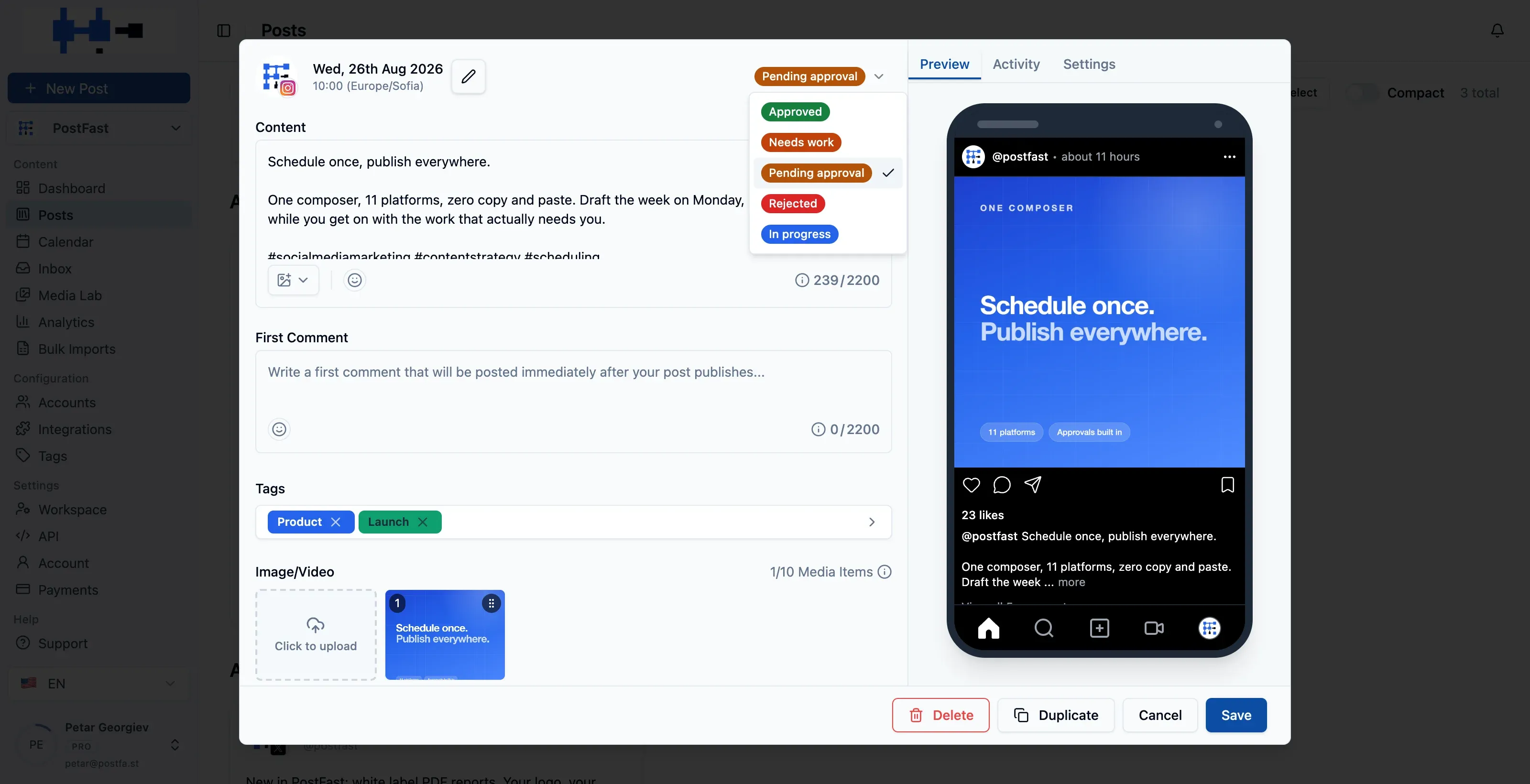
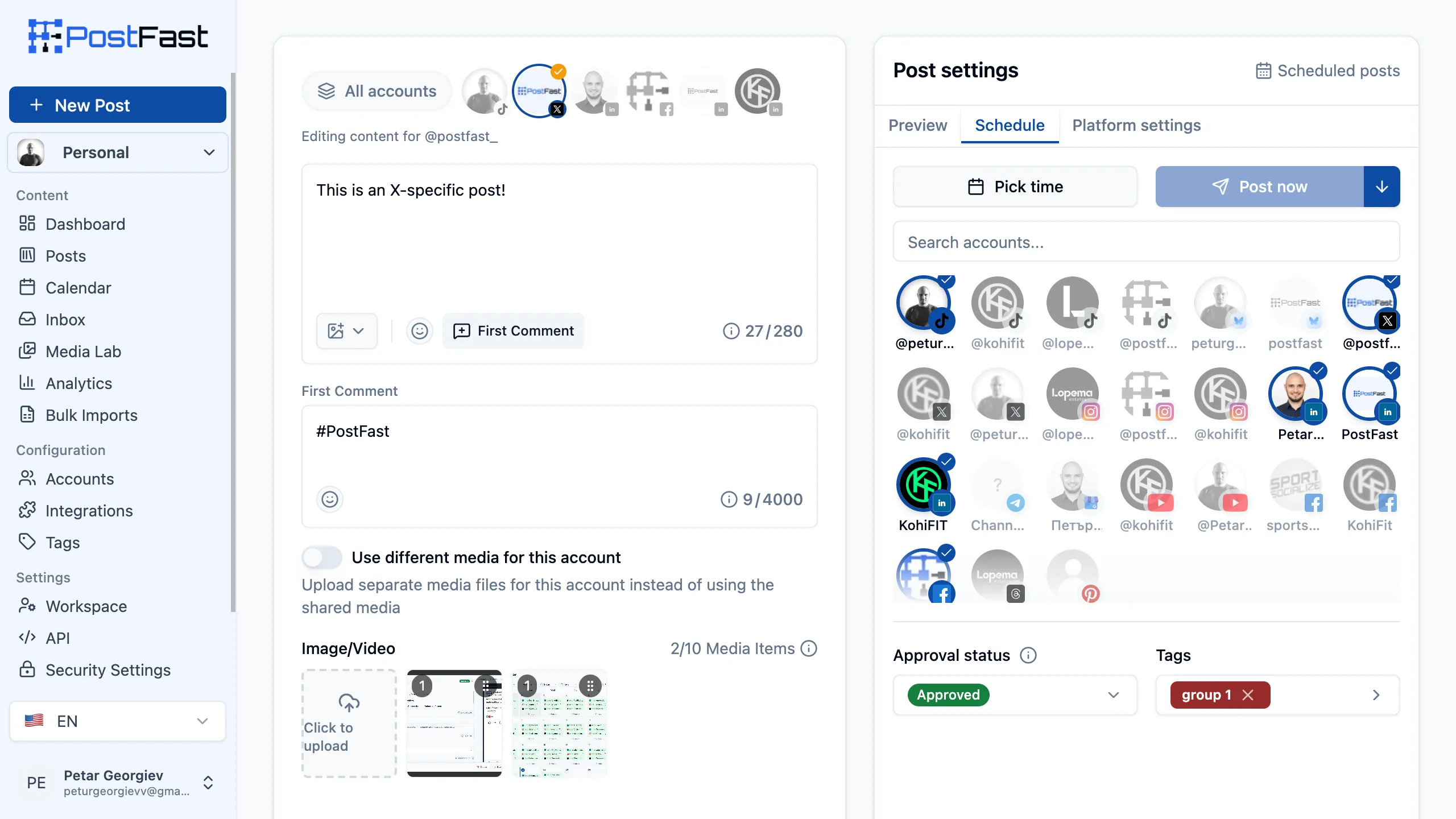
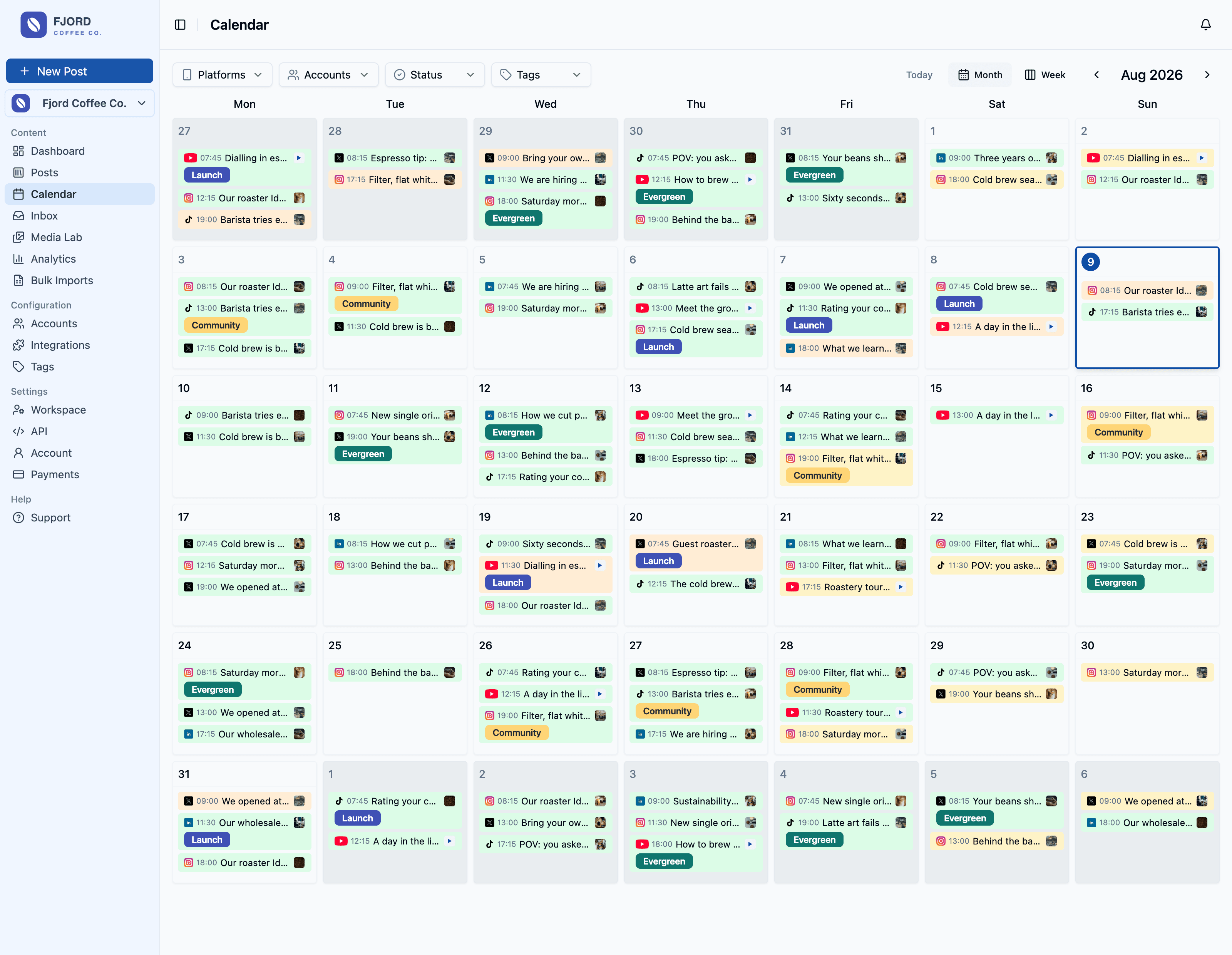
PostFast is the cleanest swap for Sprout Social if your team left because the per-seat bill broke your agency margins. Starter is €10/mo on annual, Creator €24, Growth €40, Pro €82.50, Enterprise €199 (all annual-billed; monthly is €12/€29/€49/€99/€239). Those numbers are total, not per-user. A 5-strategist agency on PostFast Growth pays €40/mo on annual (roughly $43) for 30 social accounts, 10 workspaces, and 8 users. The same team on Sprout Advanced pays $1,995 a month ($23,940 a year). The math isn't close for agencies whose primary Sprout value was scheduling plus approvals.
Beyond price, PostFast ships the developer surface Sprout reserves for Advanced. PostFast Growth includes a public REST API plus an MCP Server (endpoint reference at postfa.st/docs) so you can publish from Claude Code, Cursor, or NanoClaw. Sprout's API is gated to Advanced at $399 per seat per month, so a 3-seat team hits $1,197 a month just to access the API. PostFast delivers programmatic access at a tier any team can justify.
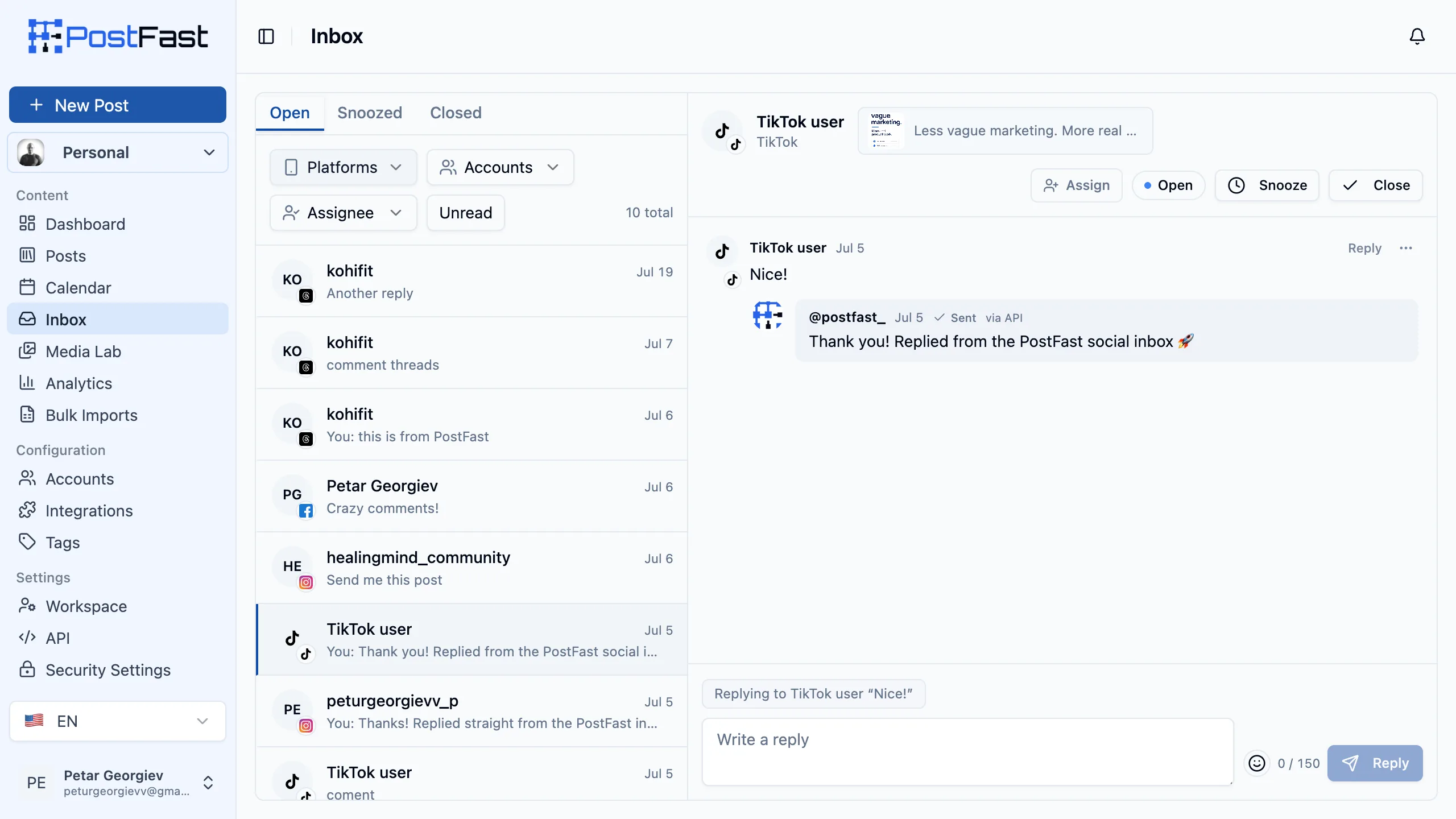
Where Sprout still wins: social listening that surfaces conversations across news and blog sources (not just social), a smart inbox spanning DMs, mentions and reviews with sentiment analysis, helpdesk integrations (Zendesk, Freshdesk), and review management across Google, Facebook, and Glassdoor. PostFast ships a comments inbox on every plan (TikTok, Instagram, Facebook and Threads) but no listening or review-management product today. If your team paid Sprout specifically for listening or customer-care workflows, that is the rare case where Sprout's value per dollar holds. For scheduling plus analytics plus API at flat pricing, PostFast wins.
Migration specifics: connect your social accounts via OAuth (same OAuth flow Sprout uses), pull scheduled content from Sprout via its Advanced-tier API, and post to PostFast via our public REST API. For teams without API access on Sprout, manual re-entry into PostFast works for small volumes. Keep Sprout running for 2 weeks in parallel so existing scheduled posts drain. The PostFast REST API covers the same verbs Sprout's does (create post, schedule, list, delete) with simpler OAuth authentication. Most teams port in 1-2 days of engineering time. The Sprout API's read-analytics calls do require a custom reporting swap if you piped them to a BI tool, but most agencies use Sprout's own dashboards and don't hit that migration cost.
Who PostFast suits, and who it does not
It suits the team whose Sprout invoice is driven by headcount rather than by output. Growth is 40 euros a month on annual for 30 accounts, 10 workspaces and 8 users per workspace, and that figure does not move when you hire. Approvals, the comments inbox, analytics export and the REST API are all in the base plan, so the usual second conversation about which tier unlocks the thing you assumed you had does not happen.
It is the wrong tool if what you actually buy Sprout for is the listening and customer-care layer. There is no social listening, no review management across Google or Glassdoor, no helpdesk integration, and no sentiment scoring. The inbox covers comments on TikTok, Instagram, Facebook Pages and Threads, and does not cover direct messages or the other networks. There is also no free tier, only a 7-day trial without a credit card, and no webhooks.
The Sprout constraint you are escaping
Seat multiplication, and the tier the API sits behind. Five people on Sprout Standard is $995 a month; the same five on Advanced, which is where programmatic access lives, is $1,995 a month or roughly $23,940 a year. PostFast Growth is 40 euros a month total, with the API and MCP server included from Starter at 10 euros.
The quieter one is approvals. Sprout puts approval workflows on Advanced, so wanting a reviewer in the loop reprices every seat you own, not just the reviewer's. Here approval status is a field on the post, so the only thing that changes as the team grows is how many people you invite.
What migrating from Sprout involves
Connect each account through OAuth, the same consent screens Sprout used. On Facebook Pages, Instagram, Threads and TikTok, PostFast then backfills the last 60 days of already-published posts automatically, including posts that never went through Sprout, so reporting is populated on day one instead of starting empty. The other seven platforms connect normally without backfill.
For the queue itself there are two routes. Sprout's content planner supports CSV export of scheduled posts, and PostFast accepts bulk CSV import at up to 200 rows and 10 MB per upload, with columns for content, schedule time, target accounts and media URLs. If you would rather script it, the REST API is on every plan. Use Sprout's 30-day trial window overlap to run both in parallel rather than cutting over cold.
Budget for the two things that do not come across: historical analytics, and any BI pipeline you built against Sprout's API. If continuity of trend data matters to a client report, run both tools for a month so you have overlap rather than a gap.
- Starting price
- €10/mo annual (Starter)
- Platforms
- 11 (Facebook, Instagram, X, TikTok, LinkedIn, YouTube, BlueSky, Threads, Pinterest, Telegram, Google Business)
- Free plan / trial
- 7-day trial, no credit card
- Standout
- Flat pricing plus a REST API + MCP Server on every plan
2. Best for enterprise teams that want a peer-level alternative: Hootsuite

The other enterprise veteran, priced per user from $99 Standard to $399 Advanced.
Hootsuite is Sprout's closest peer in positioning. Standard is $99 per user per month annual (10 social accounts). The 2026 re-tier added a Professional tier at $199 per user per month annual (unlimited accounts, inbox automation) and moved Advanced to $399 per user per month annual (approvals and team workflows). Enterprise is custom and requires at least 5 seats. Hootsuite publishes to 10 networks and bundles Talkwalker-powered listening, its Wisdom AI assistant, and enterprise integrations like Salesforce and Proofpoint (Enterprise tier).
For teams evaluating Sprout against Hootsuite as a lateral move, the feature sets are broadly comparable: both have a mature unified inbox, listening, publishing, and analytics. Hootsuite's listening via Talkwalker reaches 150M+ websites versus Sprout's social-only listening. Sprout's sentiment analysis is deeper on social channels. Hootsuite pricing is roughly half Sprout's at the Standard tier ($99 vs $199), though per-user billing is still the cost driver on both platforms.
Where each wins: pick Hootsuite if your use case leans on cross-media monitoring (news, blogs, forums) and Employee Advocacy through Amplify. Pick Sprout if you need helpdesk integrations (Advanced) and a cleaner smart inbox. Pick neither if the reason you are leaving is the per-seat bill; both bill by user and the line item compounds identically. For serious price savings, skip to PostFast, Publer, or Postiz.
Cost comparison: 3 users on Sprout Standard is $597 a month. Same team on Hootsuite Standard is $297 a month. That is half the cost for a broadly similar mid-market feature set. At the top self-serve tier the gap has closed: Sprout Advanced and Hootsuite Advanced are both $399 per seat since Hootsuite's 2026 re-tier, $1,197 a month for 3 users on either. Hootsuite stays materially cheaper at the entry tiers but loses on sentiment depth. If you chose Sprout originally because of sentiment and smart-inbox UX, Hootsuite may feel like a step backward in spite of the savings.

Who Hootsuite suits, and who it does not
It suits the organisation that needs to stay in the enterprise category but wants a different vendor: procurement-approved, SSO and compliance controls available, Talkwalker-backed listening that reaches beyond social into news and blogs, and an employee-advocacy product. If listening is the reason you pay Sprout, this is the only tool on this page that genuinely competes on that axis.
It suits nobody who is leaving over price. Standard is $99 per user per month and covers 10 accounts; approvals wait until Advanced at $399 per user per month, which is the same headline number as Sprout Advanced. You would be swapping one per-seat multiplier for another at a similar unit cost, which is the calculation to run before anything else.
The Sprout constraint you are escaping
Mostly the listening scope and the price of the entry tier, not the pricing model. Hootsuite Standard at $99 per user undercuts Sprout Standard at $199 for a broadly comparable mid-market feature set, and its listening reaches cross-media sources rather than social alone. It also covers Reddit, which Sprout does not.
What you are not escaping is per-seat billing. Three users is $297 a month on Standard and $1,197 on Advanced. At the top self-serve tier the two products now cost the same per seat, so the saving is real at the entry tier and gone by the top one.
What migrating from Sprout involves
A 14-day trial with no credit card, then a per-seat purchase, which means the real work is deciding who genuinely needs a login. On a per-user model that headcount is the bill, and a stakeholder who only reads reports still costs a full seat.
Check the network list against yours before committing. Hootsuite covers 10 networks to Sprout's 7, so this direction generally adds coverage rather than losing it, which is the opposite of the trade you make moving to a narrower specialist.
- Starting price
- $99/user/mo (Standard, annual)
- Platforms
- 10 (Facebook, Instagram, X, LinkedIn, TikTok, Pinterest, YouTube, Threads, Bluesky, Reddit)
- Free plan / trial
- 14-day trial, no credit card
- Standout
- Talkwalker listening (cross-media) plus Salesforce on Enterprise
3. Best for solo creators or small teams on a tight budget: Buffer

The simplest tool on this list. Free plan for 3 channels, $5 per channel after that.
Buffer is the extreme downshift from Sprout. Free forever with 3 channels and 10 queued posts per channel. Paid plans start at $5 per channel per month on Essentials (annual $60 per channel per year) and $10 per channel per month on Team (unlimited users, approvals). Buffer publishes to 11 platforms including Bluesky, Mastodon, and Threads.
Where Buffer wins over Sprout: free tier that Sprout does not match, a simpler composer, and per-channel pricing that scales down cleanly for solo operators. A solo creator scheduling to 8 channels on Buffer Essentials pays $40 a month. The same creator on Sprout Essentials (1 seat, 5 profiles) pays $79 a month and gets fewer channels. Buffer wins on simplicity and entry price for anyone scheduling to under 10 channels.
Where Buffer loses to Sprout: no social listening, no unified inbox, no sentiment analysis, no review management, no helpdesk integrations. Buffer is a publishing tool, Sprout is a marketing suite. If the reason you paid Sprout was the inbox, the listening, or the agency reporting, Buffer will feel empty.
When to pick Buffer: you run fewer than 10 channels, you value simplicity, and your primary Sprout use was scheduling plus basic analytics. When to skip Buffer: you relied on Sprout's smart inbox, sentiment work, or review management across platforms. Buffer cannot replicate any of those.
Who Buffer suits, and who it does not
It suits the solo operator or two-person team whose Sprout usage was, honestly, a calendar and a queue. The free plan covers 3 channels permanently, and Essentials is $5 per channel per month on annual, so eight channels is $40 a month against $79 for a single Sprout Essentials seat covering five profiles.
It does not suit a team. There is no inbox, no listening, no sentiment, no review management and no helpdesk integration, so if any part of your week is spent triaging conversations rather than publishing them, Buffer will feel hollow. Per-channel pricing also keeps climbing with the roster: 30 channels on Essentials is $112.50 a month on annual billing, and that tier has no approvals, so a team that needs a review step is on Team at $162.50. Compare that against the plan you would actually need elsewhere rather than against an entry price.
The Sprout constraint you are escaping
The floor. Sprout has no free tier and starts at $79 per seat; Buffer starts at zero and stays there for three channels. For a creator or a small brand that never needed the suite, that is the entire argument.
Buffer's API is also generally available on every plan including Free, where Sprout's sits on Advanced at $399 per seat. It is GraphQL rather than REST and every tier is throttled at 100 requests per 15 minutes, so it suits light automation rather than a heavy integration, but it does not require a $399 seat to touch.
What migrating from Sprout involves
OAuth per channel, then rebuild the queue from a Sprout CSV export. The step people underestimate is auditing what you lose: write down every Sprout feature your team touched in the last month before you move, because Buffer covers roughly the publishing third of it.
Count channels, not seats, when you price it. Buffer bills per connected channel and gives you unlimited users only on Team at $10 per channel, so a small team on many channels can end up paying more than they expected while a large team on few channels pays very little.
- Starting price
- Free / $5 per channel/mo (Essentials)
- Platforms
- 11 (Bluesky, Facebook, Google Business, Instagram, LinkedIn, Mastodon, Pinterest, Threads, TikTok, X, YouTube)
- Free plan / trial
- Free forever (3 channels) + 14-day paid trial
- Standout
- True free plan with 3 channels, simplest composer in the category
4. Best for teams running many accounts who need the inbox and client reporting, not just scheduling: Statusbrew

Flat per-plan pricing with a unified inbox, approval workflows, and deep reporting across many accounts.
Statusbrew bills flat by plan rather than per seat, which is the structural fix for the reason most teams leave Sprout. Lite is $69/mo annual ($89 monthly) with 1 user and 5 profiles. Standard is $129/mo annual ($179 monthly) with 3 users, 10 profiles, and social reporting with 18 months of data backfill. Premium is $229/mo annual ($299 monthly) with 6 users and 15 profiles, adding AI sentiment, approval workflows, and social plus web listening. Enterprise is custom, and an agency add-on starts from $49 per client per month. Read the seat caps before you model it: tiers bundle 1, then 3, then 6 users, and additional users are $35/mo each on top. Unlimited users only arrives on Enterprise, which is quote-priced. So a 10-person team on Premium is $229 plus four extra seats, $369/mo. This is flat pricing with a ceiling rather than per-seat billing abolished, though it still flattens out far sooner than Sprout does.
For multi-account operations the pieces are there. Spaces keep clients and brands separated, multi-step approval workflows handle sign-off, and bulk scheduling runs from CSV. Reporting is the strongest part: 18 months of backfill on Standard and up, drill-down from any data point, CSV extracts, and scheduled delivery to internal or external recipients. That covers the client-reporting cycle Sprout charges per seat for.
It ranks above the cheaper tools here because it keeps the inbox. Most alternatives in the $17 to $40 range are publishing tools with analytics attached, so teams whose Sprout day was triaging conversations lose that workflow entirely. Six users on Premium is $229 against $2,394 for six Sprout Advanced seats.
Where it loses to Sprout: a smaller support organization, no employee-advocacy equivalent, and listening that covers social and web rather than Sprout's wider news, blog and forum monitoring. Programmatic access is Enterprise-only and quote-priced, including the Insights API and MCP support for Claude, ChatGPT, Gemini, and Copilot, so automation-led teams face a sales call rather than a plan upgrade. Lite is bare-bones at 1 user and 5 profiles, so real deployments start at Standard.
When to pick Statusbrew: teams of 3 to 10 running many accounts who need the inbox, sentiment, approvals, and client reporting to survive the move off Sprout. When to skip: your Sprout use was mostly scheduling, or you want API access without a sales conversation, where PostFast, Publer, or SocialPilot cover the same ground for far less.
Who Statusbrew suits, and who it does not
It suits the team whose Sprout day was the inbox rather than the composer. Most tools in the $17 to $40 range are publishers with analytics bolted on, and a team that spent its week triaging conversations loses that workflow entirely when it moves down-market. Statusbrew keeps it: an all-in-one inbox on every tier, AI sentiment and approval workflows from Premium, and reporting with 18 months of data backfill from Standard.
Read the seat caps before modelling it, because the flat pricing has a ceiling. Lite bundles 1 user and 5 profiles, Standard 3 users and 10 profiles, Premium 6 users and 15 profiles, with extra users at $35 a month each on top. Unlimited users and profiles only arrive on Enterprise, which is quote-priced. So a ten-person team on Premium is $229 plus four extra seats. That is flatter than Sprout, not flat.
The Sprout constraint you are escaping
Per-seat billing for a feature set you are actually using. Six users on Sprout Advanced is $2,394 a month. Six users on Statusbrew Premium is $229, and that tier includes the sentiment analysis and approval workflows that pushed you to Advanced in the first place.
You are not escaping the listening gap. Statusbrew's listening covers social and web rather than Sprout's wider news, blog and forum monitoring, and programmatic access including the Insights API and MCP support is Enterprise-only and quote-priced. Automation-led teams still face a sales call, just a cheaper one.
What migrating from Sprout involves
This is the most like-for-like move on the page, so the migration is mostly configuration rather than compromise: rebuild spaces per client, re-create the approval chain, reconnect profiles, then point the reporting schedule at the same recipients. The 18-month backfill on Standard and up is the specific thing that softens the analytics handoff other tools force on you.
Model the seat count first, not the profile count. The jump from Premium's six bundled users to Enterprise is the decision that determines your bill, and $35 per extra user makes a large team on Premium quietly expensive.
- Starting price
- $69/mo (Lite, annual)
- Platforms
- 10
- Free plan / trial
- 14-day trial, no credit card
- Standout
- Flat per-plan pricing with a unified inbox, approvals, and 18-month reporting backfill
5. Best for Instagram-first brands leaving Sprout's enterprise pricing: Later

The Instagram visual grid specialist with Mavely creator affiliate features.
Later was Instagram-first from day one and leads with visual planning. Starter is $18.75 a month on annual (1 Social Set = 8 profiles, 1 user, 30 posts per profile). Growth is $37.50 on annual (2 Sets = 16 profiles, 2 users, 180 posts). Scale is $82.50 on annual (6 Sets = 48 profiles, 4 users, unlimited posts). Later acquired Mavely for $250M in January 2025 and added a creator affiliate platform on top of the scheduler.
For Sprout refugees whose brand revolves around Instagram or TikTok, Later's visual calendar and grid preview are genuinely better than Sprout's. The social inbox on Growth and above handles community management for small teams. Later Scale ($82.50/mo annual) includes custom analytics, competitive benchmarking, and Brand Health sentiment monitoring, which approximates some of what Sprout Advanced offers at roughly one-fifth of the price for a 2-person team.
Where Later loses to Sprout: 8 platforms versus Sprout's 7 (parity for most purposes), no publicly documented API at any tier, and no helpdesk integrations or review management. The Social Set model also wastes seats if you run a single brand with only 3-4 active accounts; you still pay for the 8-profile slot.
When to pick Later: your agency or brand is Instagram + TikTok-led and Sprout's price never matched your actual use case. When to skip Later: you run multi-brand, multi-network campaigns across LinkedIn, X, and YouTube with heavy inbox/support workflows. Later's specialization is a win for visual creators and a loss for general marketing stacks.
Who Later suits, and who it does not
It suits the brand whose growth actually happens on Instagram and TikTok, where the grid preview and Link in Bio are doing commercial work. If you monetise through affiliate links, the post-Mavely creator tooling has no equivalent elsewhere on this page. Scale at $82.50 a month on annual adds competitive benchmarking and Brand Health sentiment monitoring, which approximates a slice of what Sprout Advanced does at a fraction of a single seat.
It suits almost no one else leaving Sprout. There is no public API for scheduling at any tier, which rules out programmatic publishing entirely, and the Social Set model bills 8 profile slots whether you use 3 or 8. Starter caps you at 30 scheduled posts per profile, which is thin for a working brand calendar.
The Sprout constraint you are escaping
Cost per outcome on a visual-first brand. If your Sprout seats existed mainly so a small team could plan an Instagram grid, you were paying enterprise suite prices for a job Later does better and cheaper.
Be clear that you are not escaping a feature gap in your favour anywhere else. Later covers 8 networks to Sprout's 7, so coverage is roughly a wash, and the inbox on Growth handles community management for small teams but is not a sentiment-grade replacement for Sprout's.
What migrating from Sprout involves
Map your accounts onto Social Sets before you connect anything. A Set holds one profile of each network type, so how your accounts distribute across Sets decides your tier more than the raw profile count does, and getting that wrong is how teams land on Growth when Starter would have covered them.
Rebuild the queue against the per-profile post caps rather than against your old Sprout schedule, since Starter's 30-posts-per-profile limit is the constraint most migrants hit first.
- Starting price
- $18.75/mo (Starter, annual)
- Platforms
- 8 (Instagram, Facebook, TikTok, Pinterest, LinkedIn, YouTube, Threads, Snapchat)
- Free plan / trial
- 14-day trial
- Standout
- Visual Instagram grid, Link in Bio, Mavely creator affiliate tools
6. Best for teams who need the cheapest paid tier with broad platform coverage: Publer

From $4/mo for one account, plus a free plan. 13 platforms including WordPress and Mastodon.
Publer is one of two tools on this list with a real free plan (3 accounts, 10 posts per account, no X) plus the lowest paid entry in the category. Publer prices per social account: the plan card shows one account, $4/mo on Professional and $8/mo on Business on annual billing ($5 and $10 monthly), and larger rosters cost $3.20 and $5.60 per account a month on annual billing ($4 and $7 monthly), with every 10th account free. Professional covers unlimited scheduling, X, RSS and Link in Bio; Business adds unlimited AI, analytics, competitor tracking and a public API. Publer publishes to 13 networks including WordPress, Mastodon, Bluesky, Google Business, and Telegram.
For a Sprout customer evaluating purely on scheduling ROI, Publer Business at 5 accounts ($28/mo on annual billing) handles the work Sprout Standard does for $199 per seat per month. That is over a 7x cost difference per seat. Publer's Canva integration, hashtag tools, and first-comment threading cover the content-production workflow cleanly, and the public API on Business means automation-led teams don't hit a tier wall.
Where Publer loses to Sprout: no social listening, no smart inbox with sentiment, no review management, no helpdesk integrations. Publer is a publishing plus light-analytics tool. Sprout is a marketing suite.
When to pick Publer: solo operators or small teams who left Sprout because the price stopped making sense for scheduling alone. When to skip Publer: you need sentiment analysis, cross-media listening, or a true unified inbox. Publer does not offer those at any tier.
Who Publer suits, and who it does not
It suits the operator running somewhere between 3 and 15 accounts who wants the bill to track usage rather than headcount. On Professional's annual billing, ten accounts is $28.80/mo once the tenth comes free, against $199 for a single Sprout Standard seat covering five profiles. Business (from $8/mo on annual billing) adds the public API, so automation does not require a tier conversation.
It does not suit anyone whose Sprout value was the suite. No listening, no sentiment, no review management, no helpdesk integrations. The free plan also excludes X entirely, which catches people who assume free means fully featured, and the per-account model that beats Sprout at ten accounts is still a per-account model at fifty.
The Sprout constraint you are escaping
The seat price for publishing work. If most of your Sprout seats only ever scheduled posts, you were paying $199 a month per person for something Publer does from $4/mo for one connected account and $3.20 per account on larger rosters (annual billing), across 13 networks rather than 7.
The platform list is the other gain. Publer adds WordPress, Mastodon, Telegram, Bluesky and Google Business Profile, none of which Sprout publishes to.
What migrating from Sprout involves
OAuth per account, then rebuild the queue through the bulk upload flow. As with every tool here, what you are really migrating is the content plan rather than the scheduled items themselves.
If X is part of your mix, start the Professional trial rather than the free plan, because the free tier cannot connect X and you will not be testing the real thing.
- Starting price
- Free / $4/mo (Professional, annual, 1 account)
- Platforms
- 13 (incl. WordPress, Mastodon, Bluesky, Telegram, Google Business)
- Free plan / trial
- Yes, 3 accounts forever + 7-14 day paid trial
- Standout
- Public API on Business (from $8/mo on annual billing)
7. Best for SMB agencies with bulk scheduling and client approvals: SocialPilot

Agency-grade features (bulk scheduling, white-label reports, approvals) at SMB prices.
SocialPilot sits between Buffer and Sprout on both price and feature depth. Essentials is $17 a month on annual ($20 monthly) with 5 accounts, 1 user, 500 AI credits. Standard is $34 a month annual ($40 monthly) with 10 accounts, 3 users. Premium is $85 a month annual ($100 monthly) with 20 accounts, 6 users, and white-label reports (reports branding only). Ultimate is $170 a month annual ($200 monthly) with 40 accounts, unlimited users, and advanced white-label (custom domain). Enterprise unlocks API access and SSO.
For agencies leaving Sprout because of per-seat pricing, SocialPilot is the closest functional match at SMB pricing. Client approvals let you invite a client to review drafts without giving them a full seat, which Sprout only does on Advanced. Bulk scheduling handles 500-1000 posts at once, matching Sprout's content planner. White-label reports unlock on Premium ($85/mo), which is 4x cheaper than Sprout Advanced for a single seat.
Where SocialPilot loses: no social listening with sentiment, no smart inbox, no cross-media monitoring. The API is Enterprise-only (sales call required), which is a miss for automation-heavy agencies. If you used Sprout specifically for listening, SocialPilot is not a replacement. If you used Sprout for scheduling plus approvals plus client reports, SocialPilot is the sharpest SMB swap.
Agency scenario: a 6-person agency on SocialPilot Ultimate ($170/mo annual) manages 40 accounts with unlimited users, white-label reports, and all approvals on one flat plan. The equivalent Sprout setup at 6 seats on Advanced is $2,394 a month ($28,728 a year). SocialPilot delivers the same operational surface at roughly 7 percent of Sprout's cost for agencies whose value was scheduling + reporting.
Who SocialPilot suits, and who it does not
It suits the agency that bills for reporting. Premium at $85 a month on annual is the cheapest tier on this page that ships white-label reports, and the client-approval flow lets a client sign off without consuming a seat, which on Sprout means Advanced. Extra accounts at $4 a month and extra users at $5 keep the edges flexible so you can top up rather than jump a bracket.
It does not suit a team that needs the REST API without a sales call, since that stays on Enterprise. It also does not replace listening or a sentiment-grade inbox. Users are capped per tier at 1, 3, 6 and then unlimited on Ultimate, so price it by headcount rather than by account count.
The Sprout constraint you are escaping
Per-seat pricing for multi-client operations. A six-person agency on Sprout Advanced is $2,394 a month. The same team on SocialPilot Ultimate is $170 a month for 40 accounts with unlimited users, white-label reports and approvals included.
The reporting gap closes too. Sprout gates its deeper analytics behind Premium Analytics as a paid add-on on Standard and up, where SocialPilot puts white-label reports on Premium at $85 a month.
What migrating from Sprout involves
OAuth per account, then a queue rebuild through the bulk scheduler, which handles a spreadsheet of content and times directly and is one of the better ones in this group. SocialPilot lists migration and onboarding support on Ultimate if you are moving a large book of client accounts.
Set up the client approval flow before you invite anyone, so reviewers land in a working process rather than an empty one. Rebuild it before you shift scheduling volume, not after, or you will interrupt a review chain mid-campaign.
- Starting price
- $17/mo (Essentials, annual)
- Platforms
- 10 (incl. Bluesky, Google Business)
- Free plan / trial
- 14-day trial, no credit card
- Standout
- White-label reports on Premium ($85/mo) plus client approvals
8. Best for UK-based agencies with native GBP billing: Sendible

Per-profile pricing in USD, GBP, or EUR. Agency-focused dashboards.
Sendible is a London-based tool with native USD, GBP, and EUR billing. Its 2026 re-tier renamed the lineup and made every plan unlimited-users: Core is $30 a month annual ($35 monthly, 6 profiles). Plus is $84 a month annual ($99 monthly, 18 profiles). Premium is $169 a month annual ($199 monthly, 42 profiles). Elite is $254 a month annual ($299 monthly, 90 profiles). Enterprise is $638 a month annual ($750 monthly, 300 profiles). All plans include a 14-day trial with no credit card.
For UK-based agencies billing clients in pounds, Sendible is the native fit. The client dashboard and approvals are mature, and the Premium tier adds custom branded reports that serve the monthly client-reporting workflow most UK agencies run. Sendible publishes to 10 networks including WordPress, Google Business, and Bluesky. Zapier is a native integration on the current pricing page.
Where Sendible loses to Sprout: no social listening with sentiment, no cross-media monitoring, no smart inbox with ML-based categorization, and no public REST API. White label is a paid add-on on Elite ($254/mo annual) and Enterprise, from $349/mo, and unlimited users on every plan beats Sprout's per-seat model outright on cost structure.
When to pick Sendible: UK agencies that want per-profile pricing, native GBP billing, and a mature client-reporting workflow. When to skip: you relied on Sprout's sentiment analysis or listening. Sendible covers publishing plus engagement cleanly, but not the enterprise listening surface.
Who Sendible suits, and who it does not
It suits the agency whose cost problem is seats rather than profiles. Every plan now includes unlimited users, so a ten-person team on Plus at $84 a month pays the same as a two-person team, which is the exact inverse of how Sprout bills. Native GBP and EUR billing removes an FX line for UK and EU agencies, and the client dashboards are mature.
It does not suit developers, since there is no public API at any tier and Zapier is the answer to every automation question. Be precise about white label too: it is a paid add-on on Elite and Enterprise rather than included, with Sendible listing white-label pricing from $349 a month. If branded client dashboards are the reason you are looking, price the add-on and not the tier.
The Sprout constraint you are escaping
The seat charge, in the most direct form on this page. Sprout bills every person who logs in; Sendible bills profiles and lets the whole team in for free. For an agency with more staff than client profiles, that inversion is the entire saving.
What you are not escaping is bracket pricing. Profiles are capped per tier at 6, 18, 42, 90 and 300, and the steps are large, so a team needing 20 profiles pays for Premium's 42.
What migrating from Sprout involves
Connect profiles through OAuth and rebuild the queue, then spend the real effort on client structure: dashboards, permissions and report templates are where Sendible earns its price and none of it comes across automatically.
Count profiles before picking a tier rather than after. Unlike SocialPilot there is no per-profile add-on to smooth the gap between brackets, so landing just above one is expensive.
- Starting price
- $30/mo (Core, annual)
- Platforms
- 10
- Free plan / trial
- 14-day trial, no credit card
- Standout
- Native GBP/EUR billing and agency-focused client dashboards
9. Best for AI-first content operations with heavy automation needs: FeedHive

AI drafting plus automation workflows plus an official MCP Server.
FeedHive is AI-first. Creator is €15 a month (4 accounts, 2,500 AI credits). Brand is €22 a month (10 accounts, 10K AI credits, 5 workspaces). Business is €69 a month (100 accounts, 50K AI credits). Agency is €239 a month (500 accounts, 100K AI credits). The REST API and agentic access (MCP, Claude Code setup, CLI) start on Brand (€22/mo); only Creator goes without, and webhooks are on every tier.
For marketers whose Sprout use was centered on Enhance Post by AI and Enhance Reply by AI (on Professional and Advanced respectively), FeedHive delivers more AI credits per dollar than any tool on this list. FeedHive Business at €69 matches Sprout Enhance AI's scope with 50K credits plus advanced automation workflows, Post Conditions that gate publishing on engagement prediction, and recycle suggestions. Sprout's AI features are bundled; FeedHive's are the core product.
Where FeedHive loses: no free plan, a 7-day trial, no enterprise-grade social listening, and 10 publishing platforms versus Sprout's 7 (marginal advantage). The company is smaller than Sprout, which is a trust concern for enterprise buyers.
When to pick FeedHive: content operations where AI drafting is the majority of the workflow and API access matters. When to skip: you need sentiment analysis across news and blogs, helpdesk integrations, or enterprise-level SLAs. FeedHive is built for modern AI-centric workflows, not for full marketing suites.
Who FeedHive suits, and who it does not
It suits the content operation whose bottleneck is drafting rather than scheduling. If most posts start as an AI draft and recycling plus RSS automations do the rest, the credit allowances at 15 and 22 euros a month are strong value for that specific workload, and the conditional posting rules have no equivalent in Sprout. Webhooks ship on every tier, which is unusual in this category.
It does not suit an enterprise buyer replacing a suite. No listening, no review management, no free plan, a 7-day trial, and a smaller company behind it, which is a real procurement consideration when you are moving off a publicly traded vendor.
The Sprout constraint you are escaping
The price of programmatic and AI-assisted work. Sprout's API is on Advanced at $399 per seat and its AI features are bundled extras; FeedHive's REST API and agentic access start on Brand at 22 euros a month, and the AI is the core product rather than a garnish.
You are not escaping the inbox gap in your favour. FeedHive has its own social inbox on every tier, but neither it nor anything else at this price point matches Sprout's sentiment and review coverage.
What migrating from Sprout involves
OAuth per account, then the part that takes longer than expected: rebuilding your cadence as automations rather than as scheduled items. That is where the value is and it is not a like-for-like translation of a Sprout calendar.
Use the 7 days deliberately, since there is no free tier to fall back on and annual billing is charged as a lump. If the API is why you are looking, trial Brand or above rather than Creator, because the entry tier is the one without it.
- Starting price
- €15/mo (Creator)
- Platforms
- 10 (X, LinkedIn, Facebook, Instagram, TikTok, YouTube, Threads, Pinterest, Google Business, Discord)
- Free plan / trial
- 7-day trial
- Standout
- Public REST API from Brand plus an official MCP Server
10. Best for in-house marketing teams with structured editorial workflows: Loomly

Calendar-first planning plus approval chains. The editorial specialist.
Loomly simplified from four paid tiers to two (plus Enterprise) in its 2025 repricing. Starter is $49 a month on annual ($65 monthly) with 12 social accounts and 3 users. Beyond is $249 a month on annual ($332 monthly) with 60 accounts and unlimited users. Enterprise covers 61+ accounts at custom pricing. No free plan; free trial with no credit card.
Loomly's strength is the content calendar and structured approval flow. In-house marketing teams that treated Sprout's publishing workflow as their editorial backbone often find Loomly's calendar UX more disciplined. Assign statuses, track revisions, route posts through multi-step approval chains. Loomly Beyond adds custom roles, hashtag manager, calendar-level 2FA enforcement, and custom branding, which maps to what Sprout Enterprise customers use.
Where Loomly loses to Sprout: no social listening, no smart inbox, no sentiment analysis, and no public REST API (integrations through Zapier). Loomly is a calendar and approval tool; Sprout is a full marketing suite.
When to pick Loomly: in-house teams where editorial governance and approval chains are the load-bearing features. When to skip: engagement or listening is your primary Sprout use. Loomly doesn't compete in those categories.
Who Loomly suits, and who it does not
It suits the in-house marketing team where a post passes through several pairs of hands before it publishes. Statuses, revision history and reviewer assignment are the product rather than a checkbox on a higher tier, and Starter at $49 a month covers 12 accounts and 3 users, which is a quarter of a single Sprout Standard seat for a team of three.
It does not suit engagement-led teams. No inbox, no listening, no sentiment, and no publicly documented API, with integrations running through Zapier. Beyond is a five-times jump to $249 a month, so the middle of the range is thin.
The Sprout constraint you are escaping
Paying suite prices for editorial governance. If what your team actually used Sprout for was a disciplined calendar and an approval chain, Loomly does that job more structurally and prices it per plan rather than per seat.
Note the direction of the trade. You are giving up the entire engagement and listening half of Sprout to get a better calendar, which is the right trade for some in-house teams and the wrong one for any team that answers customers.
What migrating from Sprout involves
OAuth per account and a queue rebuild, plus one step the other tools do not require: define your approval states and who owns each one before you invite the team. Importing content into an undefined workflow just recreates Sprout with a smaller bill and none of the governance you moved for.
One commercial note before a long commitment. Loomly was acquired by Bending Spoons in January 2025, the operator behind Evernote, Meetup and WeTransfer, a portfolio with a documented pattern of post-acquisition repricing. Read the annual terms rather than assuming today's price is a long-term one.
- Starting price
- $49/mo (Starter, annual)
- Platforms
- 9
- Free plan / trial
- Free trial, no credit card
- Standout
- Structured approval workflows plus calendar-first UX
11. Best for open-source teams with 31-platform publishing needs: Postiz

Self-host for free. AGPL-3.0 license. 31 networks including Reddit and Discord.
Postiz is the open-source option on this list. The codebase at github.com/gitroomhq/postiz-app is AGPL-3.0. You can clone and self-host for free. The managed cloud version is $23 to $79 a month on annual billing ($29 to $99 billed monthly) depending on channel count. Postiz publishes to 31 networks including Reddit, Discord, Slack, Mastodon, Nostr, Warpcast, Dribbble, WordPress, Medium, Hashnode, Dev.to, Whop, Twitch, Skool, Kick, VK, Lemmy, MeWe, and Listmonk.
For developer-heavy agencies or brands with niche audiences on networks Sprout ignores (Reddit, Discord, Mastodon, Warpcast, Dev.to), Postiz is the widest-coverage option by a large margin. Sprout publishes to 7 networks; Postiz publishes to 31. If network breadth matters, Postiz is the only practical choice in this list.
Where Postiz loses to Sprout: no social listening, no smart inbox, no review management, no enterprise SLAs. The UI is less polished than Sprout's, and the managed cloud has had reliability issues in the past. Community support means tickets resolve slower than the priority response Sprout Enterprise customers expect.
When to pick Postiz: self-hosting or niche-network coverage is the priority. When to skip: you need the listening, sentiment, or support layer Sprout provides. Postiz is focused on the publishing layer with extreme breadth, not on the full marketing stack.
Who Postiz suits, and who it does not
It suits teams that already run their own infrastructure and treat a scheduler as one more service in the stack. Self-hosting removes per-seat, per-channel and per-workspace billing simultaneously and the licence cost is zero. The cloud tiers suit the same audience without the ops: Standard at $23 a month on annual for 5 channels, Team at $31 for 10, Pro at $39 for 30, Ultimate at $79 for 100, with the API and webhooks on every one of them.
It does not suit an organisation that needs someone to call. Community support rather than an enterprise SLA, a younger interface, and a managed cloud with a patchier reliability history than the incumbent you are leaving. Standard is also marked as having no team support, so it is effectively a single-operator plan.
The Sprout constraint you are escaping
The network ceiling, in the most dramatic form here. Sprout publishes to 7 networks; Postiz publishes to 31, including Reddit, Discord, Slack, Mastodon, Nostr, Warpcast, Dev.to and Hashnode. For a developer-tools or community-led brand, those are frequently the channels that matter most and Sprout simply does not reach them.
You also escape the API tier entirely. Programmatic access and webhooks are on every cloud plan from $23 a month, where Sprout's API waits for a $399 seat.
What migrating from Sprout involves
If you self-host, the migration is a deployment before it is a content move: stand the app up, connect each network, then rebuild the queue. Budget real time for the first step, because you are taking on the uptime and upgrade responsibility Sprout was absorbing for you.
Either way, start by listing which of the extra 24 networks you would genuinely publish to. If the honest answer is none, the breadth buys you nothing and a more polished tool at a similar price is the better trade.
- Starting price
- Free self-hosted / $23/mo cloud (annual)
- Platforms
- 31 (incl. Reddit, Discord, Slack, Mastodon, Nostr, Warpcast)
- Free plan / trial
- Self-hosted is free; 7-day trial on cloud
- Standout
- AGPL-3.0 codebase plus widest platform coverage in the category
How we evaluated
We compared every tool against Sprout Social on seven axes: starting monthly price (both per-seat and per-plan models surfaced honestly), supported platforms, free-plan or trial terms, public API availability and tier, pricing model (flat vs per-channel vs per-seat vs per-user), and feature gaps where Sprout genuinely leads (social listening with cross-media sources, smart inbox with sentiment, review management, helpdesk integrations). Every price on this page was re-verified on August 26, 2026 against each vendor's public pricing page in a real browser, with both billing toggles opened where one exists and each figure mapped to its named tier rather than read off a range. That pass confirmed every tier unchanged, including the Sprout Essentials tier at $79 per seat per month annual that the category still largely omits, and it is the reason this page quotes Sprout's floor as $79 rather than the $199 most comparisons cite. We excluded tools we could not verify live pricing for, and we excluded tools that market themselves as AI content generators rather than schedulers (Jasper, Copy.ai) because they do not replace Sprout's publishing workflow. We also excluded stagnant or abandoned tools, and tools that require a sales call to see pricing at the starter tier (a red flag for SMB-fit).
We wrote each entry with the real trade-offs included so you can pick the alternative that matches your specific Sprout use case, not a generic listicle. Where a tool is strictly better or worse than Sprout for a given workflow, we call that out directly rather than hedge. If a tool fits only on specific tiers or for certain team sizes, we say so. Each entry is structured as: pricing snapshot, where the tool wins versus Sprout, where it loses, and a specific buyer scenario with pricing math. This structure forces us to name the trade-off on each tool rather than generically praising every option. If a tool is genuinely weaker than Sprout for your use case, this listicle will tell you directly instead of listing it as another neutral option. Our measure of 'best' is not 'cheapest' or 'most-featured' in isolation; it is 'right pick for the specific user who fits the tool's strengths'.
How to choose the right alternative
Start by naming the single thing your team actually used Sprout for. Most Sprout customers use 2-3 of the features that ship in the bundle. Matching those 2-3 features against a cheaper alternative usually produces the right pick in under 15 minutes of evaluation.
If it is scheduling plus analytics plus approvals, PostFast Growth (€40/mo on annual flat), SocialPilot Premium ($85/mo annual), Loomly Starter ($49/mo annual), or Statusbrew Standard ($129/mo annual) all match Sprout Standard functionality at 15 to 80 percent less. PostFast wins on flat pricing and API. SocialPilot wins on white-label reporting at SMB cost. Loomly wins on editorial approval governance. Statusbrew wins on per-plan billing for 4+ user teams.
If it is the unified inbox plus sentiment analysis, your options narrow. Statusbrew Premium ($229/mo annual) ships sentiment as its closest per-plan priced match. Hootsuite Advanced is the closest Sprout peer on feature depth. PostFast includes a comments inbox on every plan (TikTok, Instagram, Facebook and Threads, with assignment and Open/Snoozed/Closed triage), which covers teams whose Sprout usage was mostly replying to post comments, but none of the cheaper flat-pricing tools offer sentiment-grade inbox features or DM handling. This is the one category where Sprout Social pricing plans actually earn their cost, and where switching requires careful feature-by-feature evaluation rather than a straight price swap.
If it is social listening across news and blogs (not just social networks), none of the tools in this list match Sprout's listening depth except Hootsuite Advanced via Talkwalker. Listening at that depth is an enterprise category Buffer, PostFast, Publer, and others don't enter. If listening is non-negotiable, your real options are Hootsuite or staying on Sprout.
If it is API access and automation at a sane price, PostFast Growth, FeedHive Brand and up, Publer Business, and Postiz (all plans) all ship public REST APIs without requiring Sprout Advanced's $399 per seat tier. PostFast ships an MCP server on every plan for scheduling from Claude Code, Cursor, or NanoClaw, as do Buffer and Postiz; FeedHive's starts on Brand, SocialPilot and Hootsuite run their own, and Publer's is an Enterprise beta.
For a deeper side-by-side on the closest flat-pricing alternative, see our PostFast vs Sprout Social comparison. If your evaluation is buffer vs sprout social specifically, our Buffer vs Sprout Social vs PostFast blog article adds pricing math and feature tables not included here.
Moving over is the easy part
Scheduled content comes across by bulk CSV import, up to 200 posts and 10 MB per upload, with columns for post content, schedule time, target accounts and publicly hosted media URLs. If you would rather script it, the REST API and MCP server are on every plan including the trial, so an assistant can rebuild the queue for you.
Accounts are not transferred between tools by anyone, Sprout Social included. Each one reconnects through a hosted connect link you send: it stays valid for 1 to 30 days, can be limited to chosen platforms, and the owner authorizes it on the platform's own login screen, so no password changes hands. Connecting also backfills the last 60 days of already-published posts on Facebook Pages, Instagram, Threads and TikTok, so analytics are not empty on day one.
Write to [email protected] before you start and we will help you map it across, free.
Frequently asked questions
Why is Sprout Social so expensive?
Sprout Social bills per seat per month and targets enterprise and mid-market buyers. The new Essentials tier brings the entry point to $79 per seat per month annual ($99 monthly), but Standard starts at $199 per seat and Advanced is $399. A 5-person agency on Advanced pays roughly $1,995 a month ($23,940 a year). The price reflects Sprout's positioning as a full marketing suite that bundles publishing plus listening plus sentiment plus helpdesk integrations. Teams that only use the scheduling portion of Sprout almost always overpay. Tools like PostFast Growth (€40/mo on annual flat for 30 accounts and 8 users) handle the scheduling workflow at roughly 2 percent of Sprout Advanced's 5-seat cost. The question is rarely 'Sprout or X?'. It is 'which portion of Sprout's bundle do I actually use?', followed by picking the alternative that covers that portion without charging for the rest.
Is Sprout Social Essentials at $79 enough, or do I need Standard?
Essentials covers 5 social profiles, optimal send times, and post plus profile reporting at $79 per seat per month annual ($99 monthly). It is genuinely enough if your team publishes and reports and nothing else. What it does not include is the consolidated inbox, which arrives on Standard at $199 per seat, and that is the feature most teams discover they were relying on. Two things to price in before choosing: Premium Analytics and Listening are sold as separate add-ons on Standard and up, so the listening capability people most often name as their reason for paying Sprout is not included in either seat price, and the API waits until Advanced at $399 per seat. If Essentials covers your use case, compare it against a flat-priced plan rather than against Standard, because at that point you are paying $79 a seat for scheduling and reporting that PostFast Starter covers at 10 euros a month total for the whole workspace.
What is the best Sprout Social alternative for agencies?
For agency workflows (multi-client scheduling, white-label reports, approvals, bulk operations), SocialPilot Ultimate ($170/mo annual) and Sendible Elite ($254/mo annual) are the closest functional matches at much lower per-seat cost. PostFast Pro (€82.50/mo on annual flat for 120 accounts, 30 workspaces and no per-seat charge) wins for agencies that want predictable pricing regardless of team growth. Statusbrew Premium ($229/mo annual for 6 users) covers agencies whose primary Sprout value was the unified inbox. For pure scheduling across 30+ clients with minimum operational overhead, PostFast Growth's flat €40/mo on annual gets you to 30 accounts and 8 users with API access, often replacing a multi-seat Sprout plan outright. A concrete example: a 6-strategist agency managing 40 client accounts on Sprout Advanced pays $2,394 a month ($28,728 a year). The same agency on PostFast Pro pays €82.50/mo on annual (~€990 a year), roughly 3 percent of the Sprout cost. On SocialPilot Ultimate, $170 a month (~$2,040 a year). On Sendible Enterprise, $638 a month annual. The cost ranking is: PostFast < SocialPilot < Sendible < Sprout, across the entire agency price range. If your agency's sole Sprout differentiator was the smart inbox with sentiment, Statusbrew Premium becomes the most-like-for-like swap at $229/mo annual with sentiment analysis included.
Do any alternatives include social listening?
Sprout's listening is one of its strongest features, spanning social networks plus news and blogs. Among the alternatives on this list, Hootsuite Advanced and Enterprise offer the closest replacement via Talkwalker, which reaches 150M+ websites and is arguably more comprehensive than Sprout's own listening. Statusbrew Premium ($229/mo annual) ships AI sentiment and social listening on social channels (narrower scope but cheaper). The flat-pricing tools on this list (PostFast, Publer, Postiz, Loomly) do not offer listening at any tier. If listening depth equal to Sprout's is non-negotiable, your real options are Hootsuite (via Talkwalker) or staying with Sprout. A hybrid strategy some teams use: keep a single Sprout Essentials or Standard seat for listening only, move publishing and scheduling to a cheaper flat-pricing tool for the rest of the team. That approach cuts total spend by 60-80 percent for teams that were running multi-seat Sprout plans where most seats only touched publishing, not listening. The listening seat becomes a 'research license' instead of a team license.
Which Sprout Social alternative has the best API?
Sprout's API is gated to Advanced at $399 per seat per month. That is the most expensive API tier in this comparison by a significant margin. Alternatives with cheaper public APIs include: PostFast on every plan from €10/mo on annual flat (public REST API + MCP Server, no developer application required; endpoint reference at postfa.st/docs), FeedHive from Brand at €22/mo (REST API plus agentic access), Publer Business from $8/mo on annual billing (REST API), Postiz at $23/mo cloud annual (or free self-hosted, REST API on all plans). For teams leaving Sprout specifically because the API access was price-gated, PostFast or Publer Business deliver equivalent API functionality at roughly 2 to 3 percent of Sprout Advanced's per-seat cost. The practical difference in 2026 is MCP: PostFast ships an MCP server on every plan, as do Buffer and Postiz, and FeedHive's starts on Brand, which means scheduling from Claude Code, Cursor, VS Code Copilot, and NanoClaw works out of the box without API gymnastics. Sprout does now run an MCP server, but it is narrow: read-only, and limited to published TikTok insights, so it cannot schedule or publish anything. For teams whose automation strategy is centered on AI assistants actually doing the work, check what each MCP server can reach: PostFast's covers publishing, analytics and the comment inbox on every plan. The table-stakes API verbs (create post, schedule, list, delete, account management, media upload) are available on every PostFast plan and on FeedHive from Brand up.
Can I run multi-brand agencies on a cheaper tool than Sprout Social?
Yes. PostFast Pro (€82.50/mo on annual, 120 accounts, 30 workspaces, 15 users per workspace and no per-seat charge) is the cleanest agency replacement at flat pricing. SocialPilot Ultimate ($170/mo annual, 40 accounts, unlimited users, white-label reports) covers the bulk-scheduling agency workflow. Sendible Enterprise ($638/mo annual, 300 profiles, unlimited users, native USD/GBP/EUR billing) matches Sprout's enterprise agency positioning at roughly a third of the cost of a 5-seat Sprout Advanced team. Statusbrew's agency add-on starts from $49 per client per month with unlimited spaces, which aligns cost directly with client count rather than team size. For multi-brand agencies whose Sprout value was primarily multi-client scheduling plus reporting, any of these alternatives will cut spend by 75-95 percent. The key decision dimension is how you want cost to scale: PostFast scales by plan tier (fixed ceiling), SocialPilot scales by plan tier plus extra-account add-ons, Sendible scales by profile count, Statusbrew's agency add-on scales by client count. Map your growth projection for the next 12-24 months against each pricing curve and the winner usually becomes obvious. For agencies that expect to add 3-5 clients a year, PostFast's flat plans avoid renegotiation surprises. For agencies with stable client count but variable profile count per client, Sendible's per-profile model can be the cleanest fit.
How do I export data out of Sprout Social before switching?
Sprout's content planner supports CSV export of scheduled posts. Publer, Loomly, SocialPilot, and PostFast all accept bulk CSV upload at the destination; PostFast's CSV import covers post content, schedule time, target accounts, and media URLs, which is usually enough to land a Sprout export with minimal reformatting. If you prefer a programmatic path, PostFast's public REST API (docs at postfa.st/docs) supports create-post endpoints for scripted migrations. If you piped Sprout's API data to a BI tool (Looker, Metabase, Superset) for reporting, that pipeline needs an endpoint swap. Historical analytics cannot be migrated in most cases; if continuity of trend data matters, run Sprout and the new tool in parallel for 30 days so you have overlap. Statusbrew specifically advertises 18 months of data backfill on Standard+, which minimizes the analytics handoff cost. Practical migration timeline: week 1, set up new tool and connect accounts; week 2, shadow-publish to validate parity; weeks 3-4, gradually shift scheduling volume; week 5, cancel Sprout. If you use Sprout's approval workflows, rebuild them in the new tool before week 3 so your review chain is not interrupted. For multi-brand agencies, migrate one brand at a time rather than all at once. See our PostFast vs Sprout Social comparison for a detailed migration walkthrough including account reconnection and approval-flow setup, plus the Buffer vs Sprout Social vs PostFast blog article for pricing-math comparisons.
Further reading
Compare other schedulers
Researching another tool? These guides cover the same ground from a different angle.
Buffer alternatives
10 tools without per-channel pricing
Hootsuite alternatives
12 tools that skip the seat tax
Loomly pricing + alternatives
Full tier breakdown plus 6 cheaper options
PostFast alternatives
When a different tool actually fits better
Metricool alternatives
12 tools with flat pricing and a real REST API
Later alternatives
7 cheaper tools with more platforms and a real API
SocialPilot alternatives
7 tools with an API on every plan, no seat tax
Sendible alternatives
7 tools with flat pricing and an API on every plan
Publer alternatives
7 tools with flat pricing and AI-agent connectors
Postiz alternatives
7 fully managed tools, no self-hosting needed
Agorapulse alternatives
9 tools without the per-seat inbox pricing
Cloud Campaign alternatives
8 agency tools compared on white label and client seats
Try PostFast free for 7 days
Flat pricing, a real REST API on every plan, and 11 platforms. No credit card required to start.
Start your free trial