Best Time to Post Reels on Instagram in 2026: What 5,191 Real Reels Show
The best time to post Reels on Instagram in 2026, backed by 5,191 real Reels: day-by-day windows, the hours where small accounts win, and how to find yours.
On this page (10)
A Reel that flies and a Reel that flatlines are often the same video posted at two different hours. Instagram decides how far to push a Reel based on how it performs with the first small batch of viewers it shows. If that batch is asleep, the test fails quietly, and even a great clip stalls.
So the best time to post Reels on Instagram is really a question about when your audience is awake, scrolling, and in the mood to watch. This guide gives you the answer three ways: the general windows that work for most accounts in 2026, a day-by-day breakdown, and something you will not find in the usual roundups, first-party data from 5,191 real Reels published through PostFast in the last 90 days, measured two different ways. One of those measurements is built specifically to show where smaller accounts win. Let's get into it.
Best Time to Post Reels on Instagram: Quick Answer (2026)
For a general audience, these windows are the safest starting points, in your audience's local time:
| Day | Primary window | Backup window |
|---|---|---|
| Monday | 12 PM - 3 PM | 9 AM - 11 AM |
| Tuesday | 12 PM - 3 PM | 6 AM - 9 AM |
| Wednesday | 1 PM - 4 PM | 6 AM - 9 AM |
| Thursday | 12 PM - 2 PM | 7 PM - 9 PM |
| Friday | 1 PM - 4 PM | 10 AM - 12 PM |
| Saturday | 9 AM - 12 PM | 4 PM - 6 PM |
| Sunday | 10 AM - 1 PM | 5 PM - 7 PM |
Quietest hours: roughly 1 AM to 5 AM in your audience's timezone, every single day. One number worth knowing: in our data, the median Reel reached about 145 accounts, while the median Instagram post of any type reached 72. Reels earn roughly double the baseline reach of an average post, which is exactly why getting their timing right pays more.
What 5,191 Real Reels Say About Timing
Most timing guides average one big pile of posts and crown a winner. We went a step further with our own first-party data: every Instagram Reel published through PostFast in the last 90 days. That is 5,191 Reels from 158 different workspaces, small creators, solo founders and brands mixed together, with real reach numbers attached. Reels are also the biggest video format in that dataset, about 23% of all Instagram posts scheduled through the platform.
Here is the part most studies skip. We ranked every day-and-hour combination twice:
- By absolute median reach. The classic method: which hours produce the biggest typical reach. The catch is that this favors the hours when large accounts happen to post.
- By an account-normalized multiplier. Each Reel's reach divided by its own account's median Reel reach, then the median of that per hour. A 1.5x cell means Reels posted in that hour typically beat their own account's normal performance by 50%. A big account cannot drag this number up. This is the more honest "when does the timing itself help you" signal.
We only kept cells with at least 25 Reels, which left 109 qualifying day-hour combinations. The two rankings tell genuinely different stories.
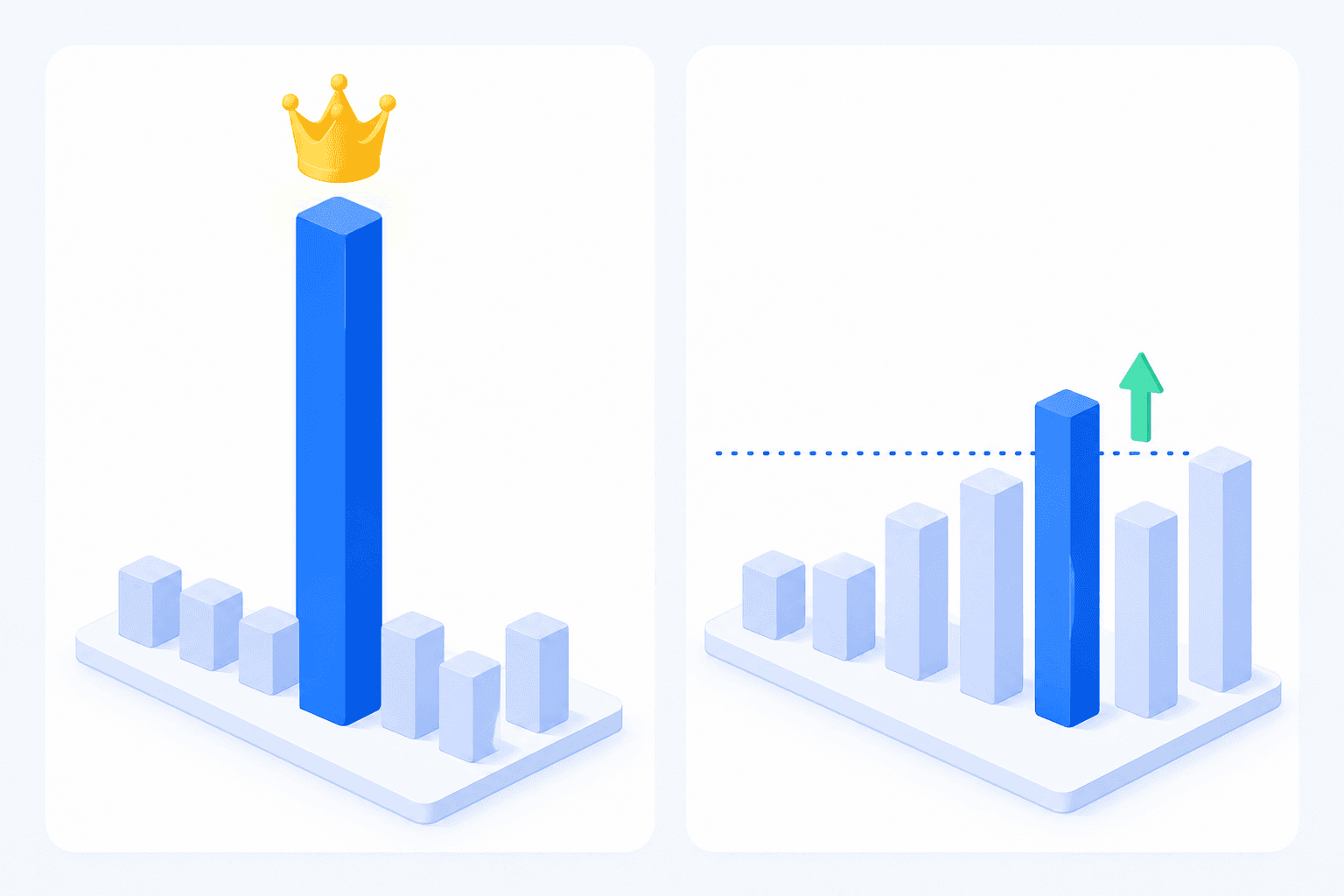
Ranking 1, absolute reach: the weekday afternoon band. The biggest typical reach clusters tightly in the 17:00 to 19:00 UTC band on weekdays, which is 1 PM to 3 PM US Eastern in summer, lunchtime through mid-afternoon for the US and early evening for Europe:
| Window (UTC) | Reels | Median reach | vs own norm |
|---|---|---|---|
| Wednesday 18:00 | 60 | 2,099 | 0.96x |
| Monday 17:00 | 37 | 1,684 | 1.09x |
| Friday 19:00 | 28 | 1,631 | 1.09x |
| Tuesday 17:00 | 78 | 1,580 | 1.13x |
| Monday 14:00 | 32 | 1,254 | 1.06x |
Look at Wednesday 18:00 closely. Highest median reach in the entire dataset, yet a multiplier of 0.96, slightly below normal. That means the huge reach there is mostly who posts in that slot, bigger accounts, rather than the hour itself sprinkling magic. The window is real and worth using, but it is crowded with strong accounts, and it will not fix a small account's reach by itself.
Ranking 2, the multiplier: where accounts beat their own average. Sort by the normalized multiplier and completely different windows rise:
| Window (UTC) | vs own norm | Reels | Median reach |
|---|---|---|---|
| Saturday 14:00 | 1.91x | 25 | 634 |
| Wednesday 06:00 | 1.91x | 35 | 146 |
| Tuesday 10:00 | 1.43x | 40 | 162 |
| Saturday 17:00 | 1.28x | 29 | 164 |
| Wednesday 10:00 | 1.24x | 26 | 222 |
Reels posted Saturday around 14:00 UTC, 10 AM US Eastern and mid-afternoon in Europe, typically reached almost double their account's normal Reel reach, and the absolute reach in that cell was strong too. It is the one window in the whole dataset where both metrics agree, which makes Saturday late morning the closest thing this data has to a free lunch.
The other multiplier winners are morning hours in European time, 06:00 and 10:00 UTC. Fewer big accounts compete there, feeds are less saturated, and an ordinary account's Reel gets a cleaner shot at its audience. If you are a smaller account tired of shouting into the busy US afternoon, the morning lanes are where the data says you overperform.
Two honest caveats. This is posting time versus outcome, we know when a Reel went out, not where its viewers sat. And accounts that post at disciplined times tend to be disciplined accounts overall. Read these as strong directional patterns, then verify against your own audience, which we cover below.
Best Time to Post Reels by Day of the Week
The per-day windows below blend both rankings with the wider industry consensus, converted to your audience's local time. One overall note from our data: the gap between days is smaller than the gap between hours, so pick days that fit your content rhythm and spend your attention on the hour.
Monday: 12 PM - 3 PM
Monday afternoons performed clearly well in our data, with the 1 PM Eastern hour among the strongest of the week and a solid secondary slot around 10 AM. People ease into the week and take a long scroll at lunch. Monday was also one of the higher-reach days overall.
Tip: Monday rewards light, energizing content. Save the heavy tutorial for later in the week.
Tuesday: 12 PM - 3 PM
Tuesday 1 PM Eastern was the single most used strong hour in our dataset, 78 Reels and a median reach near 1,600 with a positive multiplier. It is dependable rather than flashy. The interesting Tuesday secret is the European morning: the 10:00 UTC hour beat accounts' own averages by 43%.
Tip: If your audience includes Europe, schedule Tuesday mid-morning European time. Less noise, better odds.
Wednesday: 1 PM - 4 PM
Wednesday is the tale of two hours. The 2 PM Eastern slot produced the highest median reach of the entire week, 2,099, but that is the big-account hour, slightly below normal once you correct for who posts there. Meanwhile the quiet 06:00 UTC hour, 8 AM Central Europe, was tied for the best multiplier in the whole dataset at 1.91x.
Tip: Bigger account, own the afternoon. Smaller account, try the European morning where you compete less.
Thursday: 12 PM - 2 PM
Here is a finding the generic charts will not give you: Thursday was the weakest Reels day in our data. Its best qualifying hour topped out at a median reach of 451, roughly a quarter of Wednesday's peak. It is not a dead day, but it earned the smallest peaks of the week.
Tip: If you post fewer than five Reels a week, Thursday is the day to skip. Put that Reel on Saturday morning instead.
Friday: 1 PM - 4 PM
Friday afternoons work. The 3 PM Eastern hour hit a median reach above 1,600 with a positive multiplier as attention drifts toward the weekend. Mornings were softer for reach, though the day held up fine late.
Tip: Shareable and entertaining beats educational on Fridays. People are sending things to friends.
Saturday: 9 AM - 12 PM
The star of the dataset. Saturday around 10 AM Eastern, mid-afternoon in Europe, was the only window where absolute reach AND the beat-your-own-average multiplier were both near the top, 634 median reach at 1.91x. Weekend mornings are prime unhurried scroll time, and fewer brands compete there. A later pocket around 1 PM Eastern also cleared a 1.28x multiplier.
Tip: Make Saturday late morning a fixed slot in your schedule. This is the highest-confidence recommendation this data can make.
Sunday: 10 AM - 1 PM
Sunday is steady rather than spectacular, decent reach through late morning and a modest evening pocket. One quirk for global accounts: the very early 04:00 UTC hour, Saturday 9 PM US Pacific and Sunday midday in Asia-Pacific, beat account norms by 40%, useful if your audience skews west-coast night owls or APAC.
Tip: Sunday suits calmer, aspirational content, planning, routines and recaps as people set up their week.
When NOT to Post Reels
The dead zones are as consistent as the peaks:
- 1 AM to 5 AM in your audience's timezone. The floor of the dataset lives here. The worst qualifying cell, Tuesday at 01:00 UTC, managed a median reach of just 18. That is not a typo, versus 2,099 at the top. The spread between the best and worst hour is over 100x.
- Late weekday nights for business content. Attention exists but it is entertainment attention.
- Whenever you happen to finish editing. The most common mistake in the whole discipline. If your export finishes at 11 PM, that is a scheduling problem, not a posting time.
Reels Windows by Timezone
All windows above are your audience's clock, not yours. The strongest UTC hours from our data translate like this (summer time):
| Data window (UTC) | US Eastern | US Pacific | UK | Central Europe |
|---|---|---|---|---|
| Weekdays 17:00-19:00 | 1 PM - 3 PM | 10 AM - 12 PM | 6 PM - 8 PM | 7 PM - 9 PM |
| Saturday 14:00 | 10 AM | 7 AM | 3 PM | 4 PM |
| Weekday 06:00 | 2 AM | 11 PM | 7 AM | 8 AM |
| Weekday 10:00 | 6 AM | 3 AM | 11 AM | 12 PM |
Notice how the "morning multiplier" hours are unsociable in the US but perfectly normal in Europe. That is the point: they work because a big chunk of the audience is awake while the posting competition is not. Pick the row that matches where your viewers live, then let a scheduler do the conversion so you never post at 2 AM manually.
Reels vs Posts vs Stories: Does Timing Differ?
Somewhat, and it is worth using. In our data the median Reel reached 145 accounts against 72 for the median Instagram post of any type. Reels get pushed to non-followers harder, so a well-timed Reel compounds further than a well-timed photo post. Feed posts lean a little earlier in the day, see our full best time to post on Instagram guide for that breakdown. Stories are the most forgiving format since they sit for 24 hours, though posting them before peak hours still front-loads views, more on that in our guide to scheduling Instagram Stories from desktop. And if you cross-post your Reels as TikToks, note that TikTok's clock runs differently, our best time to post on TikTok analysis found its own peak windows. The full multi-platform picture lives in our best time to post on social media pillar.
How to Find YOUR Best Reels Time
Our 5,191 Reels beat guesswork, but your last 30 Reels beat our 5,191. Three steps:

1. Check your audience's active hours. Instagram professional accounts get an Insights view showing when your followers are online, by day and hour. Post 15 to 30 minutes before those peaks so your Reel is fresh when they open the app.
2. Audit your own winners. Sort your recent Reels by reach. Note the publish day and hour of the top five and bottom five. If a pattern shows up, and it usually does, that pattern outranks every chart on the internet, including ours.
3. Test the two lanes from this data. Give the weekday early-afternoon band and the Saturday late-morning slot two weeks each and compare against your baseline. Add the European-morning lane if your audience spans the Atlantic.
This loop is exactly what PostFast's Instagram scheduling is built for: your published Reels sit next to their reach and engagement numbers, you spot your real windows, and you schedule the next batch straight into them in your audience's timezone.
Common Reels Timing Mistakes
- Posting on your clock, not your audience's. The quiet killer for any account with cross-border followers.
- Copying big-account behavior. The busiest window is partly just where big accounts post. If you are small, the data says mornings and Saturday give you better odds of beating your own average.
- Treating every day as equal. Thursday earned the weakest peaks in our data. If volume is limited, spend it elsewhere.
- Posting once and judging the hour. One Reel is noise. Give a window at least four or five Reels before you trust the verdict.
- Letting timing decide whether you post at all. A consistent three Reels a week at decent hours beats one perfectly timed Reel. On PostFast, the median active account publishes about 3 posts a week, and the accounts that grow are almost always the consistent ones.
Post Reels on Schedule Without Living on the Clock
Every insight above only pays if the Reel actually goes out in the window, and the good windows have a habit of landing when you are busy, asleep, or on the wrong continent. That is the entire case for scheduling. Batch your Reels once a week, drop each into its best slot, schedule Reels and carousels in one flow, cross-post to TikTok and YouTube Shorts at their own peak times, and check the reach numbers a week later to sharpen the next round.
Stop publishing into an empty feed. Start your free 7-day trial of PostFast and put your next Reel exactly where the data says it works hardest. No credit card required.

Frequently Asked Questions
What is the best time to post Reels on Instagram in 2026?
For most accounts, weekday early afternoons around 12 PM to 3 PM in your audience's local time, and Saturday late morning around 9 AM to 12 PM. In our analysis of 5,191 real Reels, the weekday 1 PM to 3 PM Eastern band produced the highest typical reach, and Saturday late morning was the one window where Reels also beat their own account's average by nearly 2x.
What is the best time to post a Reel today?
Aim for early afternoon on weekdays, 12 PM to 3 PM in your audience's timezone, or late morning on weekends. If it is Thursday, consider holding the Reel for Saturday morning, Thursday showed the weakest peaks in our 90-day dataset.
Does the day of the week matter for Reels?
Less than the hour does, with one exception each way. In our data most days performed within a narrow band, but Saturday's late morning clearly overperformed and Thursday clearly underperformed. Between those extremes, choose days that keep you consistent and focus on hitting good hours.
What is the worst time to post Reels?
Between roughly 1 AM and 5 AM in your audience's timezone. The weakest hour in our dataset, early Tuesday morning UTC, had a median reach of 18, versus 2,099 in the best hour. The spread between the best and worst windows was over 100x.
Do Reels get more reach than regular Instagram posts?
Typically yes. Across the 90 days we measured, the median Reel reached 145 accounts while the median Instagram post of any type reached 72, roughly double. Instagram distributes Reels to non-followers more aggressively, which is also why a well-timed Reel compounds further than a well-timed photo post.
How is this data different from other best-time studies?
Two ways. It is first-party, 5,191 Reels published through PostFast over 90 days across 158 workspaces, not scraped estimates. And we ranked hours twice: by raw reach, and by how much Reels beat their own account's average in each hour. The second method removes big-account bias and shows the windows where the timing itself does the work.
How often should I post Reels?
Consistency beats bursts. Three to five Reels a week, each placed in a strong window, outperforms daily posting that burns out in two weeks. The median active account on PostFast publishes about 3 posts a week, and scheduling a week in one sitting is the easiest way to hold that pace.
Can I schedule Instagram Reels in advance?
Yes. With PostFast you can schedule Reels, carousels and Stories to publish automatically at set times in your audience's timezone, cross-post the same video to TikTok and YouTube Shorts, and compare reach across windows afterward. That closes the loop between knowing your best time and actually hitting it.
Related
Instagram scheduling with PostFast
Feed posts, Reels, Stories, carousels

How to Schedule Instagram Stories on Desktop in 2026
Yes, you can schedule Instagram Stories from your laptop without the mobile app. Step-by-step guide with auto-publish and cross-posting to TikTok and Reels.

Best Time to Post on Social Media in 2026: 61,008 Posts Scored Against Their Own Normal
61,008 posts with clean metrics, each scored against its account's normal: Instagram 3 PM local, Facebook 3 to 5 PM, YouTube 1 PM or evenings, TikTok flat.

Best Time to Post on Instagram in 2026: 10 Windows, Tested Against 23,552 Real Posts
The best time to post on Instagram in 2026: 10 tested windows plus first-party data from 23,552 posts scored against each account's own normal. 3 PM local wins.

Your Guide to Using an Instagram Image Downloader Safely
Learn how to use an Instagram image downloader the right way. Our guide covers safe methods for desktop and mobile, plus legal and ethical considerations.

Captions for Instagram: How to Write Them with AI (+ 60 Templates)
Learn how to write captions for Instagram that get engagement. 10 caption formulas, AI prompts, 60 ready-to-use templates, and scheduling tips.

SaaS Marketing Automation: The Social and Email Stack We Run at PostFast
SaaS marketing automation from our own stack: what we automate on social and in lifecycle email, the event behind each sequence, and the tools by job.