Best Time to Post on Social Media in 2026 (All 11 Platforms)
Find the best time to post on social media in 2026. Data-backed timing for Instagram, Facebook, TikTok, X, LinkedIn, YouTube, and 5 more platforms.
On this page (7)
Timing is the most underrated lever in social media marketing. Two identical posts published three hours apart can get completely different results. One gets buried. The other gets pushed by the algorithm to thousands of people.
The problem is that every platform has a different peak window. Instagram peaks mid-morning. TikTok has two daily spikes. LinkedIn just shifted from mornings to afternoons in 2026. Posting the same content at the same time across all platforms means you are optimizing for none of them.
Unlike single-platform guides that focus on one network, this article covers all 11 major social media platforms in one place. Same methodology. Same data standards. Side-by-side comparisons so you can build a complete cross-platform schedule in one sitting.
The data comes from multiple large-scale studies. Buffer analyzed 52 million posts across all platforms for their 2026 State of Social Media report, including 9.6 million Instagram posts, 14 million Facebook posts, 7.1 million TikTok videos, and 4.8 million LinkedIn posts. Sprout Social examined 2 billion engagements across 307,000 profiles. SocialPilot studied 7 million Instagram posts and 700,000 TikTok videos. RecurPost and Distribution.ai contributed data on Bluesky and Pinterest, covering over 1 million posts each.
The short version: The best time to post on social media in 2026 is Tuesday through Thursday between 9 AM and 12 PM in your audience's timezone for most platforms. TikTok and YouTube are exceptions with strong evening peaks. Wednesday is the single best day across the board.
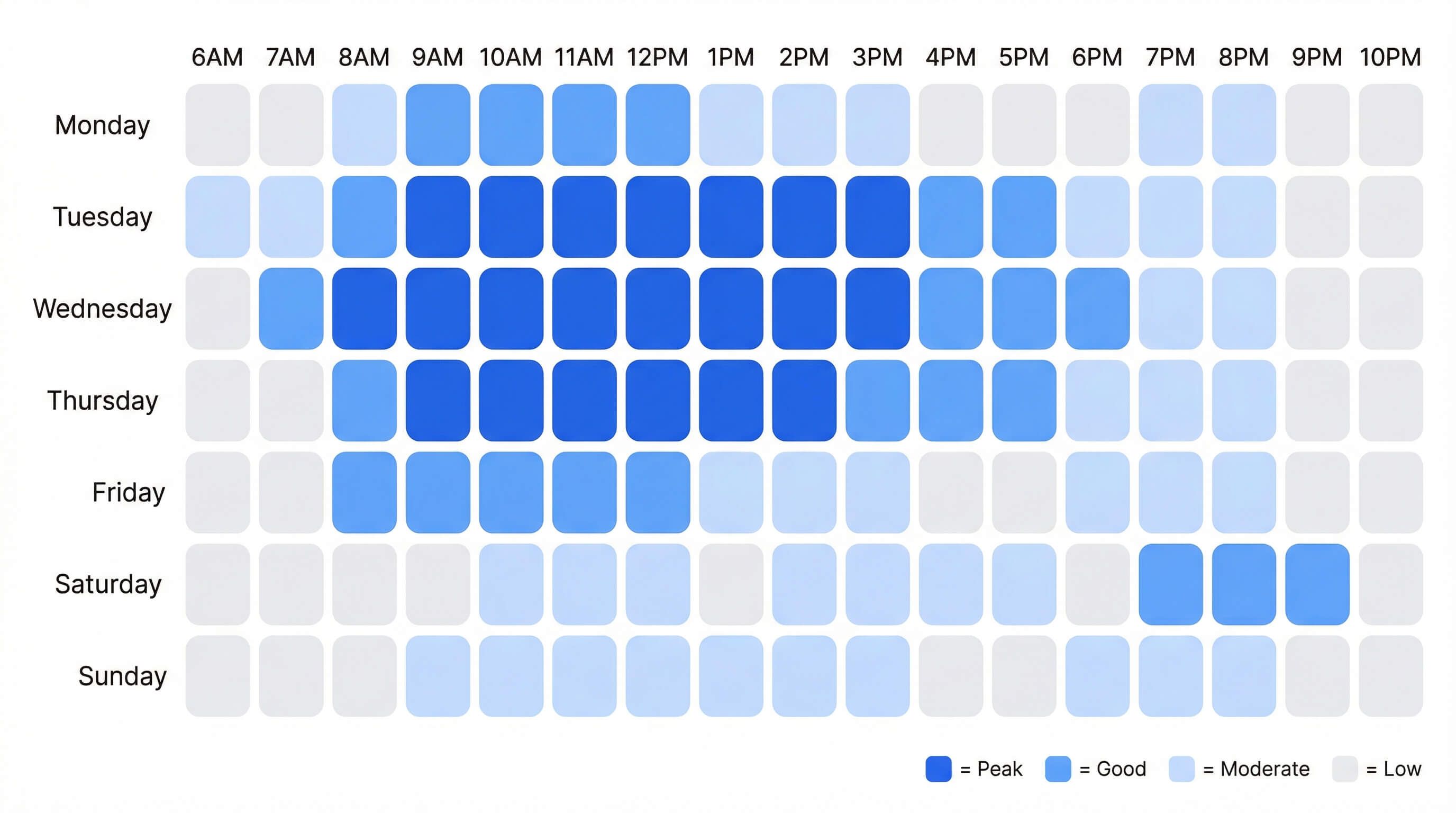
This heatmap reflects a cross-platform average. TikTok, YouTube, and Pinterest show stronger evening and weekend engagement than the average. See the platform-specific breakdowns below for the full picture.
Best Times to Post on Social Media: Quick Summary
| Platform | Best Days | Best Times | Peak Window |
|---|---|---|---|
| Wed-Thu | 9 AM - 3 PM | Wed 10 AM | |
| Wed-Thu | 8 AM - 12 PM | Wed 9 AM | |
| TikTok | Tue-Thu, Sat | 6-10 AM + 6-10 PM | Sun 9 AM |
| X (Twitter) | Tue-Wed | 9 AM - 6 PM | Tue 10 AM |
| Wed-Fri | 3 PM - 8 PM | Wed 5 PM | |
| YouTube (Videos) | Sun-Tue-Wed | 8-11 AM, 2-4 PM | Sun 10 AM |
| YouTube (Shorts) | Fri-Sat-Thu | 6 PM - 9 PM | Fri 7 PM |
| Threads | Wed-Thu | 9 AM - 1 PM | Wed 11 AM |
| Tue-Thu | 10 AM-1 PM, 8-11 PM | Any day 9 PM | |
| Bluesky | Mon, Tue-Thu | 1 PM - 3 PM EST | Mon 2 PM EST |
| Telegram | Mon-Fri | 1-4 PM + 6-10 PM | Tue 2 PM |
| Google Business Profile | Varies by industry | Before peak business hours | Weekday mornings |
All times are in your audience's local timezone unless otherwise noted.
Schedule posts at the perfect time with PostFast. Start your free 7-day trial. No credit card required.
Platform-by-Platform Breakdown
Instagram: The Mid-Morning Sweet Spot
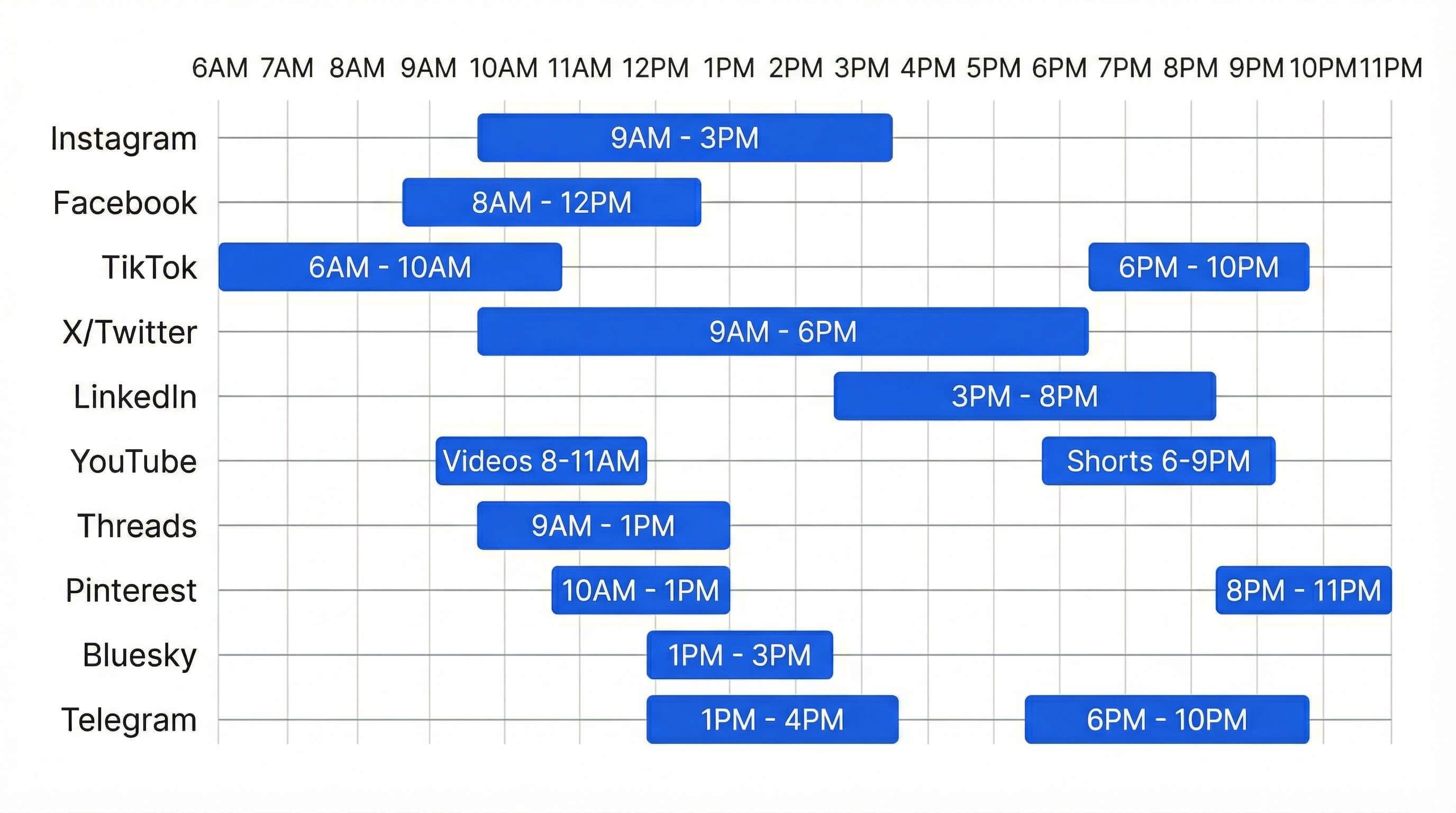
Best times: Wednesday and Thursday, 9 AM to 3 PM. Secondary window at 5 PM to 7 PM on weekdays.
Best days: Wednesday and Thursday. Saturday is the worst day for Instagram engagement.
What to post: Carousels dominate Instagram in 2026. Buffer's analysis of 9.6 million posts found that carousels get 109% more engagement than Reels. Single images trail both formats. For Reel timing specifically, our own best time to post Reels on Instagram analysis of 5,191 Reels maps the exact windows. If you are choosing between a Reel and a carousel for a mid-morning post, the carousel wins on average.
Platform quirk: Instagram's algorithm resurfaces content for up to 48 hours, but initial momentum matters most. Posts that get strong engagement in the first 30 to 60 minutes are pushed significantly harder. The mid-morning window catches people during their first real scroll of the day, right after the morning commute.
For a deeper breakdown by day, including content type recommendations and industry-specific windows, read the full guide: Best Time to Post on Instagram. For image and video dimensions, check Instagram sizes.
Facebook: Early Birds Win
Best times: Wednesday and Thursday, 8 AM to 12 PM. Secondary window at 1 PM to 4 PM.
Best days: Wednesday and Thursday. Saturday is the weakest day.
What to post: Facebook rewards video and long-form text posts more than quick image shares. Posts with questions in the caption generate more comments, which the algorithm treats as a strong signal. Off-peak posting (early morning or late evening) can yield up to 35% more engagement per impression because there is less competition in the feed.
Platform quirk: Facebook's algorithm is the most forgiving on timing. Content can resurface for days if it gets steady comment threads. But the initial push still depends on early engagement, so hitting the 8-10 AM window on Wednesday gives you the best starting position.
Read the complete guide: Best Time to Post on Facebook. For image specs and cover photo dimensions, check Facebook sizes.
TikTok: The Dual-Peak Platform
Best times: Tuesday through Thursday, two peaks at 6 AM to 10 AM and 6 PM to 10 PM. Sunday at 9 AM and 1 PM are the single highest-engagement slots.
Best days: Saturday is actually the strongest day on TikTok. This contradicts nearly every other platform where Saturday is weakest. Tuesday through Thursday are also strong.
What to post: Short-form video under 60 seconds still drives the highest completion rates, which is the primary signal TikTok's algorithm uses. Trending sounds increase discoverability but only if the video hooks viewers in the first 2 seconds.
Platform quirk: The first 60 minutes after posting determine roughly 80% of a TikTok video's total success. TikTok's algorithm tests new videos with a small audience immediately. If watch-through rate, shares, and comments are strong in that first hour, the video gets pushed to progressively larger audiences. Post when your followers are most active to win that first test.
SocialPilot's study of 700,000 TikTok posts confirms the dual-peak pattern. Buffer's data from 7.1 million TikTok videos shows Saturday outperforming weekdays by a notable margin.
For the full day-by-day breakdown, read our complete guide to the best time to post on TikTok. For video and carousel specs, check TikTok sizes.
X (Twitter): Speed Over Everything
Best times: Tuesday and Wednesday, 9 AM to 6 PM. The widest effective window of any platform. Full day-by-day breakdown in our best time to post on X (Twitter) guide.
Best days: Tuesday and Wednesday. Saturday is the worst day.
What to post: Short, punchy text posts. Threads (multi-tweet) perform well for thought leadership. Images increase engagement by 150% compared to text-only tweets. Video tweets get 10x more engagement than text.
Platform quirk: X has the shortest content lifespan of any major platform. The half-life of a tweet is roughly 15 to 30 minutes. After that, your post is effectively invisible unless it goes viral. This means timing on X is more critical than on any other platform. Even 30 minutes off-peak can mean the difference between engagement and silence. If you post on X, post during the workday window and be ready to engage with replies immediately.
LinkedIn: The 2026 Afternoon Shift
Best times: Wednesday through Friday, 3 PM to 8 PM. This is a major shift from the traditional 8-10 AM morning window that dominated LinkedIn for years.
Best days: Wednesday, Thursday, and Friday. Weekends are nearly dead.
What to post: Document posts (carousels/PDFs) get 596% more engagement than text-only posts. Thought leadership, data-driven insights, and professional stories perform strongly. Polls generate fast engagement signals that the algorithm amplifies.
Platform quirk: Buffer's 2026 data from 4.8 million LinkedIn posts shows that afternoon and evening posts now outperform mornings. The shift likely reflects changes in remote work habits. Professionals now check LinkedIn as a "wind-down" activity in the late afternoon rather than a "start the day" habit. Weekend engagement has also strengthened slightly, though it remains far below weekday levels.
For the complete LinkedIn timing guide with industry breakdowns, read: Best Time to Post on LinkedIn.
YouTube (Long-Form): Upload Before the Rush
Best times: Sunday, Tuesday, and Wednesday, 8 AM to 11 AM and 2 PM to 4 PM. Sunday at 10 AM is the single best upload slot.
Best days: Sunday, Tuesday, and Wednesday. Friday and Saturday are strong viewing days, but the best strategy is to upload 2-3 hours before peak viewing.
What to post: Tutorials, reviews, and educational content. Videos between 8 and 15 minutes hit the sweet spot for watch time and ad revenue. YouTube evaluates click-through rate (CTR) in the first 2 to 4 hours after upload.
Platform quirk: Upload 2 to 3 hours before your audience's peak viewing time, not during it. YouTube needs time to process, generate thumbnails, and test the video with a small audience. Uploading at this offset yields roughly 45% higher CTR in the critical evaluation window compared to uploading at peak viewing time itself.
For the complete YouTube guide including Shorts strategy, read: Best Time to Post on YouTube. For thumbnail and video specs, check YouTube sizes.
YouTube Shorts: Different Rules Entirely
Best times: Friday, Saturday, and Thursday, 6 PM to 9 PM.
Best days: Friday and Saturday.
What to post: Vertical video under 60 seconds. Trending topics and quick tutorials. Shorts follow a completely different algorithm than long-form YouTube. The Shorts feed behaves more like TikTok's For You page.
Platform quirk: Shorts can go viral days or weeks after upload, so timing is less critical than for long-form. But early momentum still helps. Evening uploads catch the "couch scrolling" session when Shorts viewing peaks. Do not treat Shorts timing as identical to long-form. They need a separate schedule.
Threads: Instagram's Text Twin
Best times: Wednesday and Thursday, 9 AM to 1 PM.
Best days: Wednesday and Thursday. Saturday is the worst day.
What to post: Text-first posts with personality. Threads has a 3.6% median engagement rate, which is notably higher than X. Conversational, opinionated, and question-based posts perform best. Images are optional but not required.
Platform quirk: Threads mirrors Instagram's audience because they share the same user base. But the engagement pattern resembles X more than Instagram. Content is text-first, conversations are fast, and the algorithm favors recency. Unlike X, Threads does not have the 15-minute half-life problem. Posts stay visible longer, making the timing window more forgiving.
For the complete Threads guide, read: Best Time to Post on Threads.
Pinterest: The Quiet Traffic Machine
Best times: Tuesday through Thursday, 10 AM to 1 PM for midday pinning. Evening pins on any day between 8 PM and 11 PM get the strongest engagement.
Best days: Tuesday through Thursday for midday. Evenings are strong across all seven days.
What to post: Vertical images (2:3 ratio), infographics, and step-by-step guides. Product pins with pricing drive clicks. Rich Pins with metadata outperform standard pins.
Platform quirk: Pinterest is a search engine, not a social network. Pins can drive traffic for months or even years after posting. Evening pins get up to 220% more engagement than morning pins because that is when users plan projects, recipes, and purchases. The timing window for Pinterest is far wider than any other platform. A pin posted at 9 PM on a Wednesday in March can still send traffic in September. Hitting those evening slots every day means scheduling Pins in advance; Pinterest's own scheduler stops at 10 queued Pins and 30 days out.
Bluesky: Chronological Means Every Minute Counts
Best times: Monday and Tuesday through Thursday, 1 PM to 3 PM EST primary window. 9 AM to 12 PM secondary. Weekend evenings 6 PM to 9 PM.
Best days: Monday through Thursday.
What to post: Text posts, links with previews, and images. Bluesky's audience skews toward tech, media, and early adopters. Commentary on current events, platform updates, and "building in public" content performs well.
Platform quirk: Bluesky uses a chronological feed with no algorithmic ranking. This makes timing more critical than on any platform with an algorithm. If your followers are not online when you post, they may never see it. Post when your audience is active. The data is newer and less stable than other platforms. Distribution.ai's analysis of over 1 million Bluesky posts shows 1-3 PM EST as the strongest window, likely reflecting the US-heavy early adopter base.
Bluesky's own app has no scheduler, so hitting these windows in advance means a tool. The guide to how to schedule Bluesky posts covers the limits and the PostFast flow.
Telegram: Pure Chronological, Pure Timing
Best times: Monday through Friday, 1 PM to 4 PM and 6 PM to 10 PM.
Best days: Monday through Friday. Weekends are significantly weaker for most channels.
What to post: Text updates, images, documents, and polls. Telegram channels are broadcast-only, so content needs to stand on its own without algorithmic help. Links with context outperform bare URLs.
Platform quirk: Telegram has no algorithm. Posts appear in chronological order and trigger push notifications for channel subscribers. This means timing is everything, but so is notification fatigue. Post too often and subscribers mute the channel. B2B channels skew toward the 1-4 PM workday window. B2C channels perform better in the 6-10 PM evening window. Regional variation on Telegram is extreme. A channel targeting Southeast Asia will have completely different peak hours than one targeting Western Europe.
Google Business Profile: Timing Depends on Your Customers
Best times: Post before your peak business hours. For most businesses, weekday mornings between 8 AM and 11 AM in your local timezone.
Best days: Monday through Friday. Weekends are weaker unless your business operates primarily on weekends (restaurants, entertainment venues).
What to post: Standard updates, event promotions, and offers with call-to-action buttons (Book, Order, Shop, Learn More). One image per post, no video or carousels. Posts expire after 6 months, so refresh regularly.
Platform quirk: Google Business Profile is fundamentally different from every other platform on this list. There is no algorithm-driven feed. Your posts appear in Google Search and Google Maps when someone searches for your business or your category. The "best time to post" is really "when your customers are searching for businesses like yours," which varies completely by industry. A restaurant should post before lunch and dinner rushes. A dentist should post during weekday mornings when people search for appointments. A retail store should post before weekend shopping hours.
There is no large-scale engagement dataset for GBP like there is for Instagram or TikTok. Google does not publish post engagement analytics through their API. Focus on consistency (2-3 posts per week) rather than chasing specific time slots. Use Event and Offer post types with clear expiration dates to create urgency. For Google Business Profile image specs and post formatting, check Google Business Profile sizes.
Best Days to Post on Social Media
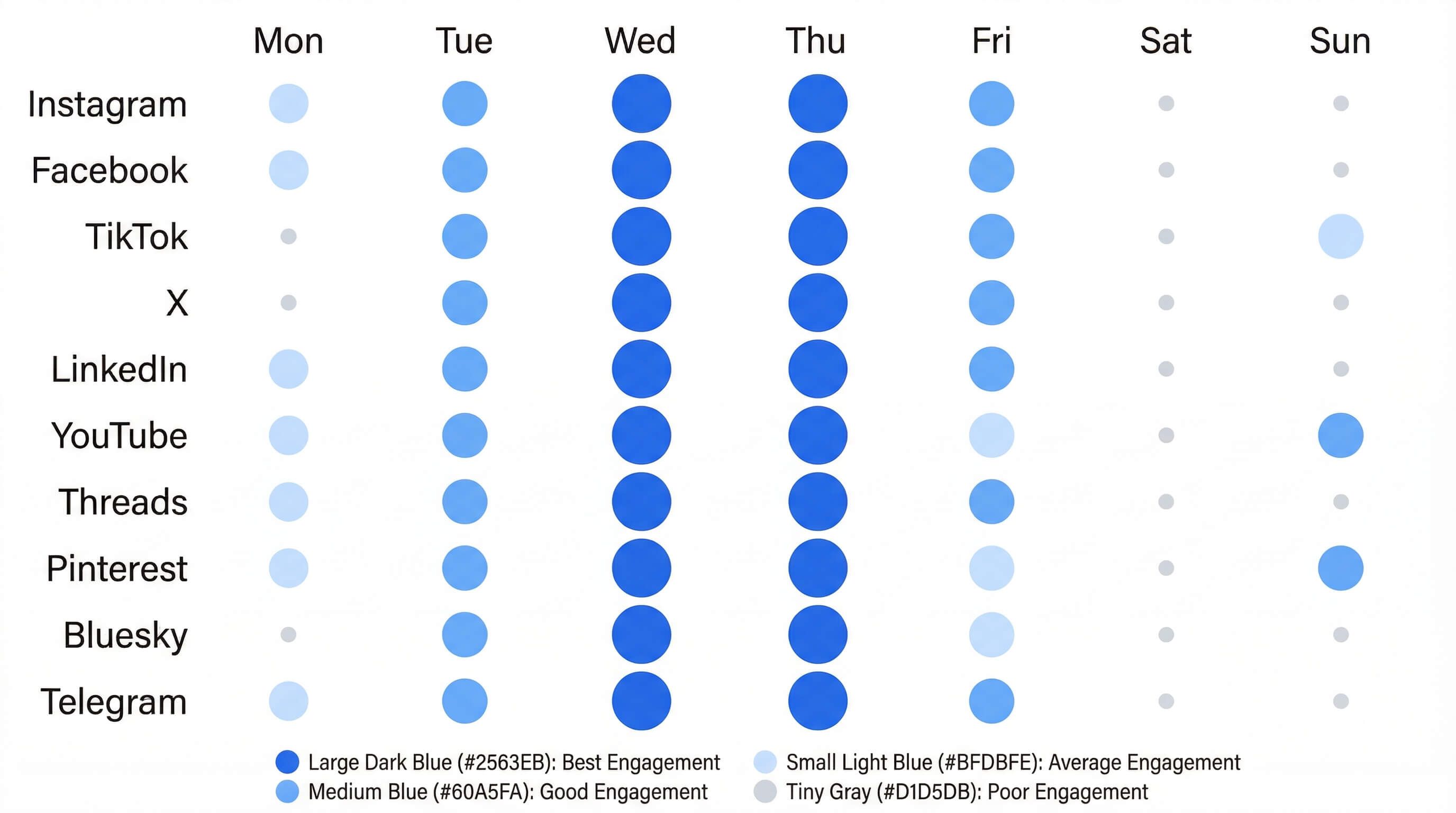
Wednesday is the single best day across the most platforms. It tops or ties for the top on Instagram, Facebook, LinkedIn, Threads, YouTube (long-form), and Pinterest.
Thursday is the second strongest day overall. It is the best or tied for best on TikTok, Threads, and Pinterest.
Saturday is the most polarized day. It is the worst day for Instagram, Facebook, X, and Threads. But it is the best day for TikTok and the second-best for YouTube Shorts. If your strategy includes TikTok or YouTube Shorts, do not skip Saturday.
Sunday is underrated. It is the best single day for YouTube long-form uploads (10 AM is the top slot). TikTok also shows strong Sunday engagement at 9 AM and 1 PM.
The takeaway: Post your broadest content on Wednesday. Save TikTok and YouTube Shorts content for weekends. Avoid Saturday on Instagram, Facebook, X, and Threads.
How to Find Your Own Best Times
The data above reflects averages across millions of posts. Our own study of 61,008 PostFast posts, each scored against its account's normal, finds far smaller swings than those averages suggest. Your audience may differ. Here is how to find your specific optimal windows.
1. Check each platform's native analytics. Instagram Insights, Facebook Page Insights, YouTube Studio, LinkedIn Analytics, and TikTok Analytics all show when your followers are most active. Start there.
2. Map your audience's timezone. If 60% of your followers are in the US and 30% in Europe, you need to decide which timezone to optimize for. Some brands post twice per day to cover both. Check the geographic breakdown in each platform's analytics.
3. Run a two-week test. Post the same type of content at different times for two weeks. Compare engagement rates (not raw likes, since follower counts fluctuate). Track by time slot, not by individual post. Two data points per slot is the minimum.
4. Use a scheduling tool with cross-platform support. Manually posting at 8 AM on Facebook, 10 AM on Instagram, 6 PM on TikTok, and 5 PM on LinkedIn every day is not sustainable. PostFast lets you schedule posts to all 11 platforms from one dashboard. Set different times per platform, queue content for the week, and let the scheduler handle the rest. If you are still choosing a tool, our comparison of 11 schedulers checks which ones auto-publish everywhere and how each one charges.
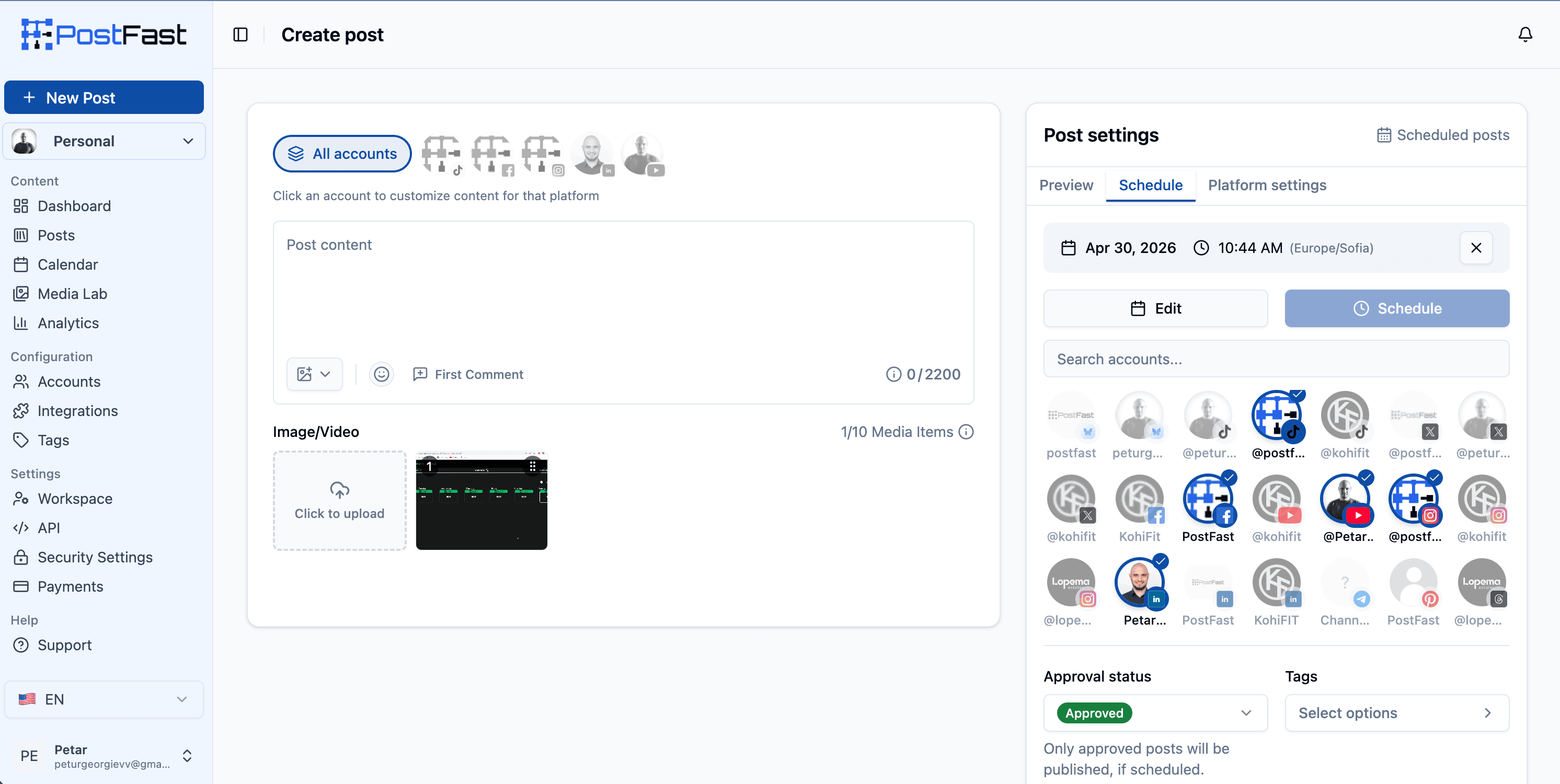
5. Revisit every quarter. Audience behavior shifts. LinkedIn's move from mornings to afternoons in 2026 is proof. Check your analytics every 90 days and adjust your schedule. What worked in Q1 may not work in Q3.
5 Common Timing Mistakes
1. Posting at the same time on every platform. Instagram peaks at 10 AM. LinkedIn peaks at 5 PM. TikTok peaks at 7 PM. A single posting time means you are optimal on at most one platform and off-peak on the rest. Create separate schedules per platform.
2. Ignoring the first hour. On TikTok, the first 60 minutes determine 80% of a video's reach. On LinkedIn, early comments boost distribution by 30%. On YouTube, the first 2-4 hours set the trajectory. Posting when your audience is asleep means zero early engagement and a post that never takes off.
3. Skipping weekends entirely. Saturday is the best day for TikTok. Sunday is the best upload day for YouTube long-form. Pinterest evenings are strong all seven days. A Monday-through-Friday schedule leaves significant engagement on the table.
4. Chasing "viral" times instead of your audience's times. The data in this article shows general trends. But if your audience is in Tokyo and the study measured US users, the times do not apply directly. Always localize to your audience's timezone and validate with your own analytics.
5. Overthinking timing at the expense of quality. A great post at a mediocre time outperforms a mediocre post at the perfect time. Timing is a multiplier, not a substitute for good content. Optimize timing after you have a consistent content workflow. Not before.

Frequently Asked Questions
What is the best time to post on social media?
The best time to post on social media in 2026 is Tuesday through Thursday between 9 AM and 12 PM in your audience's timezone. This window has the highest average engagement across Instagram, Facebook, X, LinkedIn, and Threads. TikTok and YouTube are exceptions with strong evening peaks between 6 PM and 10 PM.
What is the best day to post on social media?
Wednesday is the strongest single day across the most platforms. It tops or ties for the top on Instagram, Facebook, LinkedIn, Threads, YouTube, and Pinterest. Thursday is the second-best day overall. Saturday is the best for TikTok but the worst for most other platforms.
Does posting time really matter in 2026?
Yes. Platform algorithms evaluate early engagement to decide whether to show your content to a wider audience. On TikTok, the first 60 minutes determine 80% of a video's reach. On LinkedIn, posts that get comments in the first hour see 30% more distribution. On YouTube, the first 2 to 4 hours after upload determine algorithmic pickup. Posting when your audience is active gives your content the initial momentum it needs.
What is the worst time to post on social media?
Saturday mornings are the worst time on Instagram, Facebook, X, Threads, and LinkedIn. Late-night hours (11 PM to 5 AM) perform poorly across every platform. Sunday evenings are weak on most platforms as people prepare for the work week. The one exception is TikTok, where Saturday is actually the strongest day.
Should I post at the same time on every platform?
No. Each platform has different peak engagement windows. Instagram peaks mid-morning (9 AM to 12 PM), LinkedIn peaks in the late afternoon (3 PM to 8 PM), and TikTok has dual peaks at morning and evening (6-10 AM and 6-10 PM). Posting at a single time means optimizing for one platform and missing the window on every other. Build a per-platform schedule.
How often should I post on social media?
It depends on the platform. Instagram: 3 to 5 times per week. Facebook: 3 to 5 times per week. TikTok: daily or more. X: 1 to 5 times per day. LinkedIn: 2 to 5 times per week. YouTube long-form: 1 to 2 per week. YouTube Shorts: daily. Threads: 3 to 7 times per week. Pinterest: 5 to 15 pins per day. Consistency matters more than hitting a specific number.
Is there a universal best time that works for all platforms?
The closest to a universal window is Wednesday at 10 AM in your audience's timezone. It falls within the peak range for Instagram, Facebook, X, LinkedIn, and Threads simultaneously. But it misses the optimal windows for TikTok (evening), YouTube (afternoon), and Pinterest (evening). There is no single time that works perfectly for all 11 platforms.
How do I find my own best posting time?
Start with the benchmarks in this article, then refine using your own analytics. Check each platform's native insights for when your followers are online. Run a two-week test posting at different times. Compare engagement rates by time slot. A scheduling tool like PostFast makes this easier by letting you set different posting times per platform from one dashboard.
Does the best time to post change by industry?
Yes. B2B audiences (LinkedIn, X) are most active during work hours. B2C audiences (TikTok, Instagram) show stronger evening and weekend engagement. Finance professionals check LinkedIn at 7 AM. Healthcare professionals are more active at 10 to 11 AM. Tech audiences engage earlier than average. The general windows in this article are starting points. Use your platform analytics to find your industry's specific patterns.
Can I schedule posts across multiple platforms at once?
Yes. PostFast supports scheduling to Instagram, Facebook, TikTok, X, LinkedIn, YouTube, Threads, Pinterest, Bluesky, Telegram, and Google Business Profile from one dashboard. You can set different posting times for each platform so every post hits its optimal window. For a step-by-step walkthrough, read How to Schedule a Social Media Post to Multiple Platforms.
Start Posting at the Right Time
The data is clear. Timing affects reach. Every platform has a different window. And the gap between optimal and off-peak timing can mean 2x or 3x the engagement on the same piece of content.
Use the platform breakdowns above to build your weekly posting schedule. Check your analytics to customize the timing for your specific audience. And revisit every quarter because platform behavior shifts, as LinkedIn's 2026 move from mornings to afternoons proves.
If you want to stop juggling 10 different platform dashboards, try PostFast free for 7 days. No credit card required. Schedule to all 11 platforms from one screen. Set platform-specific times. See how PostFast compares to Hootsuite, Buffer, and Later.
PostFast supports Instagram, Facebook, TikTok, X, LinkedIn, YouTube, Threads, Pinterest, Bluesky, and Telegram, and Google Business Profile. View pricing.
Related

Best Time to Post on Social Media in 2026: 61,008 Posts Scored Against Their Own Normal
61,008 posts with clean metrics, each scored against its account's normal: Instagram 3 PM local, Facebook 3 to 5 PM, YouTube 1 PM or evenings, TikTok flat.
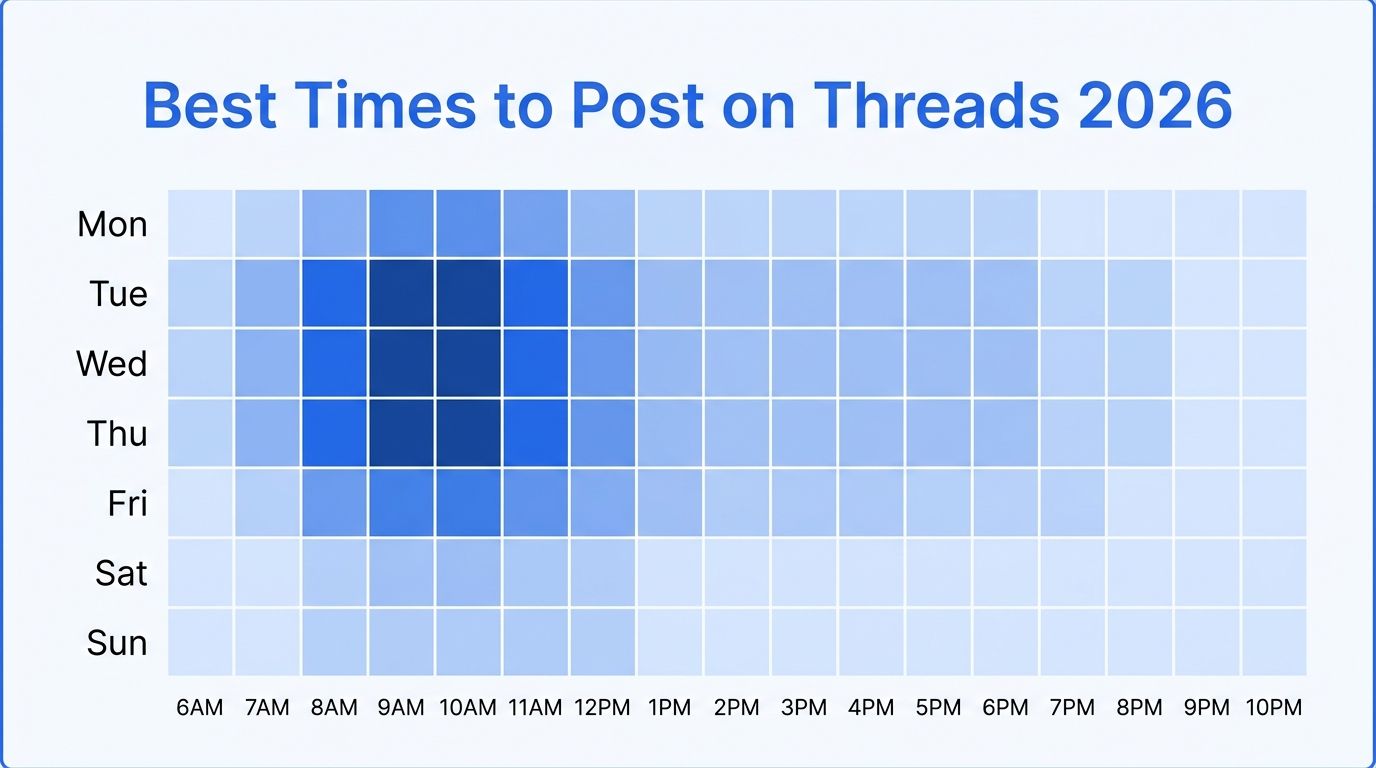
Best Time to Post on Threads in 2026 (Data-Backed Guide)
When is the best time to post on Threads? We analyzed posting patterns to find the days and times that get the most engagement on Threads in 2026. Day-by-day breakdown with specific hours.

How to Promote OnlyFans in 2026: Posting Schedule, Best Times & Platform Playbooks
Promote OnlyFans in 2026 the SFW way: the best times to post, a copy-ready weekly posting schedule, and platform-by-platform playbooks you can schedule fast.
Best Time to Post on TikTok in 2026: 15,115 Real Posts Say Timing Barely Matters
Best time to post on TikTok in 2026: a day-by-day guide plus first-party data from 15,115 posts scored against each account's normal. Timing barely moves it.

SaaS Marketing Automation: The Social and Email Stack We Run at PostFast
SaaS marketing automation from our own stack: what we automate on social and in lifecycle email, the event behind each sequence, and the tools by job.